

“If you know the enemy and know yourself, you need not fear the result of a hundred battles.”
Sun Tzu
In military, public safety, security, and business settings, we invest enormous time and energy in understanding our adversaries and competitors. We have precise terminology for describing weapons, tactics, behaviors, and possible courses of action. We can brief an enemy’s strengths and weaknesses with clarity and confidence.
But when it comes to the “knowing ourselves” part of Sun Tzu’s quote above, that same clarity often disappears.
Across organizations, “readiness” becomes something ambiguous, a description that is felt more than defined or measured, and too often treated as something “we’ll know it when we see it.” But capabilities are the building blocks of readiness, and if we’re being honest, an inability to articulate our own capabilities in a meaningful way signals that we haven’t applied the same professional discipline to understanding ourselves that we routinely apply to understanding others.
That discrepancy—our ability to describe others with precision while describing ourselves with generalities—creates a strategic blind spot. It leaves organizations with an incomplete picture of their own readiness, and that is where the illusion of capability starts to take shape.
The purpose of this article is to move beyond that limitation. To bring rigor, structure, and a shared language to assessing readiness in a way that allows executives to make informed investments, guides teams in strengthening performance, and supports organizations preparing for an uncertain future.
In the sections that follow, we’ll break down how to define capabilities—across public safety and business environments—in a practical, operational way. And we’ll look at the five elements that provide a clearer, more disciplined understanding of what your organization can truly do.
Clarifying the Problem
Before we move to the “solution,” we need a shared understanding of the problem we’re actually trying to solve.
One way to “know yourself” is to understand your ability to operate and your ability to perform the critical functions your mission depends on. In other words, your capabilities. This isn’t the only dimension of organizational self-awareness, but knowing what you can and cannot do—and knowing it with clarity—is foundational.
For the purposes of this article, we’ll assume the organization has already identified the capabilities essential to its success. Yet even with that groundwork in place, a common challenge remains: many organizations cannot assess their capabilities using a consistent process or shared terminology.
When that happens, the problem tends to reveal itself in three predictable scenarios.
Scenario 1: Confronting the Illusion of Capability
This scenario usually begins with a simple question from an executive, community member, or stakeholder: “Can we do [critical function]?” or “How good are we at [capability]?”
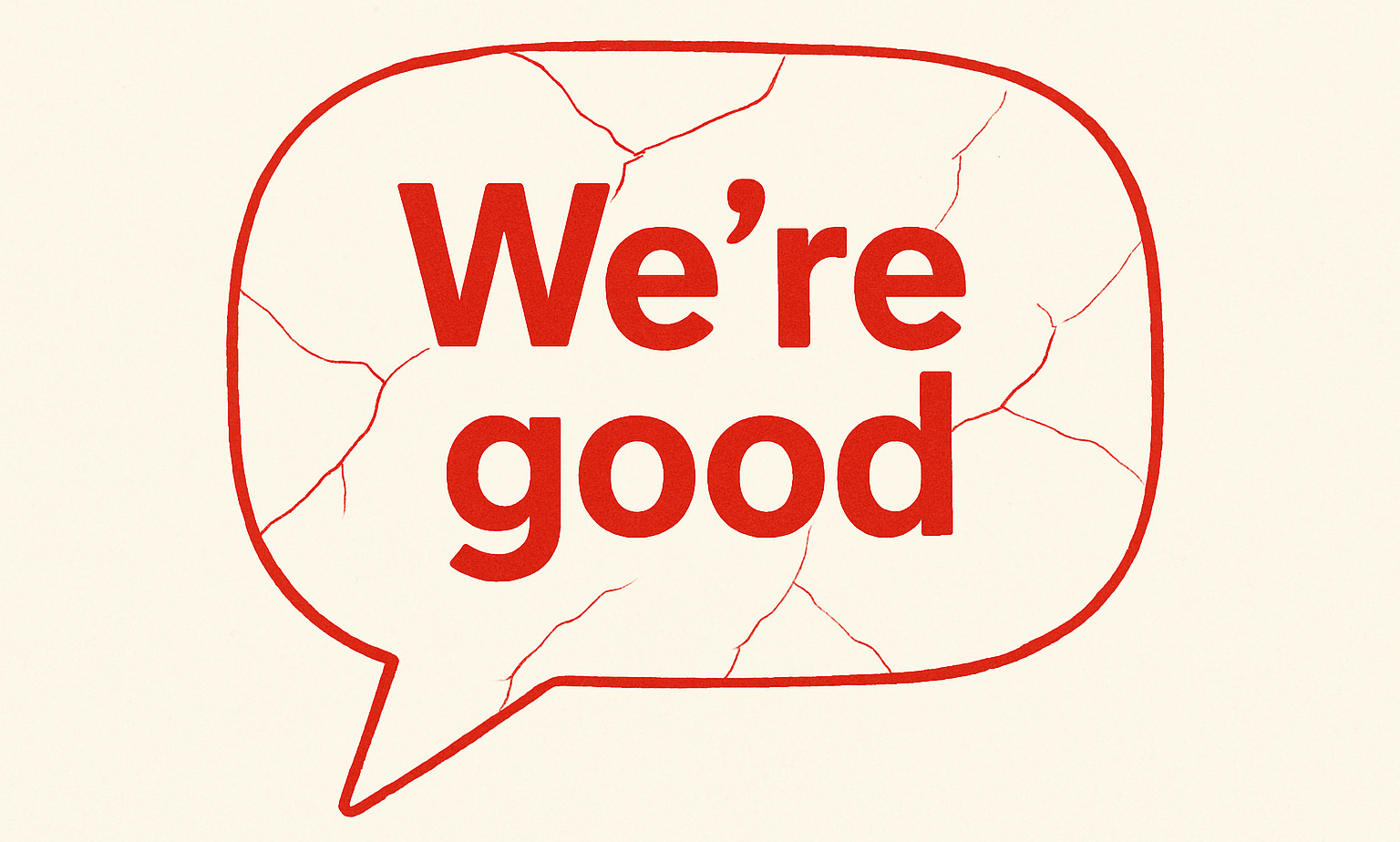
The response often comes back just as simply: “Yeah, we can do that. We’re good.”
What’s missing, of course, is everything that would make that answer meaningful.
There’s no explanation of how they know, no supporting detail, no clarification about what can or can’t be done under the umbrella of that capability. Just a general assertion.
The challenge isn’t necessarily that the team can’t do what they say—they very well might be able to. The challenge is that the assessment isn’t grounded in anything concrete. Without details, leaders can’t tell whether that confidence comes from demonstrated performance, an objective evaluation against internal benchmarks, or alignment with community or customer expectations.
When this happens, leaders are put in a difficult position. They may:
hesitate to trust the assessment, unintentionally undermining the team, or
accept it at face value, only to watch the capability fall short when it’s most needed.
This is the essence of the illusion of capability: one side of the conversation believes the function can be performed, but that belief is either not shared or not actually accurate. And without a way to validate or even discuss the basis of the assessment before the reality check of an actual incident, the organization is left operating on fragmented assumptions.
In the end, “we’re good” becomes a placeholder—one that creates a false sense of readiness and limits meaningful action.
Scenario #2: In the Midst of the Annual Budgeting Cycle
The second moment when the limitations of an inconsistent capability assessment process become painfully clear is during the annual budgeting cycle. Executives must decide which requests get funded, which get delayed, and where teams will need to find alternative ways to address gaps.
But those requests often arrive in an ad-hoc, uneven way. Without a common basis for comparison, prioritization becomes guesswork, especially when those decisions shape the organization’s trajectory for the next year.
When capabilities aren’t assessed consistently, apples-to-apples comparisons become impossible. If a capability hasn’t been evaluated holistically or against defined performance expectations, leaders have no way to determine whether a request is:
a genuine must-have,
a marginal improvement, or
simply a shiny new tool that won’t meaningfully change outcomes.
For leaders who don’t have direct experience in that function, this ambiguity makes decision-making even harder.
These challenges become more pronounced when an agency has recently invested in a capability—a new plan, a new piece of equipment, a training cycle, or a validation exercise. Teams may sense additional needs but struggle to articulate them. For example:
If you’ve just developed a new plan, do you now need training and education to operationalize it?
If you’ve just acquired new equipment, do you need detailed planning to fully integrate it into your concept of operations?
If a recent exercise exposed staffing gaps, partnership weaknesses, or single points of failure, do those insights demand investment in recruitment or coordination?
Without a clear, consistent method for assessing capabilities, these questions become harder to answer—and the budgeting process becomes a reflection of individual persuasion rather than organizational need.
Scenario #3: When Staff Changes Happen
A third moment when the limitations of an inconsistent capability assessment process become obvious is during staff transitions. When retirements occur, a new commander is promoted, or a new executive takes the helm, it can feel as though everything resets to zero.
Without a clear standard that has guided the organization—and without an objective rubric documenting current performance and needed improvements—new leaders often bring new expectations. But with no shared baseline, those expectations can feel abrupt or confusing.
Teams are left asking: What needs to change, and why?
Any change implies that current performance is insufficient for the new requirement. But when the organization lacks a defined understanding of how it operates and to what level it performs today, making sense of the requested change becomes frustrating, especially if the transition follows a negative incident or high-pressure period.
In these situations, the absence of a consistent capability assessment process complicates leadership transitions, fuels uncertainty, and risks creating misalignment at precisely the moment when clarity is needed most.
The Problem Statement | In Summary
Talking off the cuff might give the appearance of competent leadership, but if the understanding about what an organization can or can’t do in the moment isn’t clearly defined, consistently understood by people from different levels of experience and knowledge of the organization, then making informed decisions about what to do next becomes increasingly difficult. But mistaking the possession of something—a team, a tool, a process—for proficiency in it is a mistake that we can get beyond by breaking a capability down into its component parts.
Understanding “Capability”
When assessing a capability, the first step is to clarify what a capability actually is. At its core, a capability is the proven ability to perform a critical function.
In public safety, a capability might be your jurisdiction’s ability to deliver alerts and warnings, conduct a hostage rescue, execute a traffic stop, or suppress a structure fire.
In business, it might be your ability to recruit and onboard a new employee, maintain sales operations, or develop new products and services.
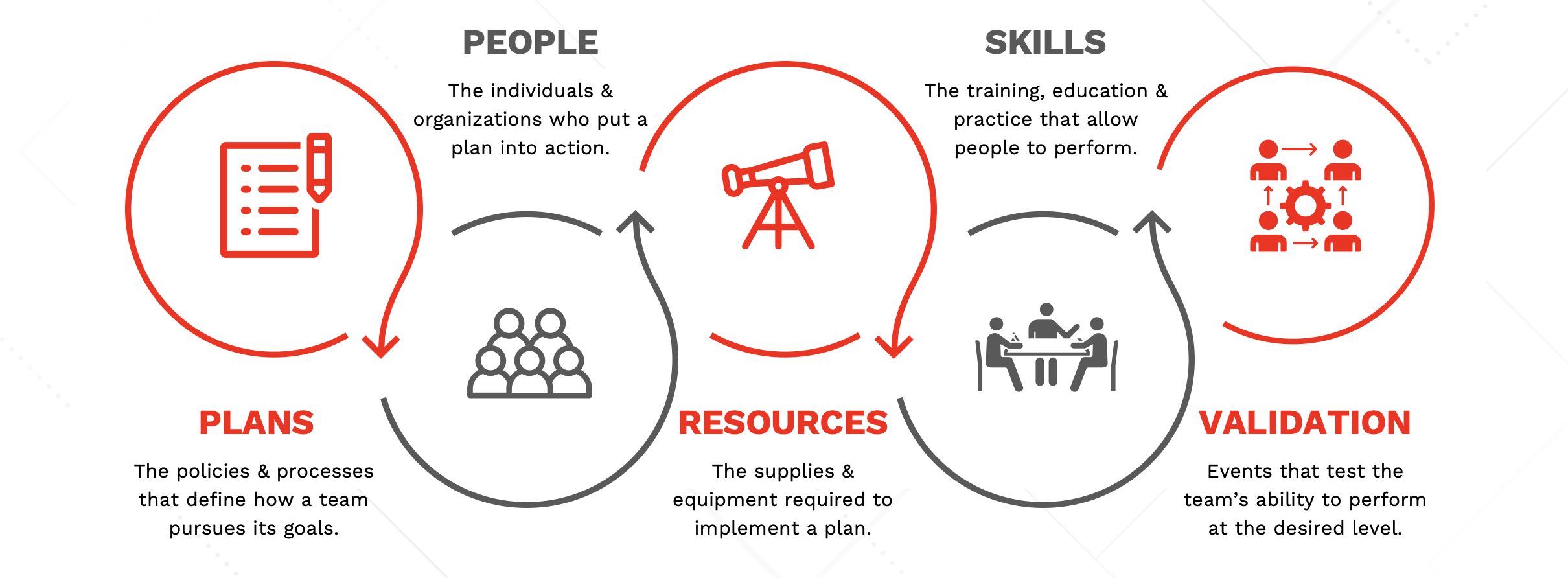
Importantly, this is about performance, not possession. Owning equipment, having a plan, or assembling a talented team does not mean you have a capability. A capability exists only when five elements come together to allow people to perform a function to a defined standard.
The Five Elements of a Capability
1. Plans. The plans, policies, processes, and other documents that describe how an organization will organize and operate to accomplish its goals. While plans are often written, they don’t have to be—planning is simply thought before action. Documentation becomes necessary when multiple people must understand their roles, responsibilities, and the intended method of operation.
2. People. The individuals, teams, and partner organizations responsible for executing the plan. This could include full-time staff, volunteers, mutual-aid partners, contract support, and anyone else who plays a role. Beyond identifying who is involved, organizations must understand whether they have the depth, redundancy, and commitment required to perform under varying conditions.
3. Resources. The supplies, equipment, facilities, and funds required to put the plan into action. Resources include what the organization already has and what must be procured before the capability can be performed reliably.
4. Skills. The training, education, and practice opportunities necessary to ensure that people can competently perform their roles. This includes pre-incident training, on-the-job skill building, practice opportunities that allows personnel to ask questions and build confidence, and just-in-time training programs to rapidly onboard unplanned staff support.
5. Validation. The exercises and simulated performance tests, structured assessments, and real-world events that allow the organization to objectively evaluate the capability and determine whether the people, resources, and plans can achieve the intended performance level.
How These Elements Work Together
By considering all five elements, organizations can more clearly see what is strong, what is missing, and what needs improvement. A capability requires all five components; if any one is absent or weak, it can undermine the entire function.
If a response falters because people don’t understand their responsibilities or how to coordinate, the gap may be planning. And if a plan does not reflect how the organization actually operates, it creates confusion for those trying to use it to guide their actions.
If the plan is clear and the people are available, but those personnel are not confident or competent, the gap is skills—and the solution may be practice opportunities rather than more resources or another validation exercise.
If the plan is in place and people are practicing it, but validation reveals performance shortfalls, the capability may require updated metrics, a revised plan, additional resources, or other adjustments to meet expectations.
When these five components come together during an incident, what emerges is readiness in action. It doesn’t matter whether you use this exact structure or your own. I’ve found these five elements especially helpful for communicating capability strengths and gaps, but the essential point is that your organization needs a consistent structure for assessing capabilities.
A Note on the Order of the Elements
The order of these elements is not a hierarchy. Plans do not “outrank” people. Plans exist to articulate expectations and responsibilities—nothing more. And while beginning an assessment with people can be useful, it can also unintentionally narrow the conversation to full-time staff and overlook partners, volunteers, or others who could be part of the capability.
The goal is not to prioritize one element over another, but to understand how all five interact to form the capability your organization is counting on.
Conducting and Using a Capability Assessment
With the five elements described, the next step is to conduct the assessment itself. The goal is to develop an honest and accurate appraisal of what your organization can actually do—not what you hope you can do or believe you can do, but what your current performance truly reflects.
Conducting a Current State Assessment
The first task is to establish a baseline assessment of the capability. This is a straightforward three-step process that defines the current state of the program and provides the foundation for all future improvement.
Perform a Document Review. Begin with a systematic review of the relevant plans, policies, training materials, resource inventories, guidance documents, and after-action reports. The purpose is twofold: to form an initial assessment of each element—plans, people, skills, resources, validation—and identify the questions that must be asked of stakeholders.
Ground Truth Initial Findings. The next step is to validate what you learned during the document review through conversations or surveys with the individuals responsible for implementing the capability. The questions can be simple: are they doing what the plan says they’ll do? Do they know their responsibilities? Do they understand the processes required for their role? What gaps do they see? Often, a plan may look solid on paper and check every doctrinal box, yet not reflect how the agency actually operates in practice. Ground-truthing bridges that gap.
Develop the Assessment. Finally, consolidate the findings into an overall assessment of each of the five elements individually and as a group. This could be as simple as a “good/needs improvement” statement for each, or as detailed scoring outcomes (e.g., 14 of 18 planning criteria assessed as satisfactory). The depth should match the purpose of the assessment, the maturity of the capability, and the level of analysis needed to make informed recommendations about what to do next.
This initial assessment forms the starting point for understanding a capability. It clarifies the reality of current performance, reduces the ambiguity that fuels the illusion of capability, and provides the foundation for looking ahead.
Conducting a Future State Assessment
The second task is to determine whether the capability is able to meet the future needs of your operating environment. This can be a short-term or long-term view, but it requires an organization to step back and consider what is likely to change around them.
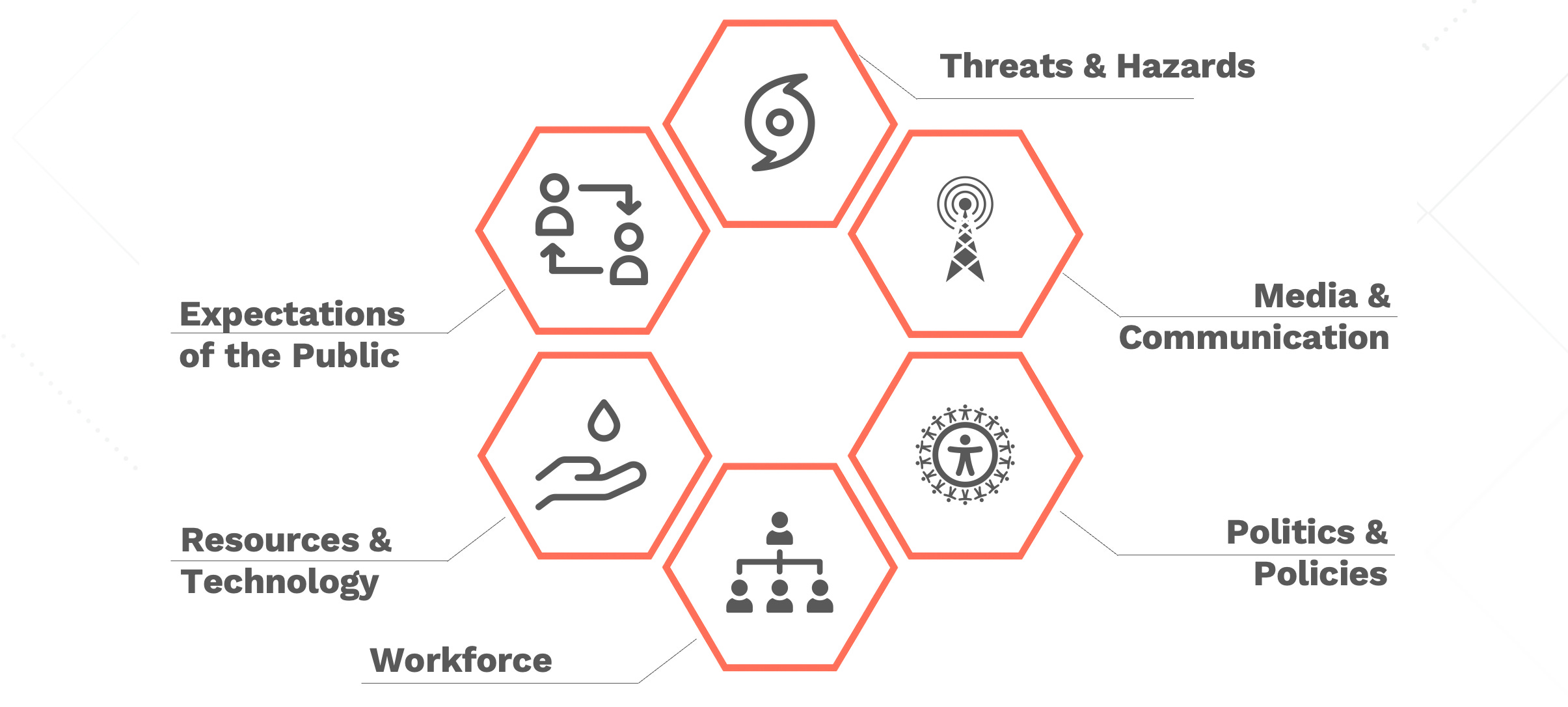
To guide that conversation, I usually focus on six elements of our operating environment:
Threats and Hazards. The risks—natural, human-caused, technological—that could challenge or overwhelm the capability. This includes both the likelihood and severity of threats, and whether those risks are evolving in ways that demand new or enhanced performance.
Media and Communication. The information environment your organization operates within. This includes traditional media, social media, real-time communication, and the pace at which information (and misinformation) spreads during incidents.
Politics and Policies. The laws, regulations, and political dynamics that shape what your organization is permitted or expected to do. Policy changes can alter authorities, reporting requirements, responsibilities, or resource levels, all of which influence capability needs.
The Workforce. The people available to perform the function—both today and in the future. This includes staffing levels, recruitment and retention trends, training pipelines, generational turnover, and the organization’s ability to sustain a qualified workforce.
Resources and Technology. The tools, systems, infrastructure, and funding necessary to perform the function. This includes emerging technologies that change how work is done, aging systems that need replacement, and the financial outlook that affects what can realistically be acquired or maintained.
Expectations of the Public/Customers. What the community or customer base believes your organization should be able to do—and how quickly and effectively they expect you to do it. Expectations shift over time, often faster than capabilities, and can redefine the acceptable level of performance.
We take this step because the world we operate in is changing, and changing fast. While we cannot predict the future with absolute certainty, we can examine the trends affecting our capability and identify where gaps are likely to emerge. Perhaps a critical piece of equipment is nearing the end of its life. Perhaps new technology offers a fundamentally different concept of operations. Perhaps performance targets need to shift. Or perhaps an upcoming wave of retirements will create staffing or skill gaps.
The purpose of the future-state assessment is to ensure that our capabilities are not optimized for the last incident, crisis, disaster, or disruption, but are prepared for the next one. By considering not only what the capability can do today, but what it will need to do tomorrow, we can “future-proof”—to the extent possible—the functions our organizations depend on, preventing atrophy and positioning ourselves to meet the demands ahead.
Using the Assessment
The first two steps are critical. Before you can determine what to do next, you need to know where you are and where you are heading. It is no different than using a map app on your phone: until it knows your current location and destination, it cannot generate a set of potential routes to get there.
A capability assessment works the same way. The current-state assessment tells you the truth about today. The future-state assessment clarifies what tomorrow will require. The value emerges when those two points are compared.
With both points established, an organization can identify the projects that are most important for closing the gap—whether that means developing or revising a plan, building new training materials, conducting a validation exercise, purchasing equipment, securing funding, expanding partnerships, or any other initiative that meaningfully improves one or more of the five elements.
The emphasis for a project should be to “begin closing” the gap because a single project rarely fixes everything. If a project is designed to fix everything, it is probably too large, too vague, or too resource-intensive to make meaningful progress quickly. Effective capability building happens in deliberate, manageable steps.
This is where a project management approach for preparedness efforts becomes invaluable. A structured process, such as a Project Management Office (PMO) structure and system, creates the discipline to translate assessment findings into actionable projects and sequence those projects so the effort is focused.
In this way, capability assessments don’t just diagnose readiness issues, but instead power a continuous improvement cycle that helps organizations avoid the illusion of capability, prioritize wisely, and adapt quickly as demands evolve.
Reversal
While I often advocate for a structured capability assessment process, a disclaimer is required.
Not being able to describe a capability using the five elements does not mean the organization can’t perform the function. That false negative may not reflect the team’s actual abilities.
Likewise, identifying needs or completing preparedness projects does not guarantee that the organization will perform to the desired standard when the incident occurs. There are false positives, and metrics can be manipulated to create the perception of readiness or meet compliance requirements.
Frameworks and assessments help clarify where you stand and how to improve, but they are not perfect predictors of future performance. There is no guaranteed return. Each leader must decide what level of risk, specificity, and clarity they need to prepare their organization for an uncertain future—and what degree of confidence they require to say, honestly, what they are capable of doing.
Closing
In military contexts, the “fog of war” is often described as uncertainty created by the enemy, the environment, and even our own forces. While we cannot control what our adversaries or competition choose to do, and we can only influence our environment to a limited degree, how we prepare and understand our own abilities is the one thing that is fully within our control.
For leaders thinking about what is true today, what they assume will be true in the future, and how to guide their organization towards success, being able to break down each capability they rely on is a significant advantage. By explaining how a capability was assessed, leaders remove much of the subjectivity that often shapes annual resource and budget decisions. It becomes easier to justify priorities, communicate tradeoffs, and demonstrate how decisions were made.
The goal isn’t to conduct assessments for their own sake. We do this work because the process provides the professional rigor needed to move beyond aspiration statements about wanting to be the best—and instead intentionally build the infrastructure required to become the organization we claim to be.
When organizations talk about getting left of bang, this is what they mean: building the systems, capabilities, and habits of readiness that prepare you for the risks, threats, hazards, and opportunities the future will bring. A clear, disciplined understanding of capability allows you to make the most of each minute left of bang—and to face the moment with confidence rather than hope.
Enjoyed This Article? Pass It On.
If this article sparked ideas, share it with your network, a colleague, or on social media. Sharing is how we expand the community of professionals committed to staying left of bang.
Really strong framework here. The distinction between possesion and proficiency cuts straight to the heart of where teams fool themslves. Most orgs can articulate their competitor's strengths way better than their own, kinda like how its easier to critique someone else's weaknesses than admit your own. The five-element breakdown gives language to stuff that usually stays vague.