

This article is part of The CP Journal’s Individual Readiness Playbook.
When most agencies tell you to remain where you are during an incident, they use the phrase shelter-in-place.
We’re not going to use that term here.
“Shelter” has always sounded passive to me. As if you’re simply waiting something out.
Instead, we’re going to use the phrase protect-in-place.
Because when you stay in your home during a disruption, you are not hiding. You are actively protecting the people inside your house from something happening outside of it.
Sometimes that threat is acute and visible—a tornado, a severe storm, a hazardous materials incident. Other times it’s more generalized—a winter storm that makes travel dangerous, a public safety power shutoff during high winds, or a prolonged outage after infrastructure failure.
In both cases, the objective is the same.
Can your household function independently for at least 72 hours without outside support?
Not indefinitely. Not off-the-grid forever. Just long enough to avoid panic, bad decisions, and unnecessary risk.
The 72-Hour Threshold
Seventy-two hours is slightly arbitrary, but it is often enough time for roads to be cleared and utility crews to begin restoration, information to stabilize, and initial chaos to subside after an incident occurs.
I’ve also found it is a long enough period of time that many people are forced to go beyond short-term plans, yet isn’t so long that readiness feels unattainable. So if you can operate for 72 hours without resupply you have bought yourself some margin, and that margin is the objective.
Plus, once the planning for 72 hours is established, it offers a framework that can be expanded upon to hit 96-hour, 1 week, or any other time frame goals you may have.
Most of what you need for 72 hours is already part of your normal routines. So when applying Principle #3 - Keep It Simple and Tied to Real Life, you realize you don’t need to build a separate emergency supply, but can accomplish this by building depth into your existing one.
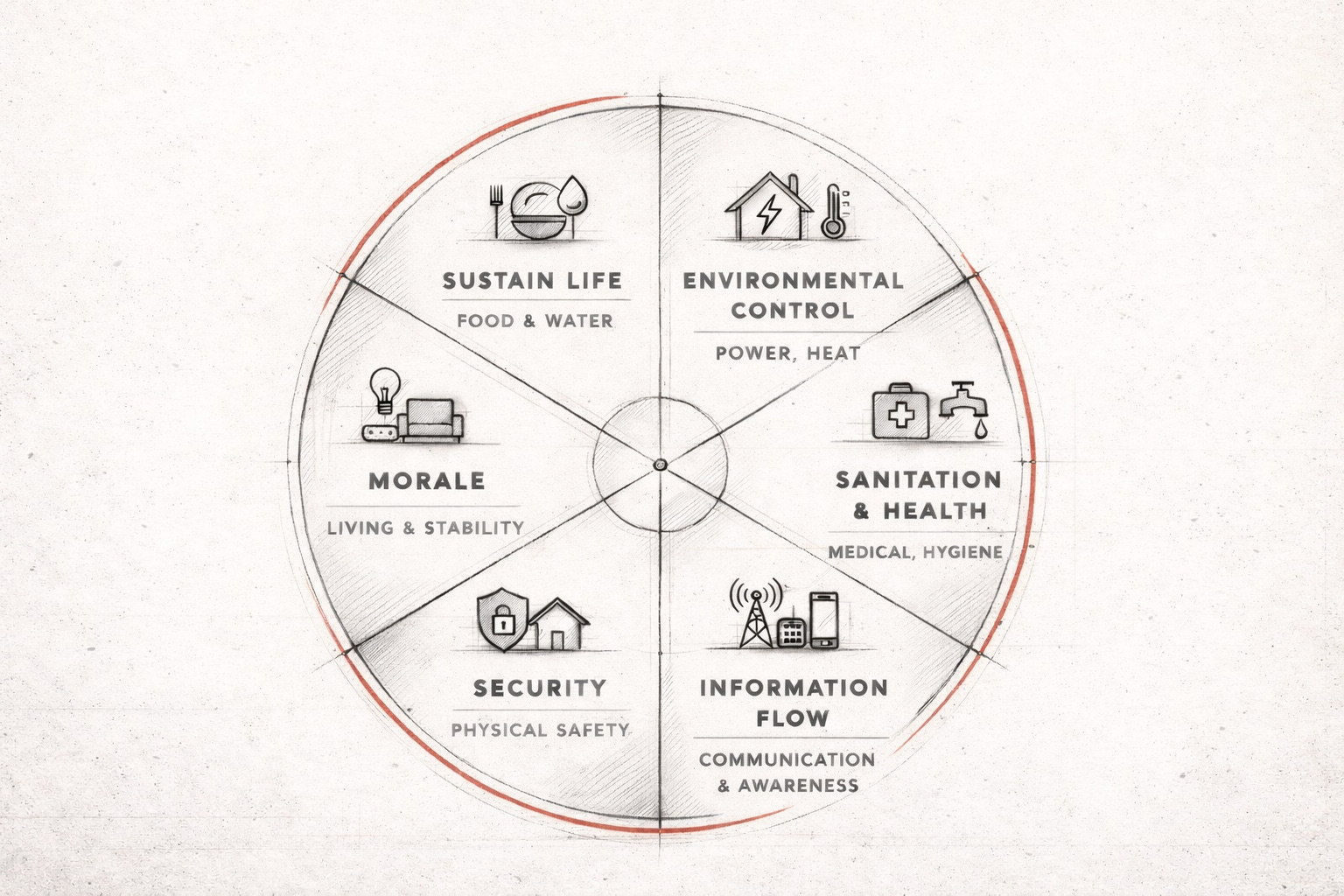
The Six Household Functions
Now, if your family is going to protect-in-place for 72 hours, your household must continue performing six essential functions, which form the basis of our planning: