

Welcome back to The CP Journal, where we break down what it takes to get left of bang.
A quick update that most of you probably won't care about: The weekly newsletter is now called Left of Bang Briefings instead of Profiles in Preparedness. Nothing else changes—it simply does a better job describing what we're trying to provide each week.
Most discussions about getting left of bang focus on improving our ability to recognize pre-event indicators, assess what they mean, decide what to do, and act before events occur.
Few, however, consider what happens when someone deliberately tries to degrade the ability to do that.
Today, the ability to get left of bang—your ability to get left of bang—is under attack.
Unfortunately, that isn’t hyperbole or exaggeration. It is the stated objective of a military capability known as cognitive warfare.
At its core, cognitive warfare seeks to influence what people pay attention to, how they interpret information, how they feel about it, and ultimately what actions they take as a result.
While cognitive warfare emerged in a military context, many of the same techniques now appear in the information environment most people navigate every day—in inboxes, social media feeds, news articles, podcasts, and other sources relied upon to understand current events.
The question for leaders, analysts, and anyone trying to get left of bang is simple: if cognitive warfare seeks to influence what we notice, how we interpret information, and what actions we take, how does it affect our ability to recognize meaningful change before everyone else?
Cognitive Warfare | Defined
Cognitive warfare1 is no longer a theoretical concept.
Over the last several years, NATO, the U.S. Department of Defense, and allied research organizations have increasingly examined cognitive warfare as an emerging military capability designed to influence how populations understand situations, make decisions, and act.
Consider a few recent examples:
On February 10, 2026, the Finnish Defense Research Agency released a Research Bulletin on NATO’s Concept of Cognitive Warfare.
On March 26, 2026, it was announced that the Department of Defense’s Strategic Capabilities Office is developing a new project to advance the U.S. military’s cognitive warfare capabilities in response to adversaries like Russia and China employing cognitive warfare against U.S. interests.
NATO has its own webpage dedicated to protecting the alliance against the threat of cognitive warfare, with articles going back to 2023, and with NATO research beginning in 2022.
The premise behind cognitive warfare is relatively straightforward: if you can influence how people think, then you can influence how they behave.
The goal is not necessarily to convince a population of a specific fact, but to shape how people process information and interpret events. This includes influencing:
Attention — what people notice
Perception — how people interpret what they notice
Memory — what they remember afterward
Emotion — how they feel about the information
Decision-making — what they ultimately choose to do
Unlike misinformation, which is often focused on the accuracy of a specific claim, cognitive warfare focuses on the process through which information is interpreted.
And to be clear, allied and adversarial nations are investing in this capability because influencing how people interpret reality creates a strategic competitive advantage.
The goal is to create division, fragmentation, and a reduced collective ability to respond effectively to emerging situations, because if you can shape how a population understands reality, you can shape how it reacts to that reality.
But cognitive warfare is relevant beyond military conflicts.
Because this is ultimately a competition to shape attention, interpretation, emotion, and decision-making, many of the same techniques are used by marketers, journalists, content creators, and analysts in political messages, advocacy efforts, articles, and reports.
For people working to get left of bang, the takeaway from this section is this: most indicators require interpretation before they become actionable, and cognitive warfare seeks to influence that process.
Cognitive Warfare & the Interpretation Problem
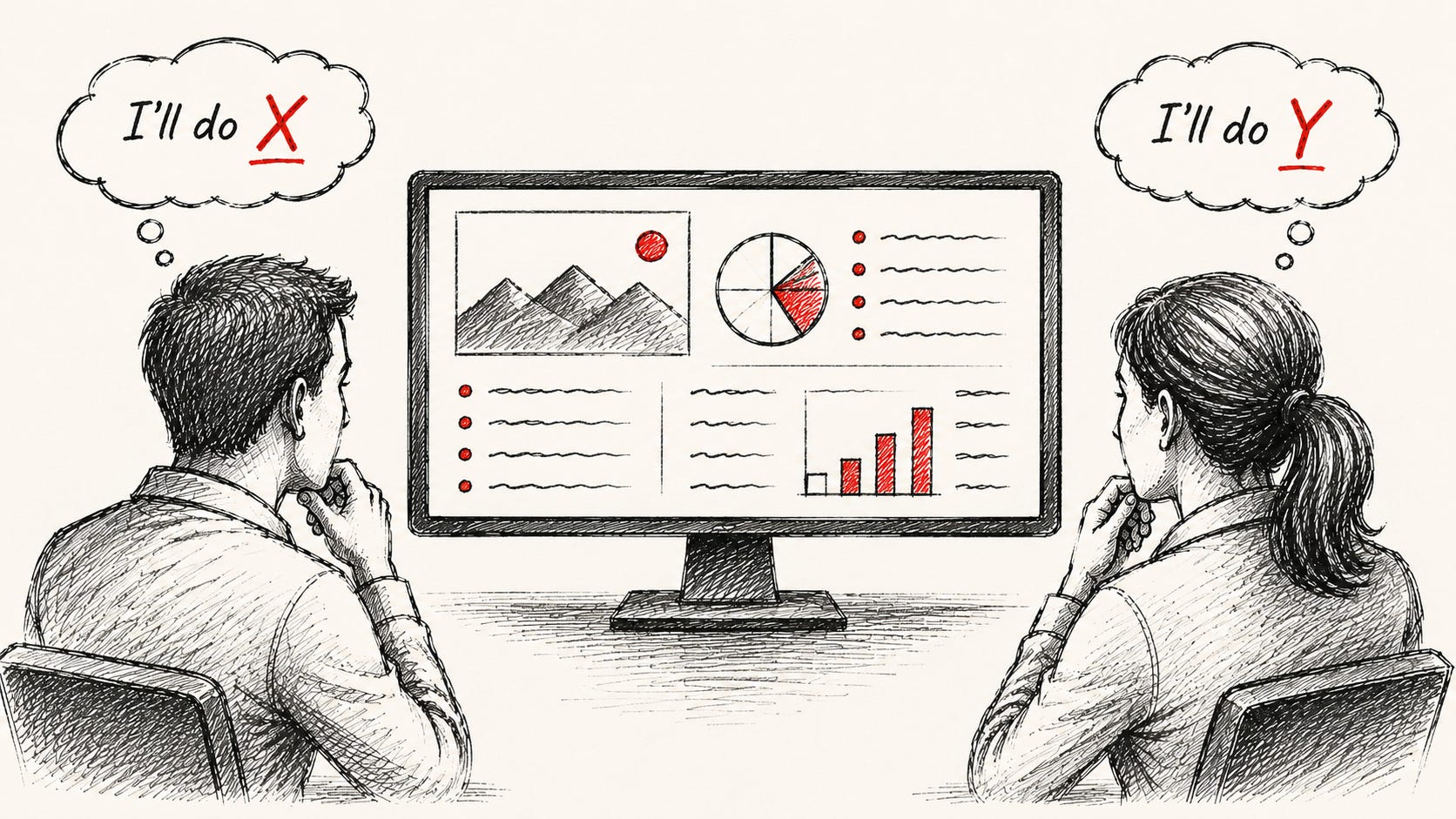
People can observe the same fact and arrive at completely different decisions.
Emergency managers see the same weather forecast and make different decisions about issuing alerts and warnings.
Investors see the same earnings report and make different decisions about whether a company’s stock is worth buying.
Security leaders see the same suspicious interaction and make different decisions about whether intervention is necessary.
The information may be the same, but the interpretation often is not.
That process of interpretation sits at the center of getting left of bang. We recognize indicators, assess what they mean, decide what to do, and act before events occur. While each step is important, assessment is where observations are transformed into understanding.
That is where the left-of-bang advantage comes from: the ability to assess the same facts that others see and convert them into meaning more quickly and more effectively than others.
Yet this is also where cognitive warfare seeks to exert influence.
When cognitive warfare is successful, people become increasingly dependent on someone else’s framing of an issue, interpretation of events, or understanding of reality. Rather than developing their own assessment, they adopt one that has already been prepared for them.
For individuals and organizations trying to get left of bang, dependency on someone else’s interpretation creates an incredible risk. We are outsourcing our assessment without consciously choosing to do it.
No one else shares the exact same goals, priorities, opportunities, constraints, and risks that you do. Effective decisions require the ability to evaluate information in the context of your own situation and determine what it means for you.
But what makes cognitive warfare particularly challenging is that it is usually not operating in the foreground.
Most readers of an article focus on the topic being discussed—the political issue, the business trend, the security concern, the disaster, or the current event. Cognitive warfare operates one layer deeper. Its influence is often directed toward the process used to interpret the topic rather than the topic itself.
It is one thing to simply believe something that turns out to be wrong. But it is significantly worse to become dependent on someone else’s interpretation of reality and losing the ability to independently assess what you’re seeing.
For people trying to get left of bang, maintaining ownership of the assessment process is essential.
9 Ways Interpretation Gets Shaped
The challenge for leaders trying to get left of bang is recognizing when their attention, assessment, emotion, or decision-making is being subtly shaped before a conclusion is reached.
The following techniques are not inherently malicious, and many are common communication, marketing, teaching, and leadership tools. The issue is whether you recognize when they are influencing how you interpret what you are seeing.
Think of these as indicators. The more of them you observe at once, the more carefully you should evaluate the assessment being presented and the messenger using them.
1. There is a process to capture attention
One of the easiest patterns to recognize is a structure used to guide a reader to perceive and personalize a threat, priming them to act before they’ve considered alternatives.
You’ll see articles:
Establish or highlight a threat
Explain why it affects you personally
Create a sense of urgency
Imply that action is required immediately
This sequence works because fear naturally narrows attention. As attention narrows, people become less likely to consider alternative explanations and more likely to accept guidance.
When you encounter this pattern, ask:
Am I evaluating evidence, or reacting to a threat frame?
If I accept this interpretation, what am I being encouraged to do next?
2. The writer becomes the prophet
Another common indicator is the suggestion that the author possesses unique insight into where events are heading.
You’ll see statements such as:
Everyone else is asleep
Most people are missing this
The warning signs are already here
This is only the beginning
Here’s what happens next
Forecasting is not inherently wrong. In fact, getting left of bang requires making judgments about the future based on incomplete information. The indicator to watch for is when confidence in a prediction begins to substitute for transparency about how that prediction was reached.
Readers can become dependent on the author’s interpretation of events instead of developing their own assessment of what the future may hold.
When you encounter this pattern, ask:
What facts, assumptions, and reasoning were used to arrive at this conclusion?
Could someone looking at the same information reasonably arrive at a different forecast?
3. Hidden Sources and Unverifiable Information
A third indicator is reliance on information that cannot be independently assessed.
You’ll see statements such as:
“I have sources.”
“I’ve been told.”
“People in the know.”
“What I can’t say publicly.”
Sometimes the information may genuinely be sensitive or unavailable for public release. Other times, the underlying facts are simply not cited, sourced, or made available for review.
In either case, the reader is unable to evaluate the evidence supporting the conclusion.
This creates information asymmetry. Readers begin relying on the author’s assessment because they believe the author has access to information they do not, or because they lack the ability to independently verify the claims being made.
When you encounter this pattern, ask:
Which parts of this argument rely on information and sources I cannot verify on my own?
4. Credential Signaling
Before readers evaluate arguments, they evaluate the messenger. Watch for credentials appearing immediately before major conclusions:
“As a former…”
“Having worked across…”
“After spending years in…”
Credentials can be relevant and valuable. They can also influence how information is interpreted before evidence is considered. Once credibility is transferred from the messenger to the conclusion, readers may accept an assessment before evaluating the evidence supporting it.
When you encounter this pattern, ask:
Are the credentials relevant to the specific claim being made?
5. Identity Formation
This might be one of the strongest techniques in modern media: once people adopt an identity, information is no longer evaluated solely on facts (if at all).
Watch for language that encourages readers to think in terms of:
People like us
Our side
Our community
What we believe
Once identity becomes attached to an issue, information is often filtered through loyalty before it is filtered through analysis. When articles consistently align with a reader’s preexisting beliefs, assumptions, or values, they eventually lead to a reader’s certainty about the analysis.
When you encounter this pattern, ask:
Would I evaluate this information differently if it came from someone outside my group?
What evidence would cause me to change my mind?
6. Anchored Against an Enemy
This is a classic attention tool: state who the enemy is.
This could be the:
Government
Media
Experts
Corporations
The Left
The Right
Political opponents
What makes this hard is that the enemy may be real. But once an adversary is established, contradictory information often becomes easier to dismiss and alternative viewpoints become easier to reject.
When you encounter this pattern, ask:
Is this actually an adversary, or am I being told it is?
What information becomes easier to dismiss once this adversary has been identified?
7. Urgency and the Compression of Time
Many influence efforts attempt to reduce the amount of time available for assessment.
Watch for phrases such as:
Act now
Before it’s too late
The next 30 days
Available until Wednesday
Urgency is not always artificial. Sometimes, immediate action is genuinely required.
But the indicator is whether urgency is being used to discourage deliberation. The less time people feel they have, the more likely they are to rely on emotion, intuition, or someone else’s interpretation instead of conducting their own assessment.
When you encounter this pattern, ask:
Is immediate action genuinely required, or is urgency being used to discourage deliberation?
What would I do differently if I had another week to assess this situation?
8. Blending Fact with Speculation
This is one of the more sophisticated techniques and one of the most difficult to identify.
An article may begin with verified facts, documented incidents, and legitimate evidence before transitioning into projections, forecasts, scenarios, or predictions.
The transition is often seamless and readers may finish an article unable to distinguish between:
Established facts
Reasonable assumptions
Speculative forecasts
The end result is a reader who remembers an assumption, projection, or speculation as if it were an established fact.
Providing interpretation is not inherently wrong. Most readers rely on experts, analysts, and writers to help make sense of complex issues.
The risk emerges when readers lose track of where the evidence ends and the interpretation begins. Once that distinction becomes blurred, assumptions can be mistaken for facts and forecasts can be mistaken for certainty.
When you encounter this pattern, ask:
Which parts of this argument are established facts, and which parts are interpretation or speculation?
Where does the evidence end and the forecast begin?
9. The Community as Validation
Humans naturally look to others for cues about what deserves attention.
Writers often reinforce credibility through social proof:
Subscriber counts
Revenue figures
Comment volume
Audience growth
Endorsements
Large audiences can be evidence that a source is worth paying attention to. They are not evidence that a conclusion is correct.
The more social validation replaces independent evaluation, the easier it becomes to adopt an assessment simply because others already have.
When you encounter this pattern, ask:
Am I accepting this conclusion because of the evidence, or because many other people already have?
If this same argument came from an unknown source, would I evaluate it differently?
In Closing
Whether you are observing the behavior of a single person or assessing a wide range of threats, hazards, and opportunities that could affect your organization, your ability to understand the environment is a critical skill.
Military organizations are investing in cognitive warfare because influencing how people interpret reality creates an advantage. Political organizations, advocacy groups, companies, journalists, marketers, and content creators all understand versions of the same principle.
People act based on how they understand a situation, so if you can influence that interpretation, you can guide the outcome. The challenge is that their goals, incentives, priorities, and motivations might not be aligned with yours. That uncertainty is exactly why maintaining ownership of the assessment process is so important.
That doesn’t mean that every attempt to persuade, teach, market, or communicate is malicious, nor does it mean that you should reject every interpretation offered by someone else.
But you should seek to maintain ownership over the assessment.
When you recognize the techniques discussed in this article, you gain the ability to pause and ask better questions. You can separate evidence from interpretation, and you can evaluate forecasts. You can decide whether the conclusions being presented are relevant to your own situation, goals, constraints, and risks.
More importantly, you get to choose.
If there is a single message I hope readers take away from this article, it is that before you can get left of bang operationally, you have to avoid becoming dependent on someone else’s framing of reality.
In an environment where cognitive warfare is a recognized capability, protecting the assessment process is itself a step to getting left of bang.
Before You Go
Organizations get left of bang when leaders begin asking different questions. Share this with someone responsible for preparing their organization for an uncertain future.
If you want to go deeper, a paid subscription gives you access to advanced courses, playbooks, and exclusive leadership writing.
Most organizations improve their readiness after a disruption occurs. Moving left of bang requires intentionally building the capabilities needed before the next disruption arrives. We help organizations lead that transition.
I appreciate this article from “The One Percent Rule” that initially turned my attention to cognitive warfare and these resources.