

Welcome back to The CP Journal, where we break down what it takes to get left of bang.
I recently had the chance to sit down with Chris Butler, the host of the Trainer’s Bullpen Podcast.
I really enjoyed this conversation and the opportunity to chat about situational awareness, the book, and a few other topics.
I hope you’ll give it a listen—you can find it here.
There’s a story that I sometimes use during presentations that captures the essence of what it means to get left of bang. Apologies if you’ve heard me talk about this before, but it’s a story I think about a lot.
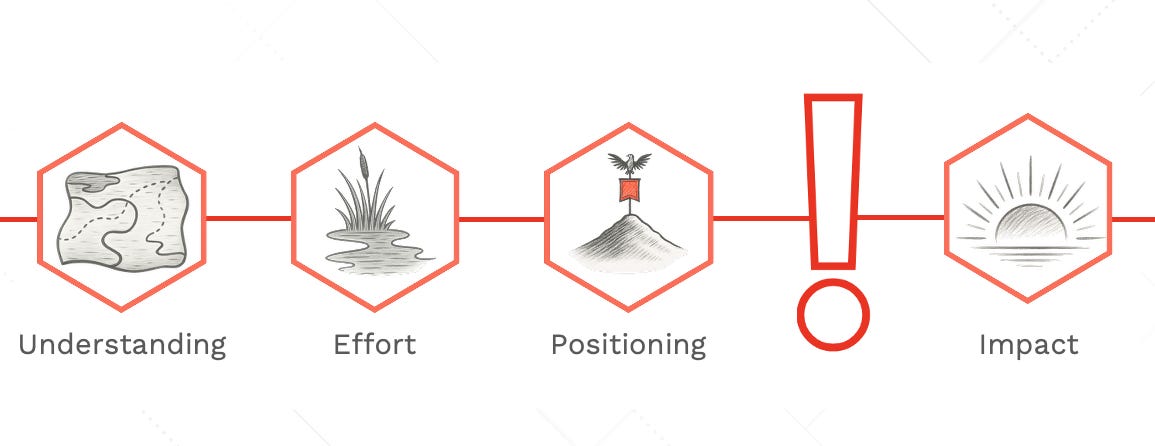
A Roman general was leading his legions toward the enemy in a swampy country.
He knew that the next day’s battle would be fought on a certain plain because it was the only dry, flat place for miles.
He pushed his army all night, marching them through a frightening and formidable swamp, so that they reached the battle site before the foe and could claim the high ground.
In the aftermath of the victory, the general called his troops together and asked them, “Brothers, when did we win the battle?”
One captain replied, “Sir, when the infantry attacked.”
Another said, “Sir, we won when the cavalry broke through.”
“No,” said the general. “We won the battle the night before - when our men marched through that swamp and took the high ground.”
—As presented in Steven Pressfield’s The Warrior Ethos.
The reason I like this story is that it challenges how most of us instinctively think about success. The captains point to the visible moments—the infantry attack and the cavalry breakthrough—yet the general points to the decision, the positioning, and the work that occurred before the battle began.
Looking backward, his logic seems obvious.
The battle would be fought on the only flat and dry piece of land.
The high ground offered an advantage.
Therefore, getting there first is what would make the difference.
The challenge, of course, is that we rarely get to operate from hindsight. We have to make decisions before we know which facts will influence the outcome and before events reveal the answer.
That is so much easier said than done, which is why we tend to admire people who can do it consistently.
One of the most remarkable things you will ever see is someone who can repeatedly put themselves or their organization in the right place, at the right time, with the right teams, skills, and resources before events unfold.
The executive or investor who identifies a market shift early.
The military commander who places forces where they will be needed rather than where they are needed now.
The public safety professional or emergency manager who recognizes a threat or hazard before conditions deteriorate.
As a society, we tell stories about them. We talk about them as if they are legends who single-handedly tipped the scales in their favor. And it’s tempting to assume they possess some special intuition or that they are simply gifted.
But mastery usually only looks magical from the outside. You might see people who appear to be naturally better at anticipating events, but there was a process for that person to learn how to do it. The question—the one that I think is the most interesting—is how do people develop the ability to do it?
What the Roman General, the investor, the commander, and the emergency manager have in common is that they rarely arrive at those decisions by accident. What appears to be intuition is often the result of years of accumulated practice and experience.
The executive who spots a trend early has likely spent years studying markets, customers, and competitors.
The military commander who sees the significance of terrain, timing, and movement has likely spent years studying how battles are won and lost.
The emergency manager who recognizes a developing threat or hazards has likely spent years examining incidents, hazards, and warning signs.
By the time they encounter a critical decision, they are not inventing a solution from scratch, but applying a skill that has been developed through years of experience and practice.
Mastery Starts With Mechanics
I was thinking about the story and how people develop their intuition this week while writing our bi-weekly leadership essay for our paying subscribers.
The article outlines a four-step sequence—Recognize → Assess → Decide → Act—that we use to apply the concepts written about in Left of Bang to the broader and wider range of threats, hazards, and opportunities that organizations want to get ahead of.
Dive deeper into the sequence here:

These steps are deceptively simple, but simple is not the same as easy.
Like any skill, mastery requires repetition. Sometimes a lot of it, and often in a variety of different settings, before it becomes intuition and second nature.
An NFL quarterback could teach me how to read a defense, but it doesn’t mean I’ll simply be able to do it right away.
A musician could teach me how to play scales on the piano, but it doesn’t mean I could make my fingers perform to the level of a concert pianist.
A pilot could teach me emergency maneuvers (once I learned how to get the plane off the ground), but the PowerPoint presentation wouldn’t make me ready for Top Gun.
We provide the steps in the article, just like we teach the Baseline + Anomaly = Decision structure in the book or the behavioral approach to threat recognition in the Tactical Analysis Program, because it creates a way to practice.
Frameworks simply make the mechanics visible and give people a process they can apply deliberately until the skill becomes familiar and eventually automatic.
At first, the mechanics will feel clunky. They feel overly analytical. They can even feel slower than simply relying on instinct. We start by defining the mechanics, though, because once you have a way to practice seeing and acting early, the mechanics eventually fade into the background.
In the real-world settings where people live and work, reality often moves too fast to consciously walk through every step of an analytical process. But if mechanics have become second nature, then you won’t find yourself trying to invent a solution in the moment. You’ll be applying a well-developed skill to a problem you’ve learned how to solve.
From the outside, that can look like intuition. In reality, it is often the result of thousands of repetitions that nobody else saw.
And that, to me, is what the Roman General’s decision represents. His march through the swamp wasn’t a lucky guess or just a hunch. To me, it was the visible manifestation of a capability that had been developed long before that particular battle ever began.
Pursuing Mastery in Proactivity
This process of beginning with the mechanics—starting with the rules of the domain—is how people develop a deep skillset in almost every field.
In Mastery—a book I have gifted more than any other—Robert Greene describes how professionals progress through different stages of development. It begins with an apprenticeship phase, where people learn the fundamentals of their craft. As apprentices, they learn the rules, the mechanics, and the principles that determine their success. Then they practice those fundamentals repeatedly until they become familiar with them.
And then at some point during that process, they see a change.
The mechanics that once required a great deal of conscious effort become more natural. And when the professional is no longer focused on performing the task itself, their attention becomes available for something more important: understanding why things are happening, recognizing patterns, adapting to changing conditions, and improving their performance.
This transition creates the opportunity for their experience to begin compounding at a faster rate. They begin applying those principles in different settings and under different conditions, and if they remain objective enough to observe the results of their decisions and adjust their approach, they continue refining the craft. Eventually, intuition and analysis begin to blend together.
What once required a deliberate process becomes a capability.
For many professionals, this progression can continue uninterrupted for decades. A carpenter continues building. A chef continues cooking. A brewer continues brewing.
But, ironically, military leaders, public safety professionals, security practitioners, emergency managers, and business leaders rarely have that luxury.
We get promoted. And every promotion changes the game.
The operator becomes a team leader.
The team leader becomes a supervisor.
The supervisor becomes an executive.
And each transition introduces new responsibilities, new priorities, and new decisions. The skills that created success in the previous role remain valuable, but they are no longer sufficient.
In many ways, each promotion drives us to re-enter the apprenticeship phase. We leave a role where we had confidence and competence, and we return to a position where we need to learn the rules of the new game.
This is one of the reasons why proactive leadership can feel difficult at first. The indicators, decisions, and actions that matter at one level of an organization are often different from those that matter at the next.
A patrol officer and a police chief both need to identify potential threats, but they are paying attention to different information.
A project manager and an executive both need to anticipate change, but they are making decisions on different timelines and with different consequences.
The challenge isn’t simply becoming proficient once. That is for a day gone by. Today, leaders need to develop new forms of proficiency as responsibilities expand.
This reality is one of the reasons we continue to build training, articles, and resources around proactive decision-making. We aren’t trying to provide a collection of unrelated models, but provide continuity in the process as professionals move between roles, responsibilities, and levels of decision-making.
As readers and our clients apply the Recognize → Assess → Decide → Act sequence to a new set of threats, hazards, and opportunities, we hope that the parallel to the Baseline + Anomaly = Decision becomes immediately apparent.
The mechanics are intentionally designed to be similar. When professionals re-enter the apprenticeship phase of a new job, they don’t have to start from scratch and can bring familiar decision-making mechanics with them.
We can’t eliminate the learning process and don’t believe there are any shortcuts to mastery. But I think we can shorten the time required to become effective by allowing people to build on skills they have already developed.
In that sense, professionals can begin acting before a new set of events impacts them, and do so with greater confidence.
Returning to Rome
And this brings us back to the story of the Roman General.
Many organizations want the outcome without accepting the requirement. They want better anticipation, better decisions, more agility, and people who can operate effectively under uncertainty. But they often treat those capabilities as traits rather than skills. They act as if some people simply possess them while others do not.
But as we’ve shown, reality is much less mysterious. It just requires putting in the work to recognize meaningful indicators, assess what they mean, make decisions under uncertain conditions, and take action before events unfold. It simply takes practice. It requires learning the mechanics, applying them repeatedly, and developing the judgment that comes from experience.
When I read the story about the Roman General, I don’t believe that he won because he knew the future. I think he won because he understood the present better than his opponent. He understood the terrain and where two armies were likely to converge. And because of that understanding, he was able to act before the outcome became obvious.
That same opportunity exists for all of us. But the people who consistently get ahead of events are rarely guessing. They are just applying skills that have been practiced so thoroughly that they appear effortless from the outside.
What looks like intuition is often mastery at work.
Before You Go
Organizations get left of bang when leaders begin asking different questions. Share this with someone responsible for preparing their organization for an uncertain future.
If you want to go deeper, a paid subscription gives you access to additional articles, training programs, workshops, and leadership development resources we’ve created to help professionals build the ability to recognize meaningful change, assess what it means, make decisions under uncertainty, and act before events force their hand.