

Welcome back to The CP Journal, where we break down what it takes to get left of bang.
On September 17th, we’re presenting “Before the Flames: Applying Left of Bang to Wildfire,” a webinar on how organizations can build a better process for recognizing emerging threats and hazards, making decisions under uncertainty, and acting while there is still time to influence the outcome.
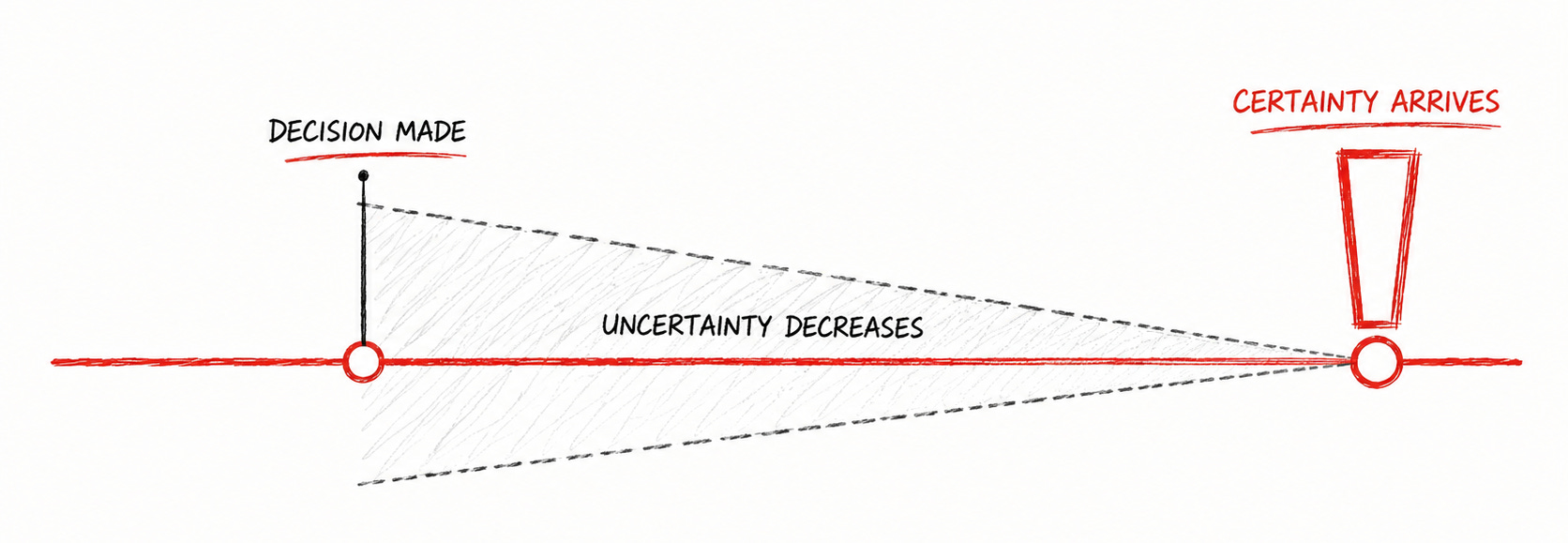
The more time you need to successfully evacuate people, the earlier you must decide to do it. And the earlier you must decide, the less certain you can be that an evacuation will be necessary.
When a public safety agency decides to evacuate an area—and it doesn’t matter if it is because of a flood, an attack, a hazardous materials incident, a wildfire, or something else—that decision is often assessed in one of three ways once the incident is over:
The evacuation was successful. The incident demonstrates why the evacuation was necessary, and people had enough time to reach a safe location.
The evacuation was deemed unnecessary. The incident never developed in a way that put the evacuated population at risk. In hindsight, people realize they could have stayed where they were.
The decision to evacuate was made too late. People did not have enough time to get to safety.
There is a fourth option, which I’ll come back to in a minute, but these scenarios highlight a paradox that professionals have to navigate when operating left of bang.
If you wait until you are certain an evacuation is necessary, you are often too late.
Therefore, consequential decisions—such as evacuating an entire neighborhood or community—often have to be made before leaders can know with certainty that the action will ultimately be needed.
Yet those decisions are often judged after the incident is over, when the uncertainty that surrounded the decision has disappeared and everyone knows how the incident actually unfolded.
To understand why leaders may have to accept so much uncertainty, it helps to work backward from the moment people actually reach safety.
How far left of bang do you need to be?
Evacuation scenarios provide an excellent example of left of bang decision-making because if you wait until your house or neighborhood is on fire to evacuate, you are likely already too late. The decision to move people to safety has to be made before that moment in time.
The question, then, is how much earlier? How far left of bang do you need to be?
To answer that, you have to account for the time required to complete an evacuation across four different components.
How much time does it take to physically evacuate? Moving a given number of people and vehicles from Point A to Point B along a fixed set of roadways takes time. It might be minutes, or it could be hours.
How much time does it take for public safety leaders to make the decision? Before an evacuation decision is made, someone has to size up the incident, assess where it may go next, determine what is at risk, and identify the geographic area that may need to evacuate.
How much time does it take to communicate that decision to the public? Once the decision is made, it often has to be communicated to the agency responsible for issuing the alert (such as a 911/dispatch center), entered into the appropriate system, approved, and delivered to the public—potentially through telecommunications networks already experiencing heavy demand.
How much time does it take for people to begin leaving? Receiving an evacuation alert does not mean someone is immediately in their car and moving. People assess the message, make the decision to leave, gather family members, pets, medications, and other essentials, and then begin evacuating.
Each of these steps consumes time. While the scale and scope of the incident and the readiness of both the agency and the community will determine how long each one takes, none of them happens instantaneously.
And those time requirements are cumulative. The longer it takes people to make the decision, communicate it, get people moving, and physically evacuate the area, the further left of bang the original decision point has to move.
That creates an important relationship that deserves to be called out. The more lead time the system requires, the earlier leaders have to act. And the earlier they have to act, the less complete the information will be, the more uncertain the forecast becomes, and the less evidence they may have to justify why the evacuation will ultimately be necessary.
Which raises a different question. If leaders are required to make decisions before the outcome is knowable, how should we determine whether they made the right one?
Is the outcome the right performance metric for left of bang decisions?
Imagine this scenario. A wildfire is moving toward a neighborhood.
Based on the wind and weather, the vegetation, fire behavior, and the roads available for evacuation, public safety leaders order the neighborhood to evacuate.
Three hours later, the wind shifts, and the fire changes direction. As a result, the neighborhood never burns.
Was the evacuation decision wrong?
That answer depends on whether you judge the decision based on hindsight or based on what was knowable at the moment the decision had to be made.
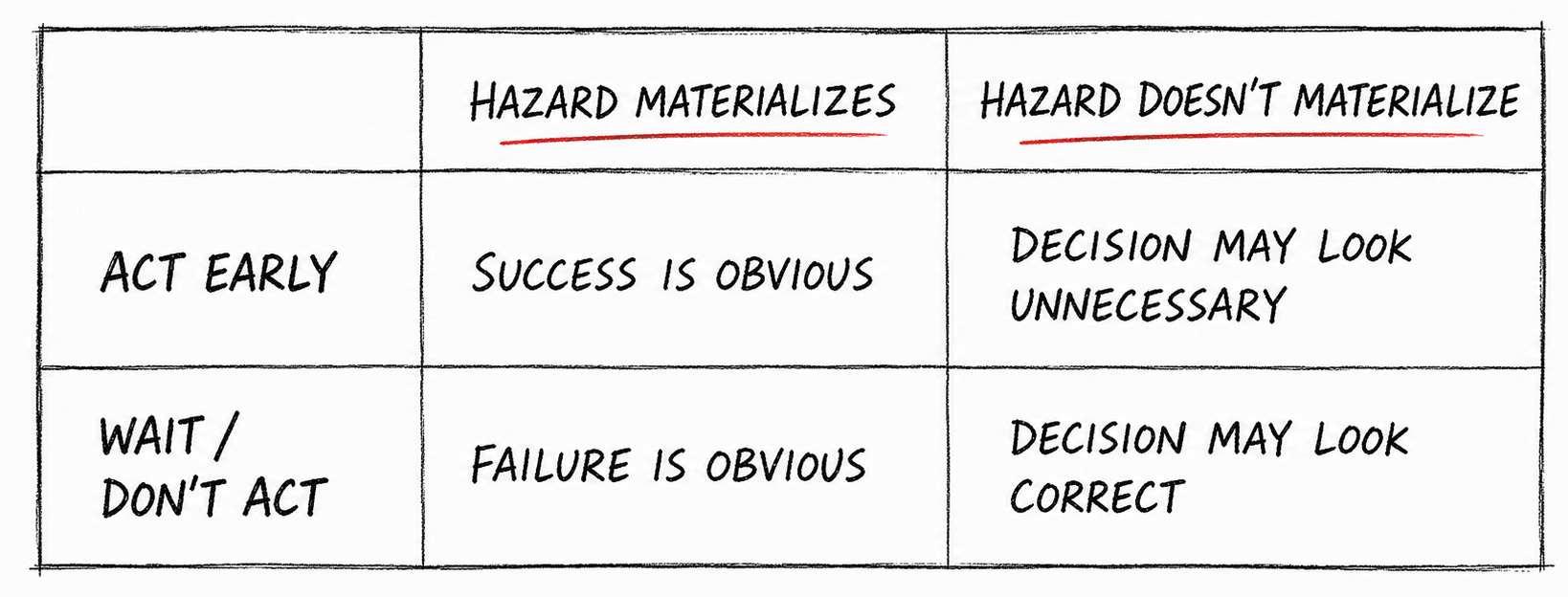
There are four ways an evacuation decision can intersect with what ultimately happens:
If the hazard materializes and the agency acts early, success is obvious.
If a hazard materializes but the agency delays or doesn’t act, failure is obvious.
If a hazard doesn’t materialize but the agency acted early, the decision may look unnecessary.
If a hazard doesn’t materialize and the agency either delayed the decision or didn’t act, the decision may look correct.
That last option is particularly dangerous because an agency might decide not to evacuate, get lucky when the hazard never materializes, and walk away believing it made the right decision. Organizations can make bad decisions and still receive good outcomes.
The opposite can also be true.
An agency can make a sound decision to evacuate based on the information available at the time, only for conditions to change and the evacuation to ultimately prove unnecessary. The outcome does not necessarily mean the decision was wrong.
This is why organizations looking to move left of bang need to distinguish between decision quality and outcome quality.
A good decision is one that was reasonable given the information available at the time, the consequences of waiting, the time remaining to act, and the criteria established for making the decision—not simply one that produced the desired outcome.
That distinction should also change how we evaluate these decisions after an incident. Instead of only asking, “Did we end up needing to evacuate?” we should also ask: “Given what we knew at the time, the time remaining to act, and the consequences of waiting, did we make the right call?”
Organizations cannot eliminate uncertainty surrounding left of bang decisions, but they can build a process for making better decisions within that uncertainty.
How do you operate left of bang?
If you cannot eliminate uncertainty, the objective is to build an organization capable of recognizing what is changing, understanding when a decision is approaching, and acting while there is still enough time to influence the outcome.
That leads to the very practical question sitting at the center of our upcoming webinar: How do we build a system that helps us make those decisions earlier and better?
On September 17th, we’ll explore that in our webinar “Before the Flames: Applying Left of Bang to Wildfire.”
Through the lens of a wildfire, we’ll look at three critical steps leaders and decision-makers can take to help their organizations recognize emerging risk, make decisions under uncertainty, and act before the window to influence the outcome closes.
If that challenge affects your work—or the work of someone you know—we hope you’ll join us and share the session with others who may benefit.
As always, thanks for reading, and we’ll see you next week.