

Welcome back to The CP Journal, where we break down what it takes to get left of bang.
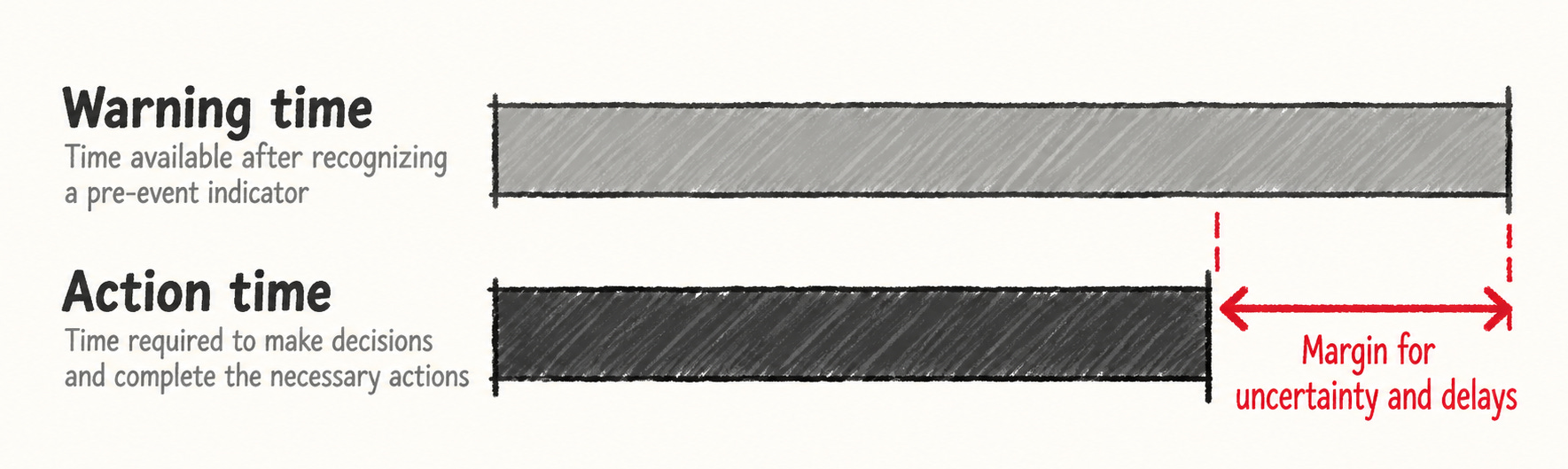
How much time does an early/pre-event warning provide?
And how much time is needed to act on that information?
Understanding the answers to those two questions, and the relationships between them, sits at the heart of the left of bang framework and has guided its evolution over the past few years. This is because recognizing a threat before it becomes an incident doesn’t necessarily mean there is enough time to do anything about it.
Consider the difference between individuals and organizations.
When an individual recognizes a threat to their personal safety, the time required to act may be relatively short. Taking cover, calling for help, or defending themselves (and others) can often be accomplished in seconds or minutes. The individual also has relatively direct control over the decisions they make and the actions they take.
For organizations, however, the challenge is often much more complicated.
Recognizing a threat may initiate a sequence of decisions and actions involving multiple people, departments, resources, and systems. Each introduces dependencies that can extend the time required to act from minutes into hours or even days. And the more complex the action, the more people involved, or the less prepared the organization is, the harder it becomes to reliably act within the time available.
That’s where the relationship between warning time and action time becomes so important.
If the time required to act exceeds the time provided by recognizing a pre-event indicator, one of two things needs to change. We either need to recognize the threat earlier (creating more time to act) or reduce the time required to act so that we can execute within the time available. Ideally, we are doing both, while preserving some margin for delays, uncertainty, and confusion that accompany real-world incidents.
Consider two incidents that demonstrate how these challenges can emerge across very different threats and hazards.
During the 2024 school shooting at Apalachee High School in Georgia, the shooter’s mother reportedly called the school approximately 30 minutes before the first shots were fired, warning of an emergency involving her son. School personnel reportedly attempted to locate him, but there was confusion involving another student with a similar name. Despite the warning, the shooting began before the threat could be stopped.
Or consider the 2025 Los Angeles fires. According to the Los Angeles County After-Action Report, the process of communicating evacuation decisions to the public took approximately 20-30 minutes during the fires. That was an improvement over the previous process, which could take up to an hour, but it still consumed valuable time as the fires spread under extreme wind conditions.
These were extraordinarily complex incidents, and these individual facts don’t tell the whole story or establish what different actions might have changed, but they illustrate the importance of understanding how much time is available and how much time an organization actually needs to act.
I recognize that we spend considerable time discussing how to identify threats earlier and move further left of bang—and those efforts remain essential—but the other side of that relationship deserves just as much attention.
How do we develop organizations that can reliably make decisions and execute within the time available? And how can advances in technology help reduce that time without sacrificing the quality of those decisions or the effectiveness of our actions?
That’s what we’ll explore in this week’s briefing.
Plans | How This Goal Is Often Pursued
One of the primary ways organizations attempt to reduce the time required to act, while also improving the effectiveness of those actions, is through planning.
By working through problems before an incident occurs, organizations can identify decisions that will need to be made, establish roles and responsibilities, determine what resources will be required, and develop processes for coordinating actions across departments and agencies.
The premise is that, instead of figuring all of that out in the middle of an incident, much of that work can be accomplished ahead of time.
This is particularly important for disasters, which often require the coordinated efforts of many different organizations. Law enforcement, fire, emergency management, 911/dispatch centers, public health, public works, transportation, human services, and other departments may all have responsibilities. And depending on the scale of the incident, those organizations may be operating alongside their counterparts at the municipal, county, state, and federal levels.
Making matters more complicated, disasters are relatively uncommon events at the local level. A city or county might go years without experiencing a major disaster, meaning the decisions, responsibilities, and processes required during one may not be practiced frequently enough to become second nature.
I recognize there are some people who love plans, and others who may see limited value in them, but plans help address that challenge. They establish expectations for how individuals and organizations should perform, help focus training and skill development, and inform decisions about the personnel, resources, and systems necessary to respond effectively.
The act of planning produces organizational understanding, which is incredibly valuable.
At its core, planning is simply thought before action. Throughout the process, people discuss problems and evaluate alternative solutions to them. They challenge assumptions, identify dependencies, and make decisions about how they intend to respond. As a result, the people involved in developing a plan often walk away with a much deeper understanding of the problem than someone who simply reads the finished document.
But that creates a challenge. The finished plan, whether it’s a PDF, a PowerPoint presentation, or a simple checklist, is how we typically capture and communicate the results of the planning process. And while those documents can communicate decisions, responsibilities, and procedures, they don’t necessarily transfer all of the understanding developed by the people who created them.
Additionally, it doesn’t take long, even in relatively small communities, to accumulate more pages of plans than any individual can reasonably be expected to read, much less remember. And because those documents are developed and updated at different times, the information contained in them may not always be consistent or reflect current practices.
The problem is not that these plans lack value, but that the organizational knowledge they contain can be difficult to access, interpret, and use when it’s needed.
Consider someone who needs to locate a five-step checklist during an incident. They might spend valuable time searching through a hundred-page PDF, only to discover that they’re looking in the wrong document or that the information is outdated.
Or they might find the correct procedures but lack the context necessary to understand how it relates to another department’s responsibilities or the decisions already being made elsewhere.
Or perhaps they’ve had that experience during a previous incident and decided it wasn’t worth the time to search for that information again. So instead, they don’t even attempt to use plans and make decisions based on what they already know and what they are seeing directly in front of them.
In each of these situations, the organization has already invested time, effort, and money in developing that knowledge, but the people responsible for acting on it may have to spend too much time finding it, interpreting it, or reconstructing it before it can provide any value.
And that brings us back to the relationship between warning time and action time.
The purpose of planning is to improve our ability to act when an incident occurs. But if the information and understanding developed through that process aren’t readily accessible and usable, we can lose valuable time during the very incidents we are preparing for.
The Opportunity | Putting Organizational Knowledge to Work
This is where advancements in technology, particularly AI, are creating opportunities that simply weren’t practical or possible before.
Consider what it would mean if the organizational knowledge developed through planning wasn’t limited to individual documents or the people who helped create them. What if a police commander, public works director, dispatcher, and elected official could access the information and context relevant to their responsibilities, without having to know which plan it came from or rely on an emergency manager to explain it?
Take wildfire as an example.
Wildfires aren’t exclusively a fire department problem. They can create electrical utility outages, require large-scale evacuations, disrupt transportation networks, create significant public health and human services needs, and demand a high volume of public information. And even after the fire is extinguished, the resulting burn scars can introduce new flooding risks that require additional planning and preparedness.
Each of those activities involves different departments, decisions, and organizational capabilities. But much of the information needed to understand the threat, develop plans, and make decisions is shared across them. Historically, that information has often been distributed across departments and documents. Each department either recreates information that another has already developed, or proceeds without the benefit of understanding what the others know.
What if we could bring that information together and make it available to everyone who needs it, in a form they can actually use?
That’s part of what we’re working toward with Hazzard.
Our initial focus is on risk assessment and helping organizations bring together their existing plans, documents, and other information into a shared understanding of the threats and hazards they face. By using AI to work across those sources, we can identify relevant information, organize supporting evidence, and develop assessments that professionals can review, validate, and use. And as additional documents and information are added, that shared understanding can continue to develop without starting the process over again.
This is an important first step toward our broader objective: making the knowledge an organization has already developed more accessible and reusable across departments, capabilities, and decisions.
We’re applying a similar principle to how we’re building Hazzard as a business, an experience I wrote about earlier this week.
For public safety organizations, I think and believe the implications go well beyond faster access to planning documents.
Think about how much time is consumed during an incident trying to determine who has responsibility for a particular action, what decisions have already been made, which resources are available, or how one department’s actions affect another. Much of that information may already exist somewhere in the organization, but finding it, interpreting it, or waiting for someone else to explain it takes time.
The more of that knowledge we can make available to the people responsible for acting, the less time they should have to spend reconstructing what the organization already knows.
This won’t eliminate the need for professional judgment, coordination, or developed skills, but it can reduce dependence on the individual planner and allow people across the organization to act more effectively within their own responsibilities.
In Closing
Getting left of bang requires more than recognizing threats before they become incidents. We also need the ability to make decisions and act on that information within the time available. And while I believe we should continue investing in our ability to recognize threats earlier, we should be equally focused on reducing the time required to act.
That’s one of the reasons why we’ve spent so much time discussing organizational capabilities throughout the year. Plans, people, resources, skills, and validation all contribute to an organization’s ability to perform. And technology is creating new opportunities to make those capabilities more effective, particularly by making the knowledge we’ve already developed more accessible and useful.
But having the right information is only part of the challenge. People still need the authority, resources, and skills to execute, and organizations need confidence that those capabilities will perform when needed. That is how we can build the ability to influence a situation while we still have time to make a difference.
Thanks for reading, and I’ll see you next week.
—Patrick