

This essay is for paying subscribers to The CP Journal.
When we talk about the strategic benefits of getting left of bang, the focus is usually on what preparedness makes possible after a disruption occurs.
Organizations that invest in their readiness are better positioned to absorb shocks, adapt to changing conditions, and in some cases even emerge stronger than before. While some organizations measure that outcome in financial terms, others define success through improved public trust, operational credibility, or strengthened partnerships.
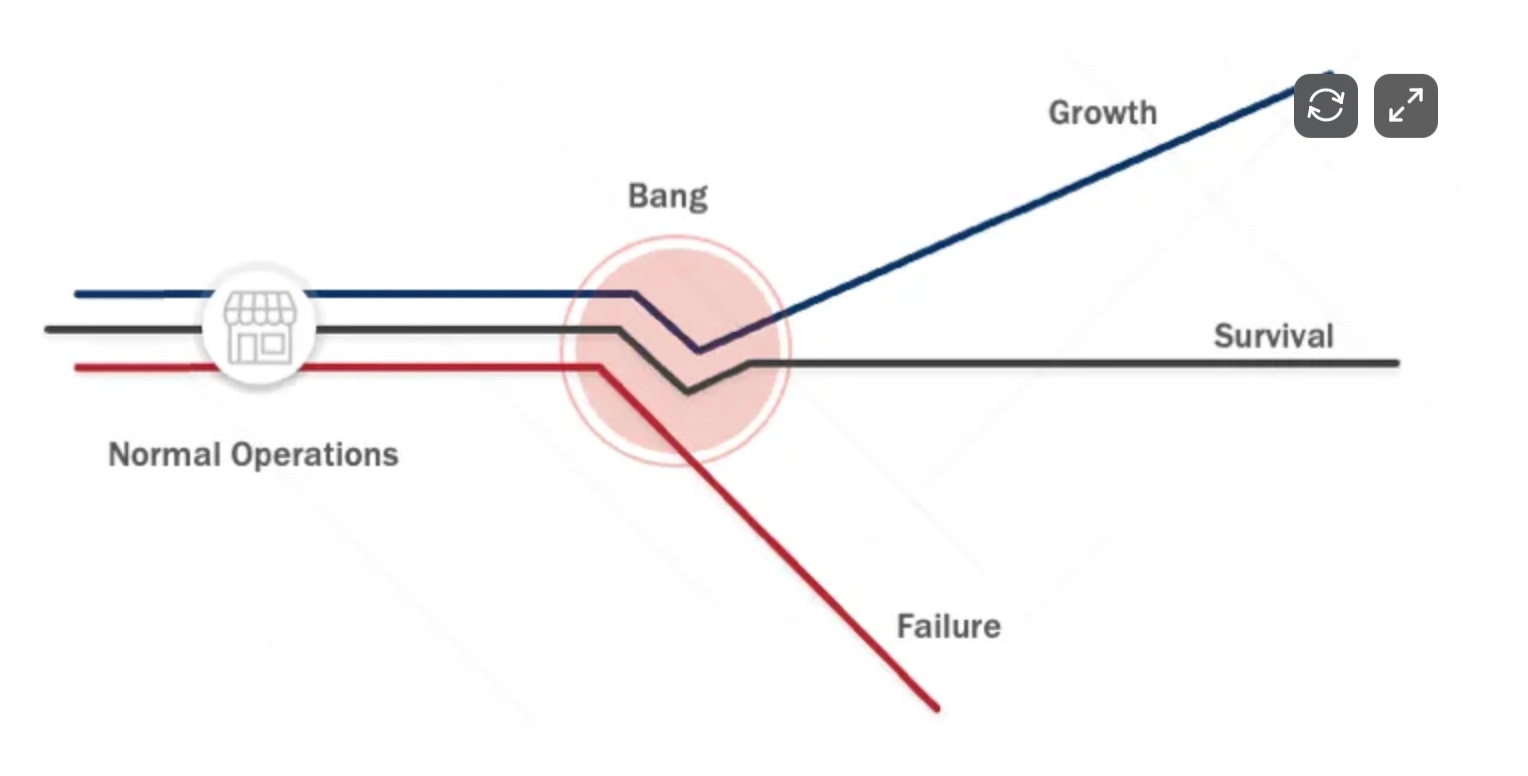
But before an organization reaches those outcomes, it must first navigate the moment when disruption actually arrives. In the graphic at the top of this article, that moment is represented by the shaded circle surrounding the point of impact, and is what we refer to as bang.
This period—when the disruption is still fresh and the conditions are changing quickly—is the hinge. The organization’s readiness determines how deep the dip at bang becomes, how long it lasts, and how quickly the organization stabilizes. Preparation either becomes the springboard organizations use to move forward and grow, or it exposes that they were not ready to escape the survival cycle.
As a result, this is the point where leadership becomes most visible and most impactful. Leaders are expected to make decisions about what the organization should do—what to prioritize, where to focus, and how to allocate effort—often without the benefit of a stable or complete understanding of what is happening.
In that sense, the moment of disruption is what leaders are actually preparing for. For incidents that cannot be prevented, bang is the point when preparation becomes operational.
Leadership is not expressed through plans or intent, but through decisions (and those decisions are best understood as hypotheses about what is actually happening). Those decisions are shaped by two things: an organization’s ability to understand what is happening, and its ability to act on that understanding.
This article focuses on the first.