

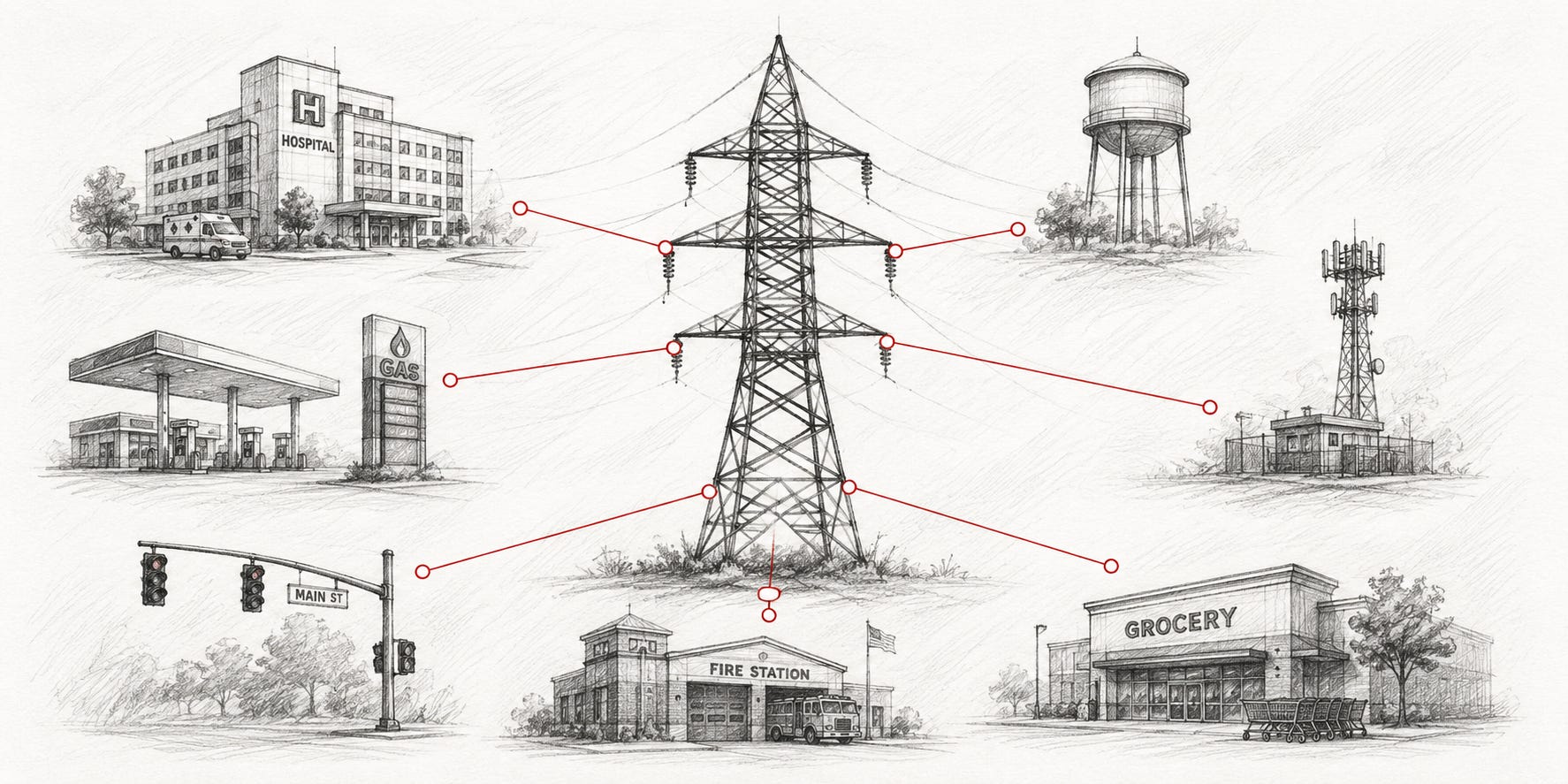
Electricity has become one of the most foundational dependencies of modern life. We have become so accustomed to reliable electrical service that we rely on it for nearly every essential function in our lives and work.
Communications, fuel distribution, water treatment, healthcare, financial transactions, food supply chains, and emergency response operations (amongst other things) all require consistent access to power. Even when outages do occur, people generally expect them to be resolved quickly. Utility crews will respond, service will be restored, phones will get charged, clocks will get reset, and life will move on. It always does, right?
Most of the time—actually, an overwhelming majority of the time—that assumption proves to be correct.
But non-routine power outages, the situations when the power doesn’t “just come back on,” present a different kind of challenge for communities and the organizations that support them.
While these outages are certainly “low-probability events,” they are not “no probability” events either. What makes them important to consider is that they are not tied to a single type of incident. Severe weather, infrastructure failures, cyber incidents, physical attacks, and grid instability can all create the conditions for significant outages to occur. And when they do, the impacts can extend far beyond the electrical grid itself.
This article is not written to predict that a major outage will occur in your community or to create unnecessary concern. The goal is much simpler: to briefly examine a series of past incidents where large-scale outages did occur, understand the impacts they created, and provide examples that organizations can use as they think about continuity, public safety, and community resilience.
Because ultimately, preparedness starts with understanding what you may need to be ready for. The better organizations understand the types of incidents that can occur and the impacts they can create, the better positioned they are to make informed decisions about readiness before an incident takes place.
The Pathways to Power Outages
While large-scale power outages remain relatively low-probability events, communities around the world have repeatedly experienced incidents over the past two decades that disrupted electrical service at a significant scale.
Importantly, there is no single pathway that leads a community to experiencing this type of outage.
Cyber Incidents
The most experienced group of people dealing with large-scale outages are undoubtedly the Ukrainians. Beginning in 2015, a cyberattack attributed to a Russian group disrupted power to approximately 230,000 people across western Ukraine. One year later, in 2016, Ukraine experienced another cyberattack targeting the electric grid. This time, the attack included malware designed to damage equipment and complicate restoration efforts as operators attempted to re-energize systems.
While incidents like these can initially feel like “over there” problems, similar concerns have increasingly emerged in the United States. In 2024, the U.S. government publicly discussed ongoing operations related to “Volt Typhoon,” a cyber campaign attributed to China that had reportedly targeted critical infrastructure organizations in the U.S. since at least 2021. According to federal officials, the activity included efforts to gain access to operational technology systems used by utilities and other infrastructure operators.
Severe Weather
In February 2021, Winter Storm Uri struck Texas, bringing extreme cold temperatures that contributed to widespread electricity generation failures and grid collapse. Approximately 4.5 million customers lost power during freezing conditions, in some cases for multiple days. The outage strained healthcare systems, disrupted water service, created fuel shortages, and contributed to hundreds of deaths across the state.
Similarly, the Northeast Blackout of 2003 demonstrated a different pathway to a large-scale outage with many of the same impacts. Triggered by a software and transmission failure during August heat, the outage affected an estimated 55 million people across parts of the United States and Canada. Approximately 100 people died during the outage, which lasted for several days in some areas.
More recently, following the January 2025 fires in Los Angeles, many homes and neighborhoods remained without power for weeks. Following Hurricane Beryl in 2024, it took nearly a week to restore power to large areas of Houston after more than 2.1 million customers lost service.
Physical Attacks
Power outages can also result from deliberate physical attacks against electrical infrastructure.
In 2022, Russia launched waves of missile and drone strikes against Ukrainian energy infrastructure as part of the ongoing war. The attacks repeatedly disrupted electrical service across the country and forced Ukraine into years of ongoing restoration and grid stabilization efforts.
While wartime attacks can feel geographically distant from American communities, there have also been domestic examples of physical attacks against grid infrastructure. In December 2022, gunfire attacks against two substations in Moore County, North Carolina left approximately 40,000 customers without power for nearly five days.
Infrastructure Failure and Grid Instability
Not all outages originate from intentional attacks or severe weather. Complex infrastructure systems can also experience cascading operational failures.
In April 2025, a large-scale blackout spread across portions of Spain and Portugal following what officials described as a “grid instability event.” Millions of people were impacted, transportation systems were disrupted, and more than 35,000 rail passengers reportedly required rescue operations after trains lost power during transit.
Why These Incidents Matter
The point of these examples is not to suggest that every community faces the same level of risk or that a major outage is imminent. Most power outages are short-duration events that utilities restore quickly and communities recover from with relatively limited disruption.
But these incidents demonstrate that larger and more disruptive outages do occur and that they can emerge through multiple pathways. In some cases, severe weather was the cause. In others, cyber activity, infrastructure failures, physical attacks, or broader grid instability played a role.
They also demonstrate how dependent modern communities have become on reliable electrical service. When outages occur at significant scale or duration, the impacts can extend well beyond the electrical grid itself, affecting transportation systems, healthcare, communications, fuel distribution, businesses, government services, and emergency response operations.
For organizations responsible for continuity, preparedness, and public safety, these incidents provide useful examples to consider when evaluating what events they may need to prepare for and what impacts those events could create within their communities.
Preparedness begins with understanding the types of incidents that can occur, how they affect the environment around you, and whether your organization is ready to operate through them.
Before You Go
Found this useful? Share it. If this sparked an idea, pass it along to someone responsible for getting left of bang. That’s how this work spreads.
If you want to go deeper, a paid subscription gives you access to advanced courses, playbooks, and exclusive leadership writing.