

Welcome back to The CP Journal, where we break down what it takes to get left of bang.
Many operational capabilities depend on people and organizations outside of your control.
Public safety agencies rely on mutual aid during large-scale incidents.
Executive protection teams depend on intelligence providers, local staff, and venue security teams to support major events and travel.
Businesses often rely on vendors, contractors, and specialized expertise during high-consequence situations.
Military units often depend on adjacent units, air support, and private sector supply chains to sustain combat operations.
Sometimes your organization is being supported by others. Other times, your organization is the partner supporting someone else’s operation.
Dependency is not unusual, and it is how many modern organizations are designed to operate.
The blind spot is that organizations often talk about readiness as if it is entirely internal—our plans, our people, our equipment, our training. Yet operational performance frequently depends on external relationships, external expertise, external capacity, and external execution.
That creates a difficult reality: you are accountable for outcomes that depend on people you do not control.
After one recent interview, a practitioner summarized the challenge simply: “Relying on others is a really tough part of this job.”
When those dependencies are unclear, unvalidated, or poorly understood, the seams between organizations often become the point where otherwise well-run operations begin to break down.
If your capability depends on another organization’s performance, then their reliability becomes part of your readiness. Operationally, that means partners are not adjacent to your capabilities—they are part of them.
Interdependent Capabilities
In our white paper, Preparing the Organization You Will Need: A Strategic Doctrine for Getting Left of Bang, we describe capabilities as being made up of five interconnected elements: plans, people, resources, skills, and validation.
Partnerships sit primarily inside the “people” component, but their effects extend across the entire capability.
A mature partner does more than simply provide additional personnel or support capacity. They bring defined processes, understood roles, validated performance, operational experience, and the ability to integrate into larger efforts with minimal friction.
Other partners create uncertainty, risk, and friction instead.
The same internal capability may perform very differently depending on the maturity, reliability, and interoperability of the external network surrounding it. You may not control your partners, but their maturity affects your ability to perform just as your maturity affects theirs.
What Mature Organizations Do Differently
Organizations with mature capabilities tend to do three things differently when preparing to operate with partners.
1: They make their way of operating and their readiness visible.
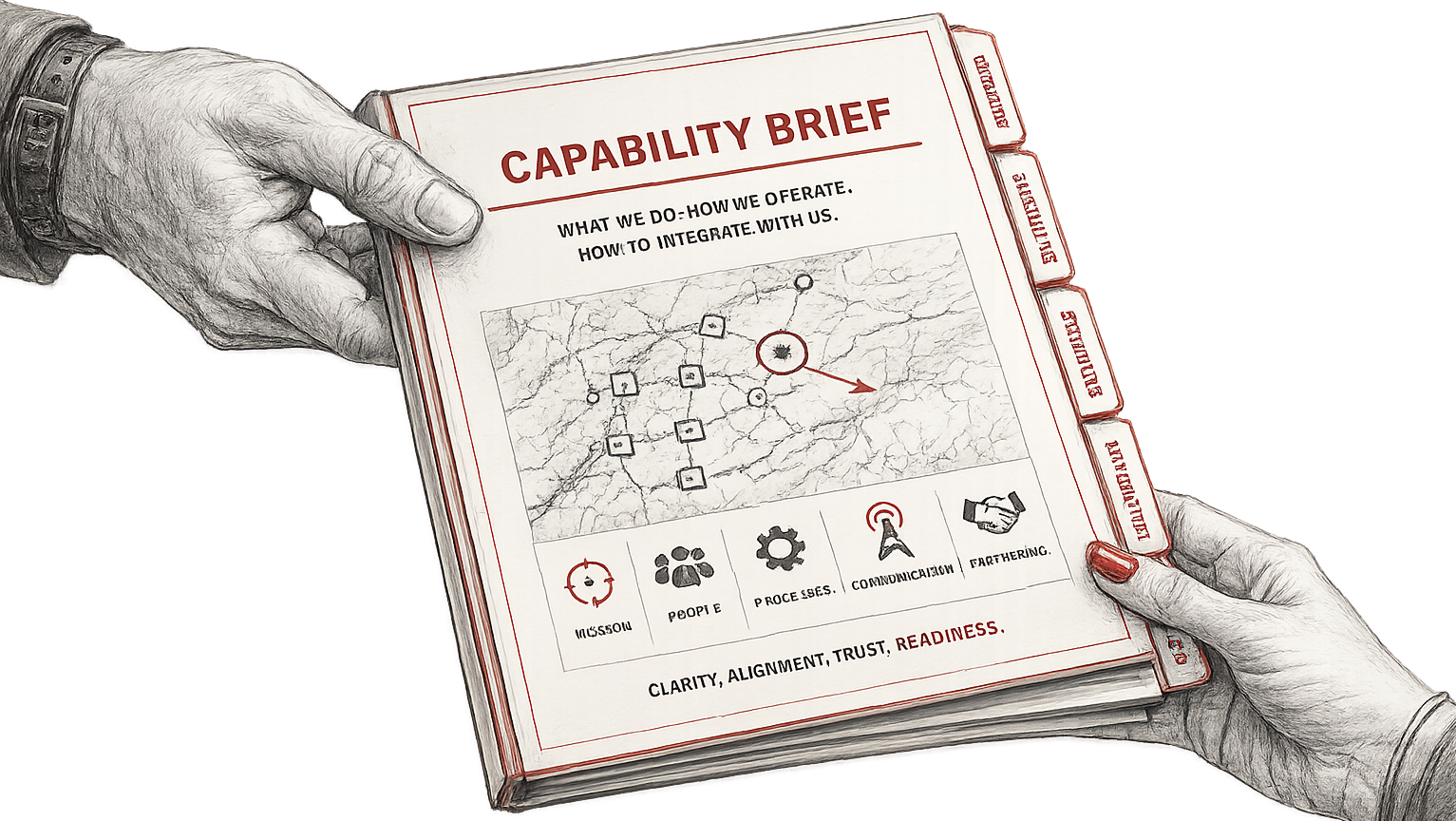
Organizations that can clearly explain how they operate, make decisions, what standards they work toward, and how they contribute build trust quickly. A partner who can provide a capability brief that explains what they can do, how they operate, and how to integrate with them immediately reduces uncertainty at the start of the operation.
2: They don’t force their partners to guess how they fit into the operation.
Partners perform better when they understand their role, decision-making boundaries, operational intent, and place within the larger system.
Many partners can execute effectively if they understand the operational context. Without that context, ambiguity creates friction. Partners may optimize locally instead of operationally, duplicate effort, hesitate, overstep, or underperform.
Mature organizations reduce that friction before operations begin by clearly communicating roles, responsibilities, expectations, and how partners contribute to the larger mission.
3: They provide value to partners before the operation.
Many organizations approach partnerships transactionally and ask, “What can they do for us?” Mature organizations also ask, “How do we make them more effective?” That shift changes the relationship from coordination to collaboration.
Trust built during operations is valuable, but trust built before operations is even better. Exercises, joint planning sessions, rehearsals, and intelligence briefings create the shared experiences that strengthen interoperability, reduce uncertainty, and build durable partnerships before they are tested under pressure.
In Closing
The organizations that perform well under pressure are rarely the ones assuming they are operating alone. They are the ones that understand their dependencies clearly, build trust before they need it, and deliberately strengthen the network their capabilities rely on.
That requires maturity on both sides of the partnership. Organizations must be able to effectively lead operations supported by others, while also being the kind of reliable, capable partner that others can confidently depend on when support is needed in return.
The goal is not to eliminate dependency. In many modern operations, that is neither realistic nor desirable. The goal is to reduce the uncertainty that dependency creates by improving clarity, interoperability, trust, and readiness before operations begin.
Because every bit of uncertainty reduced across your partnerships allows leaders and teams to keep their attention focused where it belongs: on the adversaries, hazards, disruptions, and opportunities that will ultimately shape mission success or failure.
Before You Go
Found this useful? Share it. If this sparked an idea, pass it along to someone responsible for getting left of bang. That’s how this work spreads.
If you want to go deeper, a paid subscription gives you access to advanced courses, playbooks, and exclusive leadership writing.
And if you’re asking the question many leaders eventually face—are we actually becoming more prepared, or just busier?—the first step is a Strategic Briefing, where we map how your organization is preparing today, identify where gaps exist, and what that means for your ability to perform when it matters.