

This paper reflects The CP Journal’s work helping organizations treat preparedness as a strategic capability in an operating environment defined by uncertainty, disruption, and increasing demands on leadership.
It is written for public safety leaders, emergency managers, and other executives responsible for preparing their organizations for conditions that have not yet fully revealed themselves.
Its purpose is to offer a practical doctrine for getting left of bang at the strategic level: defining what readiness requires, how it should be measured, and how it can be built deliberately over time.
Short on time? Read the Executive Summary
Prefer video: Watch our webinar discussing this paper
The Leadership Responsibility for Preparedness
“You go to war with the army you have, not the army you might want or wish to have at a later time.” –Donald Rumsfeld, Secretary of Defense, December 2004
When organizations are tested, they don’t get to choose how they perform—they rely on the capabilities they built beforehand.
Donald Rumsfeld’s statement, made nearly two years into Operation Iraqi Freedom, reflects a hard reality: even with time and experience, organizations do not automatically become what they need to be. The organization that shows up is the result of decisions made long before that moment arrives—and the constraints leaders face in that moment are often of their own making.
Ensuring that the organization you want is the one you have is a responsibility that rests with leadership. In fact, preparing the organization to be ready for future disruptions or crises is arguably a leader’s most important responsibility.
If an organization lacks the capabilities required to perform under pressure, that is not a failure of the moment—it is a failure of preparation. And preparation is shaped by what leaders choose to prioritize, invest in, and build over time.
Today, that responsibility is becoming more difficult to navigate.
Leaders across public safety, government, and the private sector are operating in environments defined by uncertainty, disruption, and increasing complexity. They recognize that the conditions they will face are changing, but often lack a clear framework for deciding what those changes mean, what capabilities will matter most, and how to prepare for them in an intentional way.
As a result, many organizations continue to prepare based on what they have experienced, rather than what they are likely to face.
This paper presents a different approach. It outlines a strategic framework for preparing left of bang—treating preparedness as a capability, defining what readiness requires, and providing a structure for building it deliberately over time.
Defining The Challenge: Right of Bang vs. Left of Bang Preparation
Introduction: Learning from Experience—And Its Limits
Preparedness in most organizations improves in a familiar way: in response to major incidents.
After Columbine, active shooter response fundamentally changed. After Hurricane Katrina, emergency management doctrine was reshaped. The Boston Marathon bombing led to improvements in mass casualty coordination. More recently, communities are reevaluating how alerts are issued and how large-scale evacuations are conducted in the face of wind-driven wildfires.
These events, and countless others like them, have played a critical role in advancing our country’s readiness for disasters, disruptions, and acts of violence. These experiences—whether firsthand or observed—provide hard-earned lessons about what works, what fails, and what is missing when organizations are tested under real-world conditions.
But they also reveal a consistent pattern: the lesson only becomes clear after the event occurs.
When preparedness is primarily shaped by experience, organizations improve, but only in hindsight and after people, systems, and entire communities have been impacted by an event.
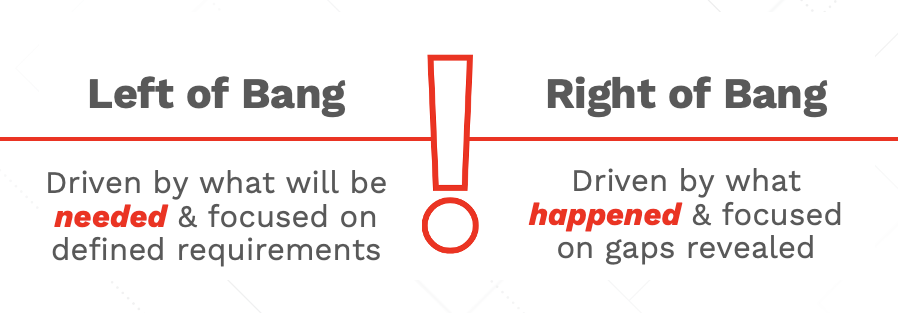
That is what it means to prepare right of bang.
Right of Bang: The Limits of Experience-Based Preparation
Right of bang preparation is an experience-based model of preparedness and refers to the improvements organizations make after an incident has already happened.
In this context, “bang” represents the events that are meaningful and impactful to an organization or a community—an active shooter, a wildfire, severe weather, civil unrest, or a cyber attack. It can also extend beyond traditional public safety or security incidents to include disruptions such as the loss of a key leader, a failed business initiative, or a breakdown in critical infrastructure.
When an organization is operating right of bang, its preparedness efforts are shaped by events that have already taken place. An incident reveals a gap or exposes a weakness, and the after-action process identifies what needs to change.
From there, organizations adjust.
Policies get updated to address deficiencies
Training programs are modified based on lessons learned
Plans are revised to reflect what experience has shown to be necessary
Exercises are designed to reinforce new procedures
This is not a flawed system. It is, in many ways, a necessary one.
Real-world events provide a level of clarity that cannot be fully replicated in planning sessions or exercises. They reveal how systems perform under stress, how people make decisions under pressure, and which assumptions prove to be false.
But experience has a limitation: it is always tied to the past.
As a result, organizations preparing right of bang are improving their ability to respond to the last incident—not necessarily the next one. They are learning, adapting, and improving, but in a way that keeps them one disruption behind the environment they operate in.
Left of Bang: Proactive Preparation
Left of bang preparation takes a fundamentally different approach.
Instead of allowing past events to dictate what an organization prepares for, leaders make deliberate decisions about what will be required in the future, and begin building those capabilities before they are tested. This shifts the core question of preparedness from, “What went wrong?” to, “What will be required for us to succeed?”
Answering those questions—and operationalizing the answers—requires four things.
An understanding of how the operating environment is changing and what threats, hazards, and opportunities may emerge.
Deliberate decisions about which capabilities the organization must develop.
Clear definitions of what “ready” looks like for each of those critical functions.
A structured approach for building and evaluating those capabilities over time.
This is not about predicting the future with certainty. It is about making informed decisions in the absence of certainty—and committing to building the capabilities required to perform under a range of possible conditions.
Organizations that operate this way are not waiting for an incident to reveal their gaps. They are proactively identifying and addressing them in advance.
They are preparing left of bang.
The Challenges of Shifting Left of Bang
The distinction between experience-based and proactive preparedness models is clear in theory. In practice, making the shift is difficult.
Across public safety, government, and the private sector, there is a growing expectation that organizations are preparing for what comes next—not just what has already happened. Leaders are being asked to anticipate emerging risks, adapt to changing conditions, and ensure their organizations are ready for an increasingly uncertain future.
As a result, many organizations are attempting to do this. They monitor trends, discuss future scenarios, and incorporate future-looking considerations into their planning, training, and exercises.
But making the shift from an experience-based model to a proactive one is not as simple as deciding to do so. Often, these efforts remain inconsistent, difficult to sustain, or disconnected from meaningful improvements in readiness.
The reason is not due to a lack of intent, but because the underlying approach to preparedness has not changed with the change in expectations. Organizations are attempting to prepare for the future using systems, decision processes, and measures of progress that were designed for a right of bang model.
As a result, two challenges consistently emerge.
Challenge #1: The Certainty Problem
The first challenge is how leaders make decisions about what to prepare for in the absence of a triggering event.
Right of bang preparedness operates with a high degree of certainty because decisions are based on incidents that have already occurred and after-action reviews that identify what needs to change. In this situation, the need for improvement is clear, the justification is validated by observed experience, and resources—time, budget, and effort—can be allocated with confidence.
Organizations preparing left of bang, however, are making decisions before an incident occurs. As a result, they operate with far less certainty. They cannot point to a specific event and say, “this is why we are doing this.” Instead, they must make informed judgements about what could happen and what will be required to succeed if it does.
This uncertainty introduces friction.
Preparedness efforts compete against other organizational priorities, and leaders must justify investments in capabilities that may not be tested immediately—or at all. At the same time, there is an inherent paradox in preparedness: by the time there is certainty about what will happen, the ability to do anything meaningful about it has often already passed.
Without a way to make decisions under these conditions, organizations default to what is easier to justify. They revert to preparing for what has already happened.
Challenge #2: The Measurement Problem
The second challenge is determining whether preparedness efforts are actually improving readiness.
In many organizations, preparedness is measured through activity. Organizations can quantify the number of plans written, exercises conducted, training sessions delivered, and improvement items completed. These activities are visible and measurable, which creates the perception of progress.
In a right of bang model, that assumption often aligns with reality. Because these activities are tied to known gaps identified in real events, more activity can reasonably lead to improved readiness.
That assumption breaks down in a left of bang model.
When preparing for the future, the number of potential risks and scenarios is effectively unlimited. There is no natural endpoint, and no clear signal that the organization is “ready.” Activity alone is no longer a reliable measure of preparedness.
Organizations can invest significant time and effort into the planning, training, and exercises—and still lack the capabilities required to perform under future conditions. This creates a different kind of risk.
Teams can be busy, but not necessarily more capable. Effort expands and resources are consumed, but that doesn’t always translate into improved performance. In many cases, the people responsible for preparedness become overwhelmed long before the organization becomes ready.
This is where many attempts to move left of bang begin to stall. Not because the intent is wrong—but because the approach has not changed.
Moving Beyond the Challenges
Taken together, these two challenges explain why many organizations struggle to move beyond an experience-based model of preparedness. It is not a lack of awareness or effort. It is a function of how preparedness decisions are made—and how progress is measured.
If organizations are going to operate left of bang, both must change.
Which raises the central question: what does a preparedness capability actually look like—and how do organizations intentionally build one?
The Preparedness Capability
Introduction: Preparedness as a Capability
The challenges outlined in the previous section highlight a fundamental issue in how preparedness is often approached.
Organizations struggle to decide what to prepare for in the absence of certainty—and to determine whether their efforts are actually improving their readiness. As a result, preparedness is frequently managed through activity: plans are written, exercises are conducted, training is delivered.
But activity does not answer a simple question: Are we more prepared today than we were yesterday? Or last year? Or three years ago?
Answering that question requires that we manage preparedness as an organizational capability. Like any capability, preparedness reflects an organization’s ability to perform a vital function under specific conditions. In this sense, preparedness is something built over time, developed through deliberate effort, and demonstrated through performance.
Making this shift requires leaders to do three things:
Understand what a capability consists of
Define the capabilities that will determine success or failure
Establish what it means for each of those capabilities to be “ready”
The sections that follow outline a structured approach for doing so—one that allows organizations to move beyond activity and deliberately build, measure, and improve their preparedness over time.
The Components of a Preparedness Capability
If preparedness is to be developed as a capability, it must be clearly defined.
A capability is not a single plan, training program, or collection of resources. It is the integration of multiple elements that, together, determine whether an organization can perform a function when required. When any one of the elements is missing or underdeveloped, the capability itself is incomplete—regardless of how much activity is taking place.
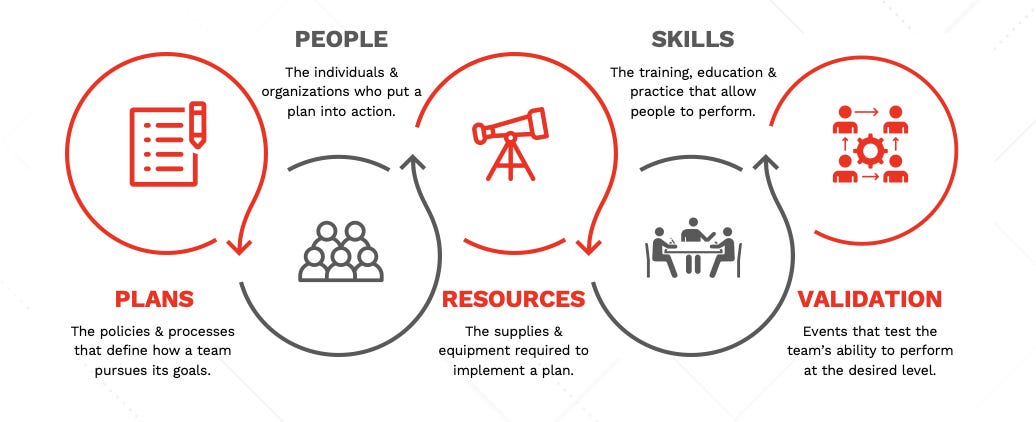
Capabilities are built from five interdependent elements.
Plans define what the organization intends to do and how it intends to do it.
They provide structure, outline responsibilities, and establish how the organization expects to operate under specific conditions. Plans translate intent into a shared understanding of action—but on their own, they do not ensure execution.
People determine who is responsible for executing the plans and performing the function.
This includes not only an organization’s staff, but also its partners. Functions are ultimately performed by people, not documents, which makes clarity of roles, accountability, and leadership essential.
Resources provide what is required to execute the plans.
This includes equipment, systems, facilities, software, funding, and external support. Even well-designed plans and well-trained personnel will fail to meet performance expectations if the necessary resources are unavailable, inaccessible, or insufficient under real-world conditions.
Skills determine how well people perform their roles.
Training, experience, and repetition develop the ability to execute under pressure. Skills are what allow individuals and teams to translate decisions into action when conditions are uncertain and time is limited.
Validation determines whether the capability actually works.
Exercises, real-world events, and assessments provide evidence of performance. Without validation, organizations are left to assume they are prepared—often based on activity rather than demonstrated ability.
These elements do not exist independently.
A plan that is not supported by trained personnel will fail. Resources without defined roles will be misused. Training that is not tied to a plan will not translate into coordinated action. And without validation, none of these elements can be trusted.
This is where many organizations encounter the illusion of a capability. They have plans, acquire resources, attend training, and complete exercises—but because these elements are not deliberately integrated and evaluated together, it remains unclear whether the organization can actually perform when it matters.
Understanding preparedness through these elements provides a different lens. It allows organizations to assess where they are strong, where they are weak, and where effort is not translating into capability.
A Portfolio of Capabilities
A preparedness capability does not begin with a plan—it begins with a leadership decision about what your organization must be able to do.
For leaders, this means defining a portfolio of critical operational and organizational support capabilities.
This capability portfolio is the set of functions an organization has determined are critical—the ones that must exist and be utilized if it is going to succeed in its operating environment. It is not an exhaustive list of everything the organization does day-to-day, but rather a deliberate selection of what matters most.
Defining this portfolio is a leadership decision. It requires leaders to assess their operating environment, understand how it is changing, understand their mission, and determine which capabilities will be most critical to success. The specific capabilities included in a portfolio will vary by organization.
For example:
A law enforcement agency may prioritize: critical incident response, mass notification, investigations, or evacuation.
A fire department may prioritize: structure fire suppression, search and rescue, mutual aid integration, or wildfire response.
A business may prioritize: business development, talent acquisition, supply chain management, or product development.
A non-profit may prioritize: fundraising, volunteer coordination, resource distribution, or partner integration.
The goal is not to adopt a pre-determined list, but to define the set of capabilities that reflect the organization’s mission and operating environment. This portfolio becomes the foundation for all preparedness efforts. It informs how plans are written, how people are assigned, how resources are allocated, how skills are developed, and how performance is evaluated.
Organizations that do not explicitly define their capability portfolio often default to preparing for everything—and prioritizing nothing.
Defining Performance for Each Capability
Defining a portfolio of capabilities establishes what the organization must be able to do. The next step is to define how well it must be able to do it.
Without defined performance standards, preparedness efforts lack a clear end state. Capabilities may exist in some form, but it remains unclear whether they are sufficient or whether they will perform when required.
To address this, each capability in the portfolio must have a defined performance target.
We are ready for X, to do Y, to Z standards.
X defines the conditions or incidents the organization is preparing for.
Y defines the function the organization must be able to perform.
Z defines the required level of performance.
This is what makes readiness observable and measurable.
It allows leaders to prioritize, teams to align, and capabilities to be evaluated based on whether they meet the needs of the organization—not simply whether work has been completed or whether people feel ready.
Importantly, these definitions are not static. As the operating environment changes, so must the conditions, capabilities, and standards that define readiness. Adjusting the X, Y, and Z variables is how organizations maintain alignment with the future they are preparing for. It allows leaders to revisit assumptions, reassess performance, and determine whether existing capabilities remain sufficient—or whether they must be invested in and developed further.
Readiness, then, is not a fixed state. It is the condition that emerges when an organization has developed a sufficient set of capabilities, each to a defined standard, that collectively provide confidence in its ability to perform under anticipated conditions.
From Definition to Execution
Defining capabilities and performance is necessary, but not sufficient.
At this point, an organization may have clarity and may know what capabilities matter and what “ready” looks like. But clarity does not improve performance. Preparedness only improves when each capability is deliberately developed, resourced, and sustained over time.
That is the role of an operational preparedness system, which we will outline in the next section.
Operationalizing Preparedness

Introduction: Making Preparedness Part of How You Operate
Defining capabilities and performance standards establishes what preparedness requires. The next step is making the pursuit of those outcomes a natural part of how the organization operates.
To do that, preparedness must be integrated into how budget and staffing decisions are made, and how work is prioritized on a daily basis. When it is treated as something separate—assigned to a specific unit, addressed only during planning cycles, or only revisited after major incidents—it competes with other priorities for time and attention.
Preparedness only improves when it becomes part of how the organization runs.
Most organizations already have the structures required to do this: they have leaders who set priorities, managers who oversee functions, and teams that execute work. Operationalizing preparedness means using those structures deliberately to develop the capabilities the organization has identified as critical.
From Capabilities to Work: Turning Gaps into Action
For each capability in the portfolio, organizations must first assess their current state against the defined performance standard. This comparison reveals where the capability is sufficient, where it is degraded, and where it does not yet exist at the level required.
The gaps then define the work.
Some gaps may be small—updates to plans, targeted training, or adjustments to existing processes. Others may require more significant effort—new resources, new partnerships, or the development of entirely new capabilities. Regardless of size, each gap reflects a deficiency in one or more of the five elements of the capability and represents an opportunity to improve performance.
Defining these gaps is the critical step in shifting preparedness from definition to execution.
Rather than asking, “What should we work on?”, organizations ask, “What must we do to bring this capability up to the standard?”
In practice, this work is best organized and executed through discrete projects, because capabilities are not improved all at once. They are improved through focused efforts that move the capability closer to the required standard.
Projects are the mechanism through which preparedness improves.
Roles, Responsibilities, and Ownership
A project-based approach to preparedness requires clear ownership to function effectively.
Without defined roles and responsibilities, gaps may be identified, but they are not consistently addressed. Work becomes fragmented, accountability is unclear, and progress depends on individual initiatives rather than organizational intent.
Operationalizing preparedness requires assigning ownership at three levels.
At the executive level, a senior leader is responsible for the preparedness portfolio.
This role is accountable for determining which capabilities matter most, setting priorities, and making decisions about how time, attention, and resources will be allocated across the organization. These decisions reflect the organization’s strategic direction and establish the conditions under which preparedness efforts will succeed or fail.
At the capability level, each capability must have an owner.
These individuals are responsible for assessing current performance, identifying gaps, and defining the work required to meet the standard. They maintain visibility and serve as the primary point of accountability for that capability over time.
At the execution level, projects are led by individuals responsible for delivering defined outcomes.
Project leaders are responsible for closing gaps, improving performance, and moving the capability toward the required standard. Their work is scoped, time-bound, and directly tied to the priorities established at the executive and capability levels. These roles are not new positions, but are functions and responsibilities that already exist within the organization.
The difference between organizations that successfully move their preparedness efforts left of bang and those that don’t lies in whether preparedness ownership is clear and deliberately managed through each of these roles.
The Go/No-Go Decision System: Prioritizing What Gets Done
Organizations will often identify more gaps than they have the time, resources, or capacity to address. Preparedness, therefore, becomes a matter of prioritization.
To support this process, capability owners are responsible for assessing performance and identifying the gap that must be addressed. These gaps are then translated into proposed projects—each with a defined scope, objectives, and expected impact on the capability.
At the executive level, leaders decide which of those efforts move forward. This is the function of the go/no-go decision.
As each proposed project or purchase represents an investment, selecting one means not selecting another. Leaders must determine whether the effort will move the organization meaningfully closer to the defined standard—and whether it is the best use of limited resources relative to other priorities.
Projects that meet that threshold move forward while projects that do not are deferred or declined. Yet, without this discipline, projects are often approved based on urgency, visibility, or individual initiative. Over time, this leads to disconnected efforts that consume resources without improving readiness.
A structured decision process creates alignment and ensures work is tied to defined capabilities. This process forces tradeoffs into the open and establishes a clear rationale for prioritization.
Change as a Leadership Responsibility
Operationalizing preparedness is not simply a matter of managing projects or improving individual capabilities. It is a process of changing what an organization is able to do.
If required capabilities do not exist, they must be built. If they are insufficient, they must be improved. If the organization you have is not the one you want, leaders are responsible for transforming it into the one capable of succeeding.
Each project undertaken to close a gap is a decision to change how the organization operates—how people are trained, how resources are allocated, and how decisions are made.
These decisions are oriented towards the future, so they cannot be treated as final conclusions. Preparedness exists in conditions of uncertainty, and leaders must make decisions about what to build without knowing exactly what will be required. As a result, projects selected to move forward should be considered to be hypotheses about how to move the organization closer to the defined level of readiness.
When projects test those hypotheses, and when exercises and real-world operations provide feedback, the organization creates a continuous cycle of decision, action, and learning.
Preparedness, then, is not about getting every decision right. It is about building a system that can adapt over time and as conditions evolve.
From Preparation to Performance
The concepts outlined in this section define how preparedness is built. But preparedness is only meaningful in what it enables.
The purpose of this work is not the plans, the projects, or the systems that support them. It is the organization’s ability to perform under conditions where time is limited, information is incomplete, and decisions matter.
Even though the mechanics of preparation—planning, training, staffing, exercises, assessments—are utilized in both right of bang and left of bang models, a proactive approach acknowledges them for what they are: inputs.
But inputs are not the outcome.
Preparedness is defined by whether those inputs translate into capability—and whether that capability enables the organization to perform when required. When that happens, leaders become able to answer a critical question: “Prepared to do what, exactly, and how well?”
This system is designed to close the gap between preparation and performance—ensuring the work being done translates into the capabilities required to perform.
Preparing for the Moment That Matters
When something happens—when there is a disruption, when decisions must be made quickly, and when the organization is forced to act—there is no time to build new capabilities.
The organization performs with what it has.
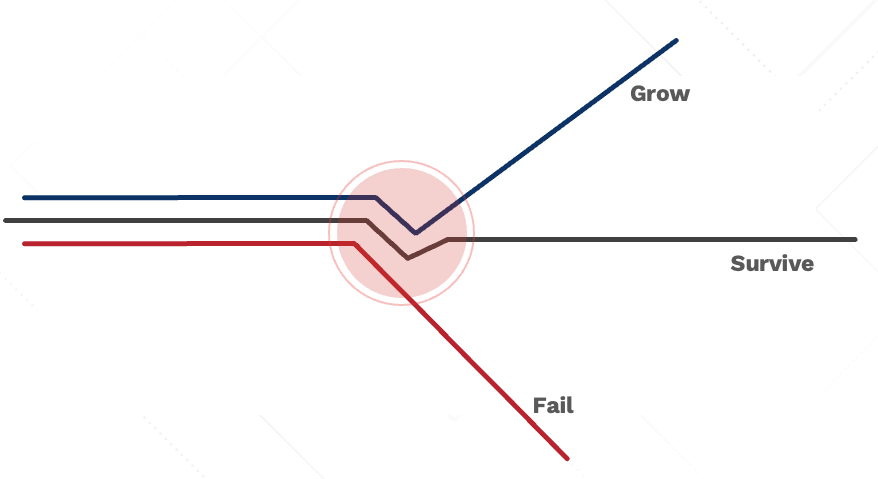
Some organizations fail. They are unable to recognize what is happening early enough to act, and they do not have the capabilities the situation demands.
Some organizations survive. They might be able to respond, but their actions are reactive, and performance is inconsistent. They meet the demands placed on them, but often at a significant cost in time, resources, and long-term impact.
And some organizations grow. They recognize the changes in their environment early, develop the capabilities their organization will need, and commit the resources in time to influence the outcome. As a result, they sustain performance under pressure and not only withstand the disruption, but also use it to improve, adapt, and strengthen their position for what comes next.
The difference between these outcomes is not determined at the moment of the incident. It is determined beforehand.
It is determined by the capabilities that were built, the standards those capabilities were developed to, and the discipline with which the organization prepared itself.
Preparedness does not guarantee success or eliminate uncertainty—but it does shape what is possible. It influences how quickly an organization recognizes change, how effectively it makes decisions, how well it coordinates action, and how long it can sustain performance.
These factors are established long before the moment they are needed.
The question is not whether the organization will face disruption, competition, or crisis.
They will.
The question is what version of the organization will show up when they do.
Preparing for an uncertain future requires more than awareness. It requires leaders to decide what capabilities will matter, what “ready” looks like, and to prioritize the work required to close the gap between the organization they have today and the one they will need tomorrow.
For leadership teams looking to put this into practice, The CP Journal applies this framework through a Left of Bang Strategic Briefing and advisory work focused on building preparedness as a capability.