

Welcome back to The CP Journal, where we break down what it takes to get left of bang.
When people reference “left of bang,” they usually think about the concept at the tactical level.
They think about the individual officer, soldier, or operator recognizing behavioral cues, detecting anomalies, and identifying threats before an attack occurs.
That interpretation is correct, but as I’ve learned throughout my career, it’s also only one part of the picture. Because the same idea that helps an individual detect danger before it unfolds can also apply to how organizations prepare and ready themselves for disruption.
The difference is that instead of behavioral cues, organizations are looking for signals in their environment—operational indicators, emerging risks, and early warnings that conditions are changing.
In other words, getting left of bang isn’t just something individuals pursue, but is something organizations can design into how they operate.
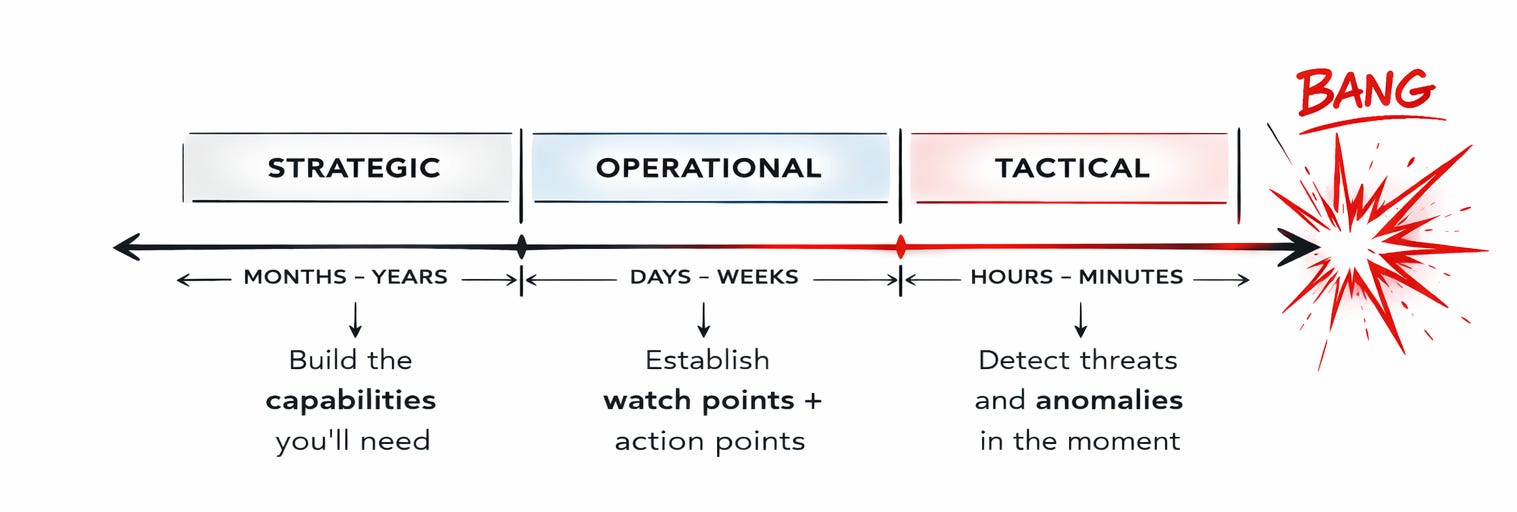
And when you start looking at preparedness through that lens, three distinct levels begin to emerge: tactical, operational, and strategic.
Each level operates on a different timescale and answers a different question about readiness.
Tactical: Detecting Danger in the Moment
At the tactical level, getting left of bang is about recognizing danger before it becomes unavoidable.
This level focuses on detection in the moment—identifying threats or anomalies before they fully unfold.
This is the level most people associate with the concept.
It is the officer recognizing pre-event indicators before violence occurs.
It is the cybersecurity analyst identifying abnormal network activity before a breach spreads.
It is the meteorologist recognizing atmospheric conditions that signal a severe storm is forming.
Across disciplines, the principle is the same: trained individuals recognize anomalies and act before the situation fully unfolds.
The tactical level is where situational awareness lives as it focuses on: observing the environment, recognizing indicators and anomalies, interpreting what those signals mean, and acting before the moment of impact.
When this works well, individuals are able to interrupt events before they escalate.
But this level alone has a limitation: it often depends on the skill of individuals rather than the design of the organization.
Operational: Creating Early Warning Signals
The operational level is where organizations move beyond relying on individual awareness and begin designing and building the systems needed to detect, decide and act earlier.
Instead of a single person recognizing a threat in their own domain, the organization establishes watch points and action points that help leaders understand when conditions are shifting and when those changes may begin to impact their operations.
These signals come from many places: intelligence or threat reporting, weather forecasts, supply chain disruptions, staffing shortages, infrastructure stress, geopolitical issues, or economic shifts.
But the purpose of operational readiness is not simply to observe signals and consume briefings. It is to connect signals to decisions.
Operational readiness systems answer questions like:
What indicators should we be watching?
Who is responsible for monitoring them?
At what point should leadership be alerted?
What actions should occur if those thresholds are crossed?
When organizations design these systems well, they move from simply being informed of potential issues to being able to act earlier.
This is where organizations begin deploying their capabilities before disruption fully arrives—adjusting posture, shifting resources, protecting operations, or pursuing emerging opportunities while there is still time to influence the outcome.
Operational readiness, in other words, is not about producing more briefings, but creating a structure that enables earlier decisions and action.
Strategic: Building the Capabilities You’ll Need
At the strategic level, getting left of bang looks even further ahead.
Instead of asking “what signals should we watch for?”, leaders begin asking: “what capabilities will we need before the next disruption appears?”
This level of readiness is about shaping the future rather than reacting to it. Strategic readiness involves:
Understanding the environment and emerging risks
Identifying the capabilities required to operate in that future
Prioritizing investments, training, and planning before the need becomes urgent
In this sense, the strategic level is about ensuring the organization will be ready when the next incident arrives.
This is where decisions about staffing, technology, partnerships, training and doctrine are made. And because those capabilities take time to build, this work must happen long before the moment of crisis.
Why This Matters
Most organizations believe they are left of bang because they train individuals well. But without operational and strategic readiness, they are often much closer to the moment of impact than they realize.
But being left of bang is not defined by how well individuals react to problems. It is defined by how early the organization begins making decisions before the problem fully arrives.
Understanding these three levels helps leaders step back and determine if they are truly focusing on and building at all three levels, or if they are over-emphasizing or over-allocating resources to only one of them.
Some organizations invest heavily in tactical skills—training individuals to recognize problems as they emerge. Others build plans and strategies, but never connect them to the operational signals that should trigger action.
It is rare to see organizations deliberately connect all three, yet when they do, they stop relying on luck, heroics, or hindsight. Instead, they begin operating with a deliberate ability:
Recognize change early
Adapt before conditions deteriorate
Build capabilities before they are urgently needed
In other words, they move further and further left of bang.
And the earlier an organization can operate on that timeline, the more options leaders have to influence the outcome.
Before You Go
Found this useful? Share it. Passing this along helps grow a community focused on staying left of bang.
If you want to go deeper, a paid subscription gives you access to advanced courses, playbooks, and exclusive leadership writing.
And if you’re working to strengthen how you get ahead of problems, before they become emergencies, that’s our work—from strategy and assessments to planning and exercises.
I have been kicking around an issue for a while. A short summary - we have technology that can analyze huge amounts of data really fast. Gives us cool, clean, pretty reports and analysis - hence the 5G infrastructure. The problem comes in when humans take days, weeks, months to make a decision - we still work at the 1 and 2G infrastructure. Staffs are not all equal, the decision maker is on leave, politics crashes the best of ideas. Left of Bang is a great process - but sometimes we are our own worst enemies.