

This article is part of Baselines & Anomalies, a series that examines events through the left of bang framework.
To receive new issues in your inbox, make sure you turn on notifications for this series.
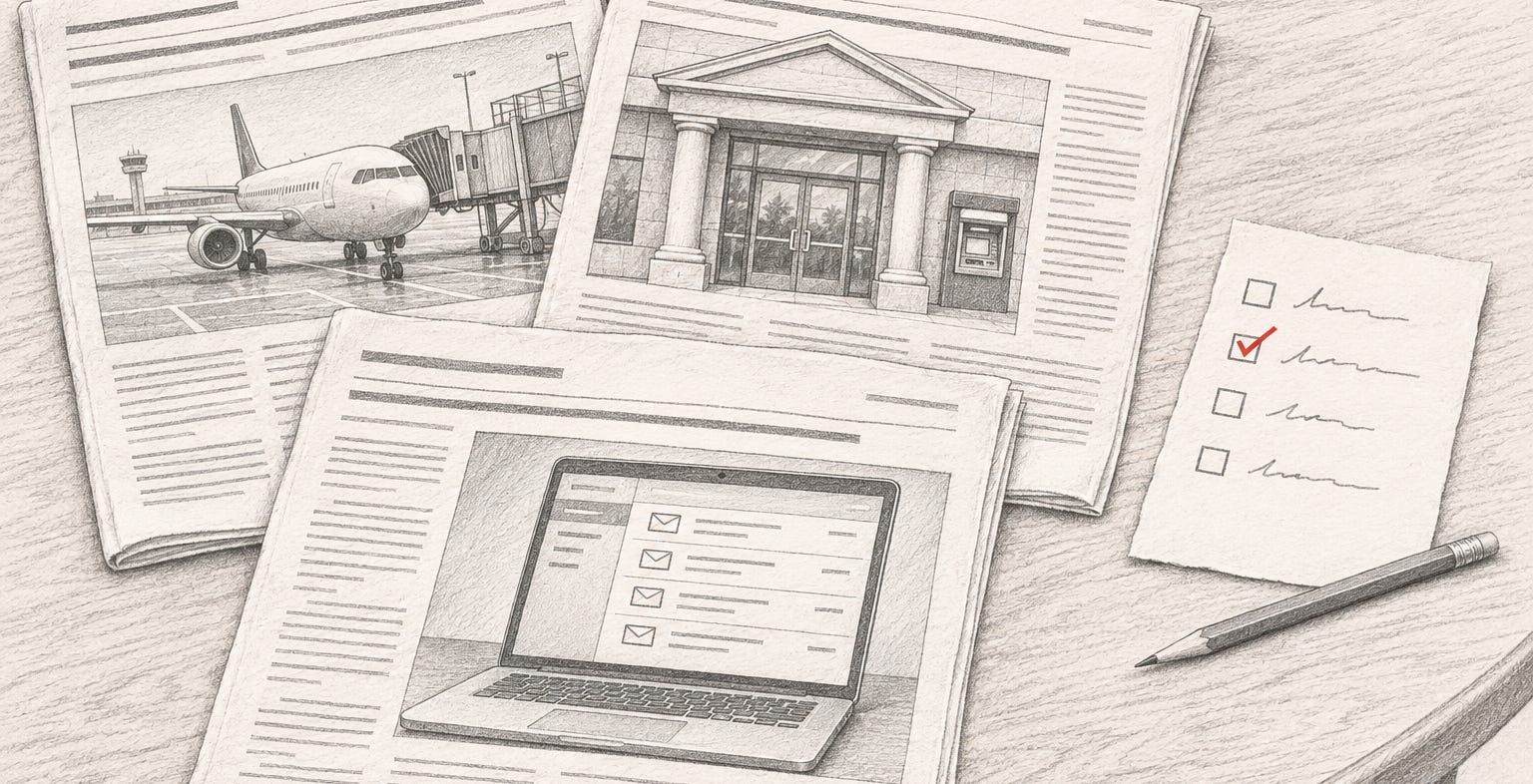
It has been a “dynamic” couple of weeks in the world of cybersecurity and technology reliability. You are likely well-versed in these now, but as a not-so-short recap:
November 12th: A global Microsoft 365 outage disrupted Outlook and Teams, leaving people unable to access email or join meetings.
November 13th: The FAA halted departures nationwide for nearly five hours after a failure in its communication network.
November 16th: JPMorgan Chase said a software bug delayed transactions, affecting customers at other banks. Note: on November 19th, they did disclose a cyberattack, but said it was distinct from the November 16th event.
November 16th: A system outage delayed United Airlines departures for about 90 minutes. A memo from the pilots’ union pointed to the system that calculates aircraft weight and balance.
November 17th: An internal network the National Security Agency (NSA) uses for classified communications went offline during what the agency described as scheduled maintenance.
November 22nd: Delta switched to manual workarounds after its automated weight-and-balance system malfunctioned. More than 1,000 flights were delayed that day.
Those outages landed alongside other headlines, forming the backdrop against which people were trying to make sense of them.
Belgian authorities were investigating a cyberattack that disrupted supermarket refrigeration earlier in the month.
American military bases were ordered to plan for 90 days without the grid at the end of September.
The European Union urged households to be self-sufficient for 72 hours in the event of a crisis.
Oh, and in the last couple of days, the FBI, the CIA, and the Department of Agriculture have all announced that they were hacked as well.
I recognize that a lot has already been written about this wave of outages and events. There have been questions and conspiracy theories. There has been coverage of people stocking up on household supplies and panic buying. And there has been outright dismissal of any suggestion that this is not normal.
But as I look back on this truly remarkable wave of events, I think there are three lessons that both public safety leaders looking to protect their community and individuals looking to protect their family can apply in the future.
Lesson #1: The View Through the Windshield is Different Than the One in the Rearview Mirror
When Chase and United ran into problems on November 16th, the Microsoft outage and the FAA ground stop were still fresh incidents. Someone paying attention saw that several systems that people rely on had failed in a matter of days, and you had to decide whether that was enough of a reason to do anything differently while the reports were still coming in.
We now have separate explanations for several of those outages, but on November 16th, those explanations were still coming in. Today, someone might look back and think that filling the pantry or keeping a little extra cash on hand was an unnecessary decision, but that is only a view that exists in the rearview mirror.
In disasters, there is a moment when options simply disappear.
In a flood, there is a period of time when you can evacuate your home and drive to safety, and then there is a moment when all of the roads are flooded and you can’t.
In a network outage affecting your bank, there is a period of time when you can easily withdraw your cash from an ATM, and then there is a moment when you can’t.
But you don’t actually know exactly when that moment is going to come. So at the time, the question was much simpler. If another service went down, would it create a problem for my family? And is there anything I need to do before that moment to keep it from becoming a problem?
If the banking outage made you realize you had no way to pay for groceries without a card, taking out a little cash while you could was a reasonable precaution. If your cards worked fine all week, you still had the cash. If you waited until you needed it, getting it might have been harder.
To judge the decision, go back to what you knew when you made it, what the precaution cost you, and what waiting might have cost.
This is an important part of getting left of bang. If every precaution you end up never needing feels like an overreaction, you might wait for more certainty the next time. But by the time you have absolute certainty about what is happening, you might simply be too late and not have any options left.
So if you took a precaution you’re now second-guessing, ask whether it made sense under the circumstances. Maybe you’d do something differently next time, but be specific about what you’d change. If the precaution was reasonable, give yourself some credit for taking it. I’d hate for the lesson you take from this to be that you should wait longer the next time something looks off.
Lesson #2: Pay Attention When People Start Acting Differently
During the outages, there was another change worth paying attention to. People were asking friends what they were doing to prepare, talking about what they were buying, and in some cases making an extra trip for supplies. You could see that people were doing things they wouldn’t ordinarily do, even if you were still catching up on the outages themselves.
In Left of Bang, we call this an atmospheric shift. We can’t see everything ourselves, so a change in how other people behave can be the first clue that they’ve picked up on a danger we’ve missed.
When people around you start acting differently, it’s worth asking what they might have seen that you missed. If a friend tells you they took out some extra cash, I’d ask what prompted them to do it. Maybe they had trouble making a payment that morning. Maybe they saw a post predicting a much bigger outage. I’d want to know whether they experienced the problem firsthand or merely heard about it, but if three friends send you the same text message, you’ve learned something about how widely the incident is circulating.
You still need to assess the situation for yourself, but seeing others react to a situation can be a valuable indicator that other people have recognized a potentially dangerous situation.
There’s another reason to pay attention to what people are doing, too. Their response can change what’s available to you. If enough people buy bottled water because they’re worried about a disruption, the store can run out while the tap is still working. You can see the effect of the shift in behavior while you’re still sorting out what started it.
I’d treat that kind of shift as a Watch Point. It’s a reason to spend a little more time figuring out what’s happening and whether it could affect you. You might check whether the disruptions you’re reading about are reaching your area, or ask someone what they’ve experienced firsthand. From there, what you do depends on what a disruption would mean for your household and how prepared you already are.
Two people can see the same shift and have good reasons to make different calls.
Lesson #3: Decide What Would Make You Act
Say you and your neighbor both hear that people nearby are having trouble paying for groceries because credit card readers are down. Your neighbor had enough food at home to get through the week. You were counting on stopping at the store that evening. You can both agree about what is happening and how long it might last, but your neighbor can afford to see how things go. You have a decision to make before dinner.
That’s one reason why I’d be careful about taking your cues from what other people decide to do. You rarely know what someone else already has on hand, what they’re responsible for, or how long they can afford to wait. When someone says they’re sitting tight, that might make sense for them, but you have to figure out what makes sense for you.
This is where Watch Points and Action Points can help. Reports about network outages might be a Watch Point for you to check whether the store you planned to visit is affected and what other options you have. If the store confirms it can only take cash, that might be your Action Point to use the cash you have on hand to buy what you need for dinner. The point of thinking through those thresholds ahead of time is that you’ve already decided what information would change what you do.
If you found yourself scrambling during the outages, think about what would have given you a little more room to wait. That’s one of the advantages of getting a little more prepared over time. The next time you see the same warning sign, you may have more time to figure out what’s happening because you’ve already taken care of the thing that would have made you rush.
Where Do You Go From Here?
When I think about the risk that outages like this pose, I start with two questions.
How likely is it that a service I rely on will be disrupted?
And what would happen to my family if it were?
When it comes to ensuring the reliability of a communications provider, the banks holding my money, or the FAA, there isn’t a whole lot I can do to affect the likelihood side of the equation. But the impact portion of the risk is something that I can, at a minimum, influence.
It doesn’t matter if the outage is caused by a deliberate attack from a nation-state actor or a software update that goes wrong—either can leave you dealing with the same immediate problem.
Our read of the operating environment heading into 2027 gives me reason to think this may be one of several stretches like this. We depend on a lot of systems to get through an ordinary day, and the way information travels can make it hard to sort out what’s happening while those systems are down. When we combine an evolving threat landscape, rapid changes in technology, a fractured media environment, a shifting workforce, and political priorities, there are many opportunities for small incidents to have global impacts.
If the past couple of weeks exposed a gap in your household’s readiness, start there. Pick one thing that would have made the disruption easier to deal with or given you more time to decide what to do. We wrote the Individual Readiness Playbook to help our subscribers work through those decisions and build your capability a little bit at a time.
