

This leadership essay is for paying subscribers to The CP Journal.
There is an organizational readiness equivalent to the myth that “if you build it, they will come.”
The myth appears when organizations invest significant time, money, and effort into launching new programs, buying new equipment, or training their teams. And it comes from an understandable assumption: if an organization becomes better at doing something, then it should be able to achieve better outcomes because of it.
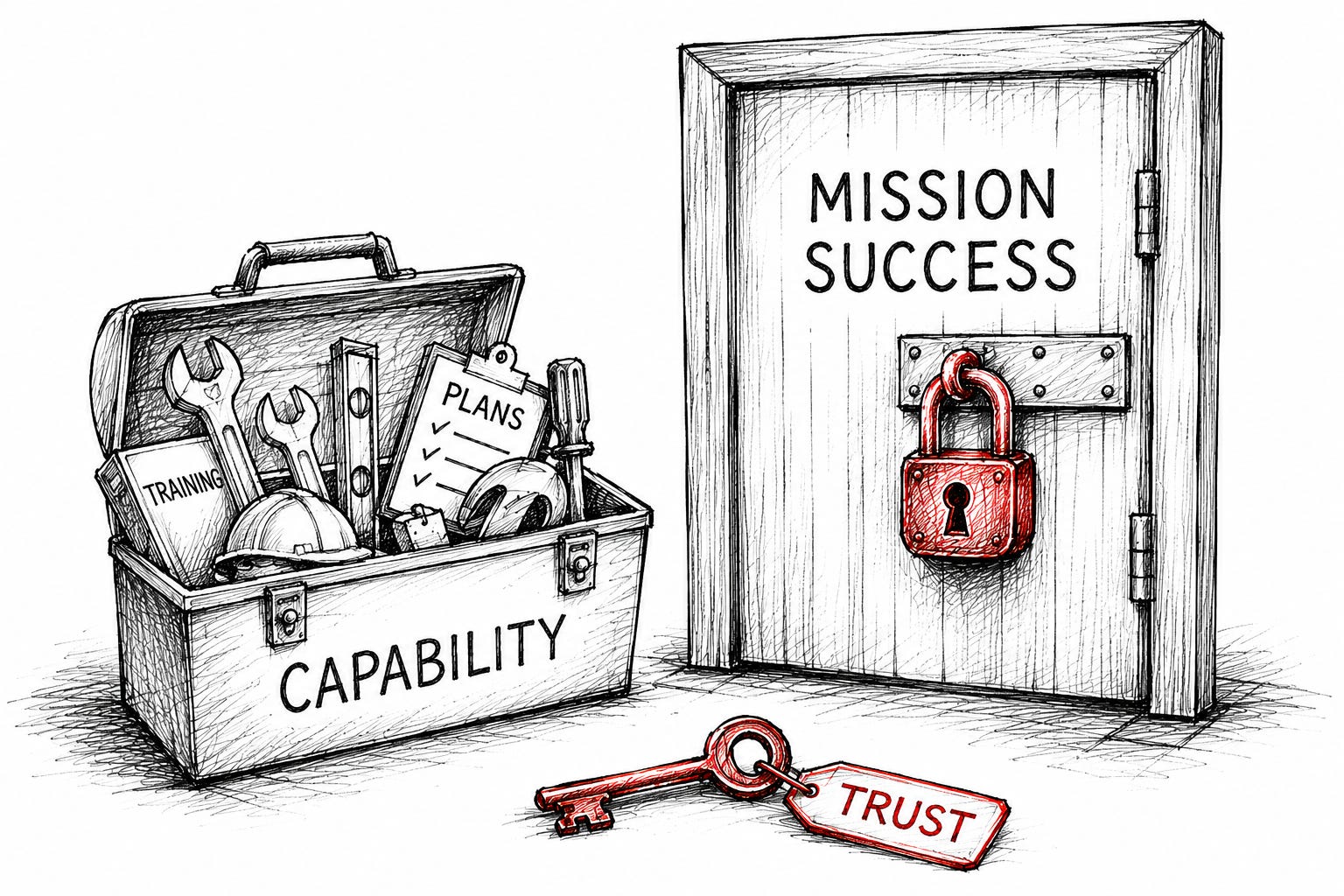
Yet organizations routinely discover that having a capability—the combination of people, plans, skills, and resources that allows an organization to do something well—and being able to use it are not the same thing.
Reader’s Note
After drafting this essay, I realize I’ve used the word capability a lot.
If you’re new here, think of a capability as any function that is critical to your organization’s success.
In public safety, this could be evacuation, alert and warning, emergency communications, or structure fire suppression.
In business, this could be business development, supply chain management, recruiting, or customer service.
Simply put, a capability is something your organization needs to do well. If you want to learn more about what goes into a capability and how to assess one, I recommend you start with our white paper, “Preparing the Organization You Will Need.”
The reality is that many capabilities never reach their full potential. Sometimes they are used only sparingly before being abandoned. Other times, organizations find that the very people they intended to help with their capabilities ultimately resist, reject, or undermine the use of something developed for their benefit.
Why does that happen?
Part of the answer is that success in public safety and security is determined externally. Organizations can develop expertise, acquire equipment, and write plans—all of those things are within their control—but if the people they are responsible for protecting do not trust them enough to accept, or support, or cooperate with the use of those capabilities, then much of that investment becomes an unrealized promise.
So here is my premise for this essay: capabilities do not exist in a vacuum.
Their effectiveness depends on the environment in which they operate. They require legitimacy, trust, and public cooperation to function, and that trust must exist in both the organization deploying the capability and the capability itself.
I have chosen to write this as a leadership essay because preparing an organization for the future is not simply a matter of building the ability to do something well. It also requires preparing the environment in which that capability must operate.
Said another way, if leaders are responsible for ensuring the capabilities they invest in are usable, then they are also responsible for helping create the conditions that allow those capabilities to succeed when they are needed the most.
Few examples illustrate the relationship between capability and trust more clearly than the current Ebola response in the Democratic Republic of Congo.