

Welcome back to The CP Journal, where we break down what it takes to get left of bang.
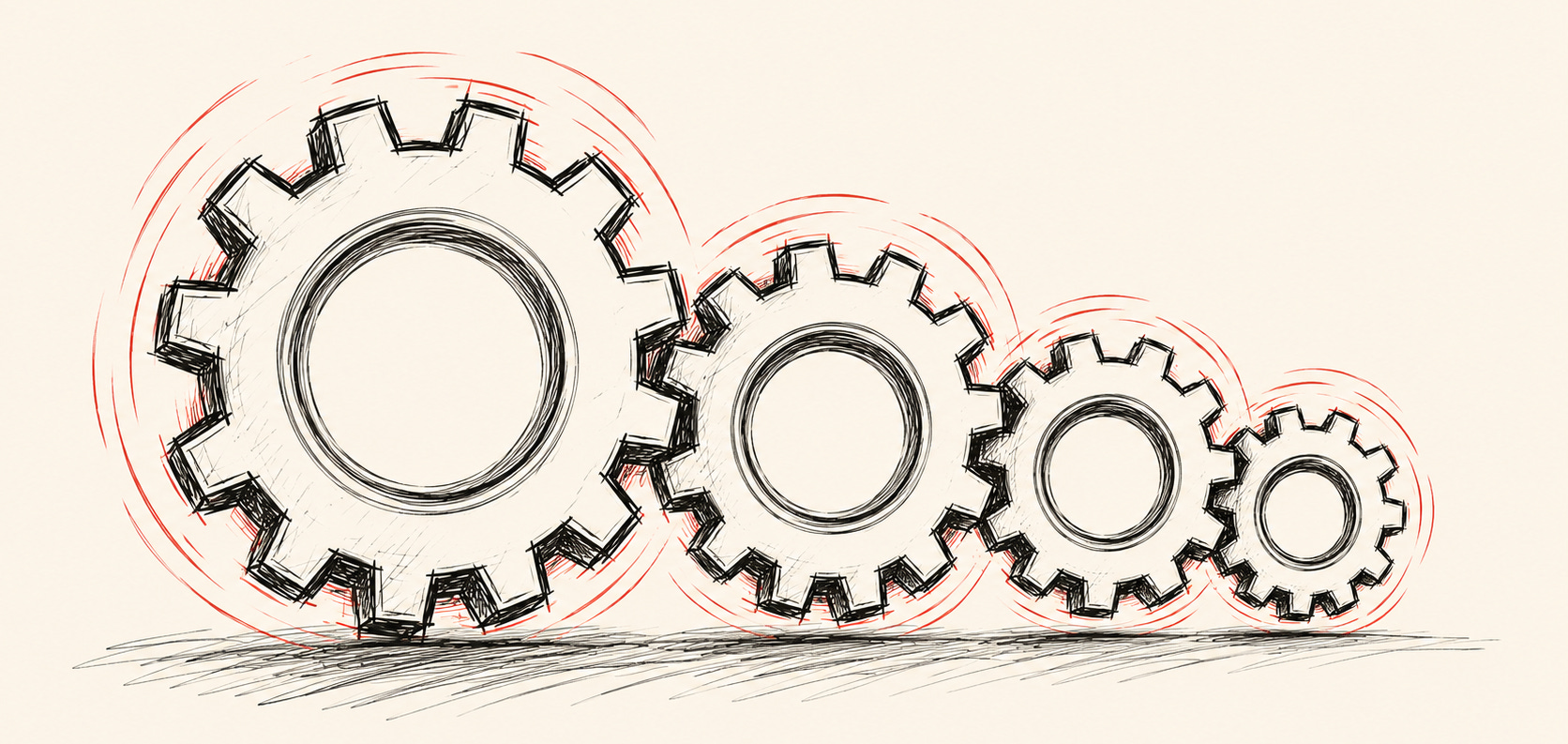
I had a commander in the Marines who taught what he called his “gear theory” of leadership.
His idea was simple. Every person in an organization is a gear and their role determines the size of their gear. The commander at the top of the org chart is a very large gear and turns relatively slowly.
Each level below him on the organizational chart is a smaller gear, which has to spin progressively faster just to keep pace with him. By the time you reach the most junior Marine in the unit, that gear is spinning at a sprint—even if the commander doesn’t feel like he’s moving particularly fast.
Even though people will adapt to almost any baseline operating tempo in time, his lesson was about what happens when the commander changes how fast his gear turns.
Every time a leader suddenly accelerates, every gear beneath them has to accelerate even more to keep pace. A small increase at the top becomes a much larger increase at the bottom of the organization and it creates this pattern of sudden spikes in the work and effort of the organization.
As a leader, if you do that often enough or do it without warning, eventually the gears in the organization begin to break as they are unable to keep up. The people represented by those gears make mistakes or choose to disconnect from the system altogether, counteracting many of the gains the organization has made.
His point was, even though you can’t always prevent that spike in work from happening, as a leader, you need to be aware of it and understand the impacts that sudden changes in pace have on a team.
I’ve thought about that lesson many times over the years, but it’s been coming to mind more and more often recently. The environment we work in is becoming increasingly more demanding. Every week seems to bring another new vulnerability, another threat to evaluate, another new technology to understand, and another expectation to meet.
What this means—in practice—is that organizations are not only experiencing a higher baseline operating tempo, but also a non-stop set of spikes in work. This is taking a toll on the people leading these organizations and the organization’s ability to prepare for an uncertain future.
Here’s my premise for this essay: as the pace of required adaptation increases, the ability to absorb change and adapt to new threats and hazards will be what separates organizations that emerge stronger from those that break.
Doing that requires organizations to build three distinct capabilities to keep the organization’s gears spinning at pace that both matches the demands of the environment and is sustainable to continue changing in the future as well.
Let’s get into what those are.
The Three Capabilities
Every time an organization successfully adapts to a new threat, vulnerability, or expectation, it completes the same basic cycle.
First, someone has to recognize that a gap or vulnerability exists.
Second, someone has to develop a solution that addresses the issue.
Third, that solution has to spread throughout the organization and be adopted by people who were never involved in identifying the problem or developing the solution.
Those three steps sound almost too simple to write down, yet organizations routinely face the consequences of failing to complete the cycle.
When a vulnerability isn’t recognized, organizations continue operating as if nothing has changed and with a false sense of security.
When a solution can’t be developed, organizations are left with open vulnerabilities to known problems.
When a solution is never implemented, the organization has done little more than build a good idea that sits on the shelf.
Regardless of which capability isn’t functioning, any failure to complete these three steps creates the same outcome: the organization remains exposed.
So, for leaders focused on moving their organizations further left of bang, recognizing which of these three capabilities is limiting adaptation in their organization becomes one of the most important questions they can ask.
You can see this cycle in cybersecurity.
While recording this week’s episode of Baselines & Anomalies, I looked at CISA’s directive to shorten the time federal agencies have to address high-priority vulnerabilities. Agencies that once had two or three weeks to deploy a patch now only have three days.
Someone has already identified the vulnerability, and the technical problem has already been solved with a patch. And then the race begins.
Can the update reach thousands of devices before attackers exploit the vulnerability? Recognition and solutions matter, but in this case, implementation determines whether the organization actually becomes more secure.
You can see this cycle in physical security.
In last week’s briefing, we shared an article describing Boko Haram’s use of AI tools to modify motorcycles so fighters could jump over defensive trenches that had stopped them during an earlier attack in Nigeria.
Whether those efforts were identified through intelligence or first became known after the reporting doesn’t really change what comes next. The organization responsible for defending against that threat must recognize what changed, determine how to respond, and ensure every location adopts the new defensive measures before the next attack occurs.
Any delay in developing the solution leaves the vulnerability open.
There are countless more examples we could analyze, and even though the names, threats, and environments all change, the cycle doesn’t.
As I wrote this essay, I was reminded of my interview with Blake Paris, who argued that security professionals need to become marketers.
I don’t believe he meant that they need better advertising skills, but that good ideas or insightful observations rarely improve security on their own.
Unless security professionals can persuade and influence the rest of the organization to invest in addressing them, the process stalls long before the organization becomes more secure.
Building Organizations That Can Keep Up
While understanding this cycle is relatively easy, building an organization that can complete it over and over again is where leadership becomes critical.
In my experience, I’ve found that different people gravitate toward different parts of this process. Some people are naturally skilled or interested in recognizing emerging problems, others know how to build solutions, while others have learned how to communicate, organize, and drive implementation across a large system.
But organizations only become more ready and more resilient when all three capabilities work together. Strength in one area can never compensate for weakness in another.
Recognition without solutions changes nothing.
Solutions without implementation accomplishes nothing.
And the ability to implement without the ability to recognize gaps produces nothing.
Ensuring that all functions can perform—and perform well together—is where leadership comes in. Building the ability to do this is rarely automatic, so leaders need to choose where to invest their time, money, and effort to ensure their organization can do all three.
Since each function depends on the same foundation, the process to determine the greatest need can be done consistently. You need people with the right skills, plans and processes that ensure effort is applied productively, sufficient resources, and regular validation that everything works before it’s needed.
These investments often feel expensive because they are made before anyone knows exactly when they’ll be tested, but they determine whether the next identified gap becomes a manageable adjustment or another organizational fire drill.
My point is that leaders can’t control how quickly the environment changes, but they can control whether their organizations are prepared to adapt when it does. And increasingly, that may be the difference between organizations that simply survive change and those that emerge stronger because of it.
Before You Go
Know someone responsible for helping an organization prepare for uncertainty? Share this newsletter with them.
Go deeper with a paid subscription for advanced courses, playbooks, and full podcast episodes.
Ready to strengthen your organization’s readiness? Active Analysis Consulting helps organizations improve decision-making, operational capability, and preparedness.