

Welcome back to The CP Journal, where we break down what it takes to get left of bang.
When major incidents happen in other cities or to other organizations, how does your leadership team determine whether you need to take action or prepare from something similar?
It doesn’t matter whether I’m speaking with police and fire chiefs, corporate security leaders, emergency management directors, or anyone else—this is one of my favorite questions to ask during readiness interviews.
I’m curious about the answer because, in the environment we work and operate in today, there is no shortage of significant incidents to learn from. The news is unrelenting with reports on new and emerging threats and hazards. There is a nonstop feed of stories about incidents that could have been handled better, along with continual commentary about what a recent incident reveals about the future.
Sometimes, leaders are confronting something genuinely new, though other times it is an old risk that has returned because previous safeguards have eroded, assumptions have changed, or people have simply stopped paying attention to it.
But it is a question that has never not been answered. Every leader has a system they can describe, even when they have never intentionally designed the process.
It doesn’t mean that all the systems are good ones or all of the answers reveal truly effective processes—and the people I’m interviewing are usually the first to provide that assessment—but part of being an executive is learning about incidents and then answering the question: what are we going to do about it?
Leaders have to answer that question first for themselves, then to the people they report to, and finally to the organization they lead. And it’s a gnarly challenge because it requires leaders to separate two important, but distinct capabilities:
First, they have to become aware of emerging threats, hazards, and disruptions and determine whether those developments pose enough risk to warrant action.
Then, they have to decide what to do about them—and turn that decision into meaningful improvements in their team’s readiness.
But that is the expectation for leaders today. They are responsible for learning from incidents that occur elsewhere, anticipating how changes might affect their own communities or organizations, and making improvements—sometimes with limited or decreasing resources.
It is a complex problem, but it is also a left of bang problem.
Organizations that don’t go through this process remain reactive and only change after something bad happens to them. Because that outcome is becoming increasingly unacceptable, it requires leaders to continually improve how they first recognize and assess changes, and then decide and act.
For now, I want to focus on the second part of that process because recognizing a threat early is only valuable if your organization can do something with that awareness. In my experience, the organizations that do this well view the ability to prepare as a critical capability.
Why Preparation Has to Become a Capability
There are three reasons why preparation needs to become a repeatable organizational capability.
The first is that, after recognizing a new or emerging threat, you probably don’t know how much time you’ll have to prepare for it. Often, it is only in hindsight that the moment a threat becomes real is clearly determined.
But when looking forward in time, leaders rarely receive a warning with a clear date and time attached to it. So being able to prepare quickly and effectively might be the difference between a completed project and an unresolved issue when the bell rings.
The second reason why preparation needs to become a capability is because the volume and velocity of the threats, hazards, and disruptions organizations are dealing with is very high at the moment.
I talked about this in Episode #3 of Baselines & Anomalies, where we looked at the avalanche of issues leaders had to assess in July. If there is always something new to improve, then organizations need to be able to assess an issue, make a decision, improve their readiness, and close out the project so they can turn to the next problem.
In a slower and more predictable environment, organizations might be able to address one major threat at a time and allow preparation to follow a seasonal rhythm, but that approach doesn’t hold up in an environment defined by volatility and uncertainty. You cannot build a new preparedness process from scratch every time the world changes. You need an organization that already knows how to prepare.
The third reason to develop your organization’s ability to prepare is that the harder it is to make a change, the more that difficulty influences the decision about whether to change at all. I discussed this in this week’s episode of Baselines & Anomalies, where we assessed the risk posed by changes to Substack’s platform.
Moving a website—at least our website—is not easy for us. It takes time, disrupts our work, introduces new costs, and is generally a pain. That means the difficulty of moving platforms has to be considered when deciding whether a change is significant enough to warrant action. The action threshold, for us, becomes higher because the response is expensive.
The same principle applies to preparation. If developing a new plan takes 18 months, if procurement is cumbersome, if training is created from scratch every time, and if organizing an exercise requires a heroic effort, then leaders will naturally wait for a high degree of certainty before acting.
But if preparation is a well-developed capability, leaders have more options. They can confidently make smaller improvements earlier and take incremental actions. They can test assumptions without committing the entire organization to a massive project. They can reverse course if the threat develops differently than expected.
Developing the ability to prepare changes the decisions the organization can make.
How Do You Build Preparation as a Capability?
Preparing as a capability means your organization can identify what must improve, determine what will produce the greatest readiness gain, complete the work using the resources available, and validate that the change produced the intended result. It is the repeatable process used to build and improve everything your organization does.
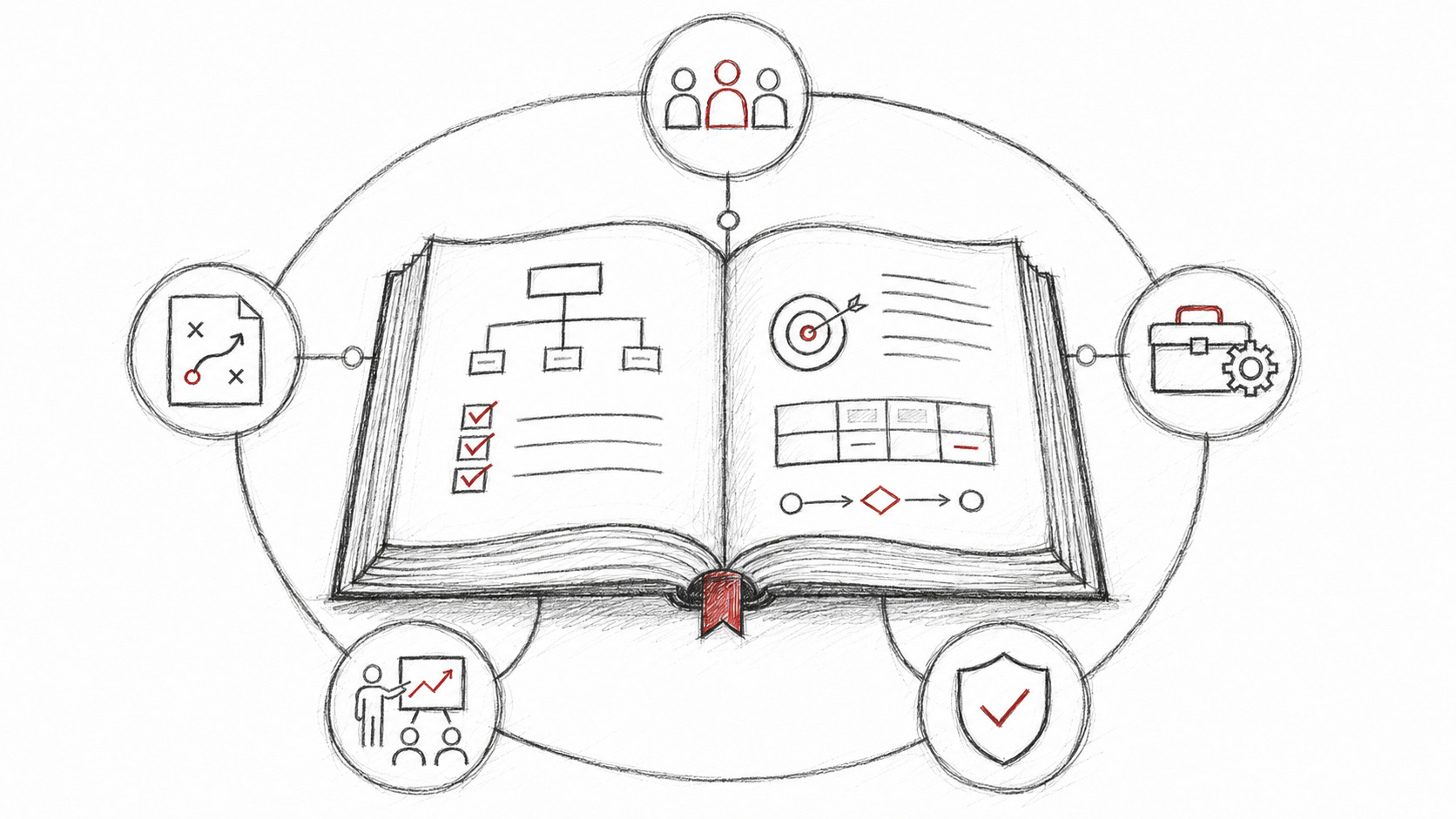
One way to institutionalize this ability in practice is to build your organization’s modern-day Blue Book. The original Blue Book was developed by Baron Friedrich von Steuben—my spirit Prussian Army officer—after he arrived at Valley Forge and helped turn the Continental Army into a fighting force capable of defeating the British. The Blue Book codified his training principles so they could be taught, repeated, and embraced across America’s new military as it continued to grow.
Today, your Blue Book probably isn’t a physical book, but rather a wiki, an internal playbook, or a collection of repeatable processes that explains how your team prepares.
It can establish things like:
How new threats, hazards, and lessons enter your decision-making process.
How you define readiness performance targets, assess your capabilities, and identify high-priority gaps.
How preparation and readiness projects are selected, scoped, assigned, managed, and completed.
How plans and procedures are developed and maintained.
How staff, volunteers, and partners are recruited and integrated.
How resources are procured, developed, and maintained.
How training is built and delivered, and how exercises are conducted.
Most importantly, it should reflect how you prepare, based on how you operate during a crisis or disruption. From that foundation, you can build your team’s capacity for continuous improvement. You can teach people how preparedness work gets done, validate their ability to do it, identify friction, and improve the process one repetition at a time.
This is also where adaptation comes from.
Instead of relying on herculean efforts from your team or improvising a new process every time something changes, you build the routines that allow the organization to change deliberately.
This is the work that follows every meaningful change your organization identifies—whether it is a new threat, an operational lesson, a technology shift, or a change in the environment you work in. Don’t leave it to chance. Preparation is one of the two critical elements that allow an organization to capture the left of bang advantage, so build the muscle now.
Which brings me back to the question I ask leaders when something significant happens somewhere else: If your organization needs to change in the future, can it? Is it ready to?
While You’re Here…
Recognizing a readiness gap is only useful if your organization can turn it into completed work. The Project Execution Playbook provides a repeatable structure for scoping, assigning, executing, and closing preparedness projects. We’re continually adding more to this playbook, so give it a look.