

Welcome back to The CP Journal, where we break down what it takes to get left of bang.
I don’t think it is controversial to say that “things are changing” in the world. Technology is changing. The threats and hazards that organizations face are evolving. Politics, budgets, the workforce, the way people communicate, and what they expect from organizations all seem to be in a continual state of flux.
But saying that “things are changing” isn’t particularly helpful either. When I think about the conversations we’ve had with our clients, even though I can’t think of a time when there was a debate about whether change was occurring, I can think of many times when the leader was trying to figure out what they should do about it.
I’ve found that it can create a sense of anxiety for leaders trying to decide what needs to change for their teams and organizations.
Make a change too early and you might spend money, consume staff capacity, launch projects, and disrupt things that are working in order to prepare for a future that never arrives.
Wait too long and you may discover that the plans, skills, technology, staffing, or organizational structures that worked in the past are no longer good enough.
There isn’t a single, universal answer that can make it easier for leaders to decide what the priority should be or where limited resources should go. What an organization needs to do to prepare for the future is unique to them.
This challenge becomes harder still when you realize a lot of people struggle to explain what they are seeing. You can have a sense that the operating environment is changing, but if you don’t have a shared vocabulary for describing it, then it is difficult to explain why something matters, compare observations with other people, challenge assumptions, or build a shared understanding of what the organization should do about it.
I think leaders often experience this uncertainty as a forecasting problem: “If I could just figure out what is going to happen, I would know what to do.” But I think it is better understood as an orientation problem.
You don’t need to know exactly what the future will look like, but you do need a way to understand the environment you are operating in, recognize when something important is changing, talk about those changes with the people around you, and determine what they might mean for what you do next.
That is how we begin getting left of bang to those changes.
In this briefing, I’m going to introduce the six elements I use to assess the operating environment and the practice I use to continuously make sense of how those elements are changing. Then we’ll take that understanding one step further and look at how to turn observations about change into decisions about what you and your organization should actually do about them.
If you’re into this, buckle up because this week’s briefing is not short.
The Need to Anticipate & the Snake Oil of Prediction
The underlying premise to everything that follows is that getting ahead of the changes in our operating environment requires us to do something before their impacts fully arrive. We might need to build a new capability, develop our workforce, invest in technology, change a plan, or position our organization differently.
Every investment in capability is implicitly a bet about the future. We are making a judgment that something will be important enough tomorrow to justify spending time, money, attention, or credibility on it today. That means that getting left of bang requires some degree of anticipation.
Without it, we would be closing our eyes, spinning around, and throwing darts. We might hit the bullseye every billionth time, but we would more likely miss the dartboard altogether and probably hurt someone. Mostly, we would waste a lot of darts.
So we need to think about what may be ahead, but there is an important distinction between anticipation and prediction.
Anticipation considers possibilities and prepares for them.
Prediction claims to know what will happen.
Every minute I spend on the internet makes me increasingly wary of the second.
There is an enormous market for people willing to tell us what the future will look like. It has existed since the beginning of time. People will tell you where the economy is headed, what AI will do to your profession, which country will go to war, what political event will change society, which technology will make your business obsolete, or what crisis is coming next.
The more confidently they say it, the more compelling it can become. But it’s worth remembering that the prophet has the opportunity to profit. Fear and certainty can get attention and build audiences. That attention can bring them money, or influence, or power, or create dependency with their audience.
That doesn’t mean every person making a prediction is consciously manipulating an audience, but we should be skeptical of the incentives at play when someone claims to know what is coming. We should question it further when fear, certainty, and continued attention benefit the person making the claim.
There is no crystal ball. No one secretly has access to the future and is generously sharing what they saw there with the rest of us. If they did, I have a hard time believing their first choice would be to post about it on social media or explain it on cable news.
Still, I understand why we listen.
If you’re responsible for preparing an organization for what comes next, having someone else hold the flashlight is incredibly appealing. There can be a sense of relief to have someone tell you where to look, what to worry about, and what to prepare for. And if they’re wrong, you weren’t the only one who got it wrong. You followed the expert. You followed the forecast. You followed what everyone else believed was coming.
I recognize that defensibility can be important when your decisions consume real money, affect people’s careers, change organizational priorities, and put your own reputation on the line. The problem, however, is that prediction doesn’t actually give us certainty. At best, it only gives us the perception of certainty.
And when we become dependent on someone else’s predictions, we also give up our agency. We allow someone else to decide what deserves our attention, which changes matter, what we should fear, and ultimately which future we should prepare for. I don’t know many leaders who are truly comfortable giving that power away.
The goal is to regain our agency over this process. Instead of asking someone else to tell us what is going to happen, we can become better at understanding the environment we are operating in, noticing how it is changing, and determining what we are going to do about it.
We don’t need someone else to hold the flashlight for us. We need to get better at seeing for ourselves. And that starts by defining the operating environment in a way that allows alert and reflective observers to identify the changes that are important to them.
The Six Elements of the Operating Environment
If we are going to get better at seeing for ourselves, we need some structure for what we are looking at.
An operating environment is too complex to take in as a single thing. There are too many forces, too many variables, and too many changes occurring at the same time. Without some way to break it apart, almost everything can feel important—or nothing does.
I’ll acknowledge up front that there are already plenty of frameworks for doing this. Military planners use models such as METT-TC and ASCOPE. Businesses use tools like PESTLE, SWOT, and Porter’s Five Forces. Even though each was developed for a purpose, and each can be useful for the problem it was designed to solve, none of them met what we needed for the left of bang framework.
We needed a practical way to identify the parts of the operating environment that are most likely to change what an organization needs to notice, decide, or do. And we needed to see those changes clearly enough to understand what they might mean.
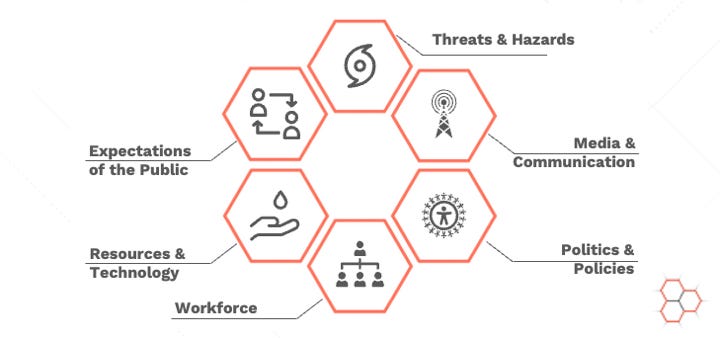
Today, we frame the operating environment around six elements:
Threats & Hazards. The natural, technological, human-caused, and organizational risks that could disrupt operations, cause harm, or create consequences for the organization and the people it serves.
Media & Communications. The information environment surrounding the organization and its operations, including how information is created, shared, received, interpreted, and amplified through traditional media, social and emerging media, internal communications, and other channels.
Resources & Technology. The resources, systems, infrastructure, equipment, technology, financial capacity, or external services the organization depends on to operate.
Community or Customer Expectations. The needs, expectations, behaviors, priorities, and perceptions of the communities, customers, stakeholders, or populations the organization serves.
Politics & Policies. The laws, regulations, policies, authorities, political priorities, leadership decisions, and broader governance environment that enable, constrain, or influence what the organization can and is expected to do.
Workforce. The people required to operate the organization, including staffing, availability, skills, experience, morale, retention, recruitment, and other factors affecting the workforce’s ability to perform.
Even though these six elements don’t have the necessary vowel to turn them into an acronym—a significant limitation—the labels don’t require much translation before people can begin using them. A police chief, hospital executive, emergency manager, business owner, or nonprofit leader can all understand what we mean when we talk about workforce, technology, community expectations, or policy.
That simplicity is intentional because we want a framework that can be used continuously, not just during a strategic-planning session or a formal assessment. We wanted something that can help us or someone else read an article, sit through a presentation, hear an observation from a team member, or watch a tech demo and ask: Does this represent a change we should take note of?
The six elements are also better thought of as lenses. AI, for example, may first look like a “Resources & Tech” issue. But it can also change the workforce by altering skill requirements. It can affect “Media & Communications” through synthetic content and misinformation. It can change customer expectations about speed and service, create new threats, and drive new political or policy decisions.
I don’t want to spend any time deciding or debating which box AI belongs in, but I do want to examine it across the parts of the operating environment that are important to us. Over time, these six elements help us establish the baseline—your developed understanding of current and expected conditions—for our operating environment and make it easier for us to notice the changes that can affect us.
And once we are able to recognize those changes and talk about them in a way that lets us understand them, we can begin asking the question we actually care about: What, if anything, should we do about it?
Why Start Now
If the goal is to recognize a change in the operating environment early enough to do something about it, we do need to talk about timing.
Everything that goes into getting left of bang takes time. Recognizing the change, assessing whether it matters to the organization, deciding what to do about it, and actually implementing that decision—building a capability, completing a project, changing a process, hiring someone, buying technology, training a team—all require time. And it all has to come from somewhere.
As we discussed in Briefing #85, the amount of time your organization needs to go through those steps determines how far left you need to begin.
If your organization has developed these abilities and can move through the process quickly, you can wait for more information before acting.
If it takes your organization months or years to make and implement a meaningful change, you cannot necessarily wait until everyone agrees about what is happening, and may have to make the decision while the signals are still weak.
That is why the time to build this practice is before you need it. The goal isn’t always to make every decision earlier, but to get better at completing the Recognize → Assess → Decide → Act sequence fast enough to act while you still have options.
You now have the six elements to help determine what to watch. The next step is building the practice that helps you consistently determine what matters and what you do about it.