

Welcome back to The CP Journal, where we break down what it takes to get left of bang.
One of my favorite parts of my job is interviewing executives about how they are getting their organizations left of bang and preparing them for an uncertain future. I learn something in every conversation because each organization and leader approaches this pursuit in slightly different ways.
And yet, even with those differences, there are clear patterns that emerge.
These patterns show up in how organizations think about preparedness—whether they believe it’s even possible, how they pursue it, what they prioritize, and what tradeoffs they’re willing to make along the way. Over time, those decisions shape how the organization actually operates.
Which means that when the question comes up—how do we move left of bang?—the answer depends heavily on where the organization is starting from, and whether they can see it clearly or not.
The challenge is that most teams don’t have a shared way to describe that starting point.
People use different language to describe their organization’s level of readiness and how they build it. They’re drawing from different incidents, different experiences, and different goals. As a result, people often talk past each other—not necessarily because they disagree, but because they’re operating from different models of what preparedness actually is.
Most organizations are doing a lot of work in preparedness. Far fewer can clearly describe what that work is actually building. This is a challenge we explore in more detail in our white paper, Preparing the Organization You Will Need.
What we’ve found is that once teams can name and see those patterns clearly in their own organization, they can begin to establish a baseline for where they are, and from there, make deliberate decisions about how to move forward.
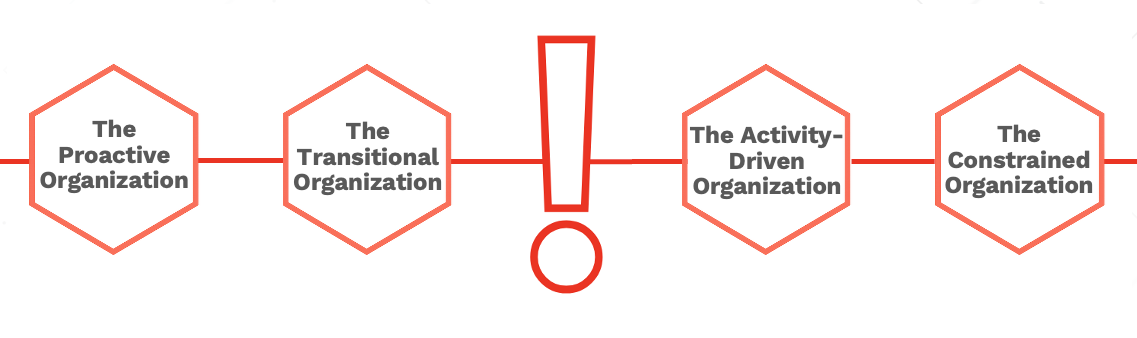
To help with this, we use a simple diagnostic built around four common organizational personas.
These personas aren’t labels—they reflect patterns of behavior we’ve seen repeatedly across organizations. Once a team can recognize which pattern they are operating in, it becomes much easier to understand what’s actually driving their preparedness decisions and what they should do to move further left of bang.
Here are the four personas:
Persona #1 | The Activity-Driven Organization
This organization is consistently busy with preparedness work. Plans are being written and updated, training is being conducted, exercises are being run, and new resources are being acquired. When gaps are identified, they are usually acted on quickly.
This organization sits just to the right of bang on the timeline because preparedness work is selected based on visible needs, emerging issues, or recent problems. Over time, this creates a steady flow of activity across many areas, though not necessarily progress towards defined outcomes.
What defines this organization is not a lack of effort but a lack of direction. There is strong agency: when something needs to be done, the organization moves. But that work is not consistently guided by a defined set of capabilities or performance expectations.
As a result, it is difficult to determine whether all of this effort is improving readiness in a meaningful way. Activity accumulates, but progress is hard to measure, and often assumed rather than demonstrated.
You’ll hear this:
“We do a lot of training and exercises and coordination.”
“We’ve been working on that.”
“We identified that gap and addressed it.”
“We’re busy—we’re doing a lot right now.”
“We’ve made a lot of improvements over the last few years.”
What it takes to move forward:
This organization already has energy and initiative. The shift is not about doing more—it’s about becoming more deliberate. If everything is a priority, you’re not being proactive—you’re being responsive at a higher tempo.
Progress begins when the organization starts clearly defining the capabilities it is trying to build and uses those to guide decisions about where to invest time and effort. Without that clarity, activity continues, but direction remains diffuse, and the organization stays anchored in place, even as the volume of work increases.
Persona #2 | The Constrained Organization
This organization’s preparedness efforts are shaped by operational demands and perceived limitations. Most time and attention are consumed by day-to-day responsibilities, leaving little space for sustained improvement.
This organization sits far to the right of bang on the timeline because preparedness is driven almost entirely by reaction and immediate demands. Preparedness activities occur intermittently—often when required, when time allows, or after an incident—rather than as part of a consistent effort to improve over time.
What defines this organization is not a lack of awareness, but a lack of agency. Leaders understand what should be done, but do not believe they have the ability to consistently act on it within the constraints they face.
Staffing limitations, workload, and competing demands are experienced as fixed conditions. Over time, this creates a learned realism about what is and isn’t likely to stick, and preparedness becomes something that must fit within the system, rather than something the system can be shaped to support.
You’ll hear this:
“We just don’t have the time.”
“We’re going from one thing to the next all day.”
“We know we should be doing more, but…”
“Every time we start something, something else takes priority.”
“That’s just the reality of how this job works.”
“We’ve tried things before, but they don’t stick.”
What it takes to move forward:
It would be easy to look at this organization and assume something is wrong—but in many cases, they are describing a real set of constraints. Staffing limitations, operational demands, and competing priorities are not abstract—they are experienced daily.
The shift begins with recognizing that improvement is possible within those constraints—not outside of them.
Progress does not come from adding more work, but from creating a simple, repeatable way to focus limited time and attention on what matters most. Early movement often comes from small, visible changes that demonstrate the system can, in fact, be influenced.
Persona #3 | The Transitional Organization
This organization is actively trying to shift from a reactive posture to a more proactive one. Leaders recognize the limitations of focusing only on past incidents and are beginning to look ahead to future risks and demands.
This organization sits just to the left of bang on the timeline because it is beginning to prioritize future conditions and emerging risks, not just past events. At the same time, because this shift is occurring while still managing day-to-day operations, leaders face a constant pull back toward reactive work.
Preparedness efforts include both maintaining current operations and exploring what may be needed next. Some structure exists—key people are involved, conversations are happening, and initiatives are underway—but the approach is not yet fully defined or consistently applied, and progress can vary depending on who is leading it.
You’ll hear this:
“We can’t just keep reacting.”
“We’re trying to get ahead of this.”
“We’ve been talking about that more.”
“We’re starting to look at what’s happening in other places.”
“We’ve got the right people involved—we just need to structure it better.”
“We’re doing some of this already, just not consistently.”
What it takes to move forward:
This organization is already moving in the right direction. The challenge is turning that momentum into something that lasts.
Progress comes from formalizing what is currently informal—defining priorities, assigning ownership, and creating a consistent process for deciding what to work on and how to evaluate it. Without that structure, progress remains uneven, and the organization is pulled back toward reactive work as competing demands take over.
Persona #4 | The Proactive Organization
This organization approaches preparedness as a defined and managed capability. The capabilities it needs are clearly identified, prioritized, and owned.
This organization sits far to the left of bang on the timeline because it is deliberately preparing for conditions that have not yet occurred. Preparedness work is selected based on defined priorities, not recent events, and is sustained over time through a structured system.
Training, planning, resources, and validation efforts are aligned to improve specific capabilities. Performance is regularly reviewed against defined expectations, allowing the organization to understand where it is strong, where it is not, and what to do next.
You’ll hear this:
“These are the capabilities we’re focused on this year.”
“We know where we’re strong and where we’re not.”
“This is who owns that.”
“We’re measuring that against a defined standard.”
“This is part of how we run the organization.”
“When we identify a gap, we turn it into a project and track it.”
What it takes to move forward:
This organization is not focused on shifting left—it is focused on sustaining and refining its system.
Progress comes from continuously evaluating performance, adjusting priorities as conditions change, and strengthening the system so it endures over time. The opportunity is not to build the system, but to evolve it and ensure it remains aligned with the environment it is meant to operate in.
From Diagnosis to Action
Every day, executives and leaders make decisions that shape their organizations—what projects to invest in, what skills to develop, what equipment to purchase. And more importantly, they make decisions about what not to pursue. At their core, these decisions are about turning strategy into real capability.
But there is no guarantee that these decisions will materially improve readiness. They are, at best, hypotheses and bets on what will move the organization forward and further left of bang.
The value of the diagnostic is that it improves the quality of those bets and helps organizations retain their highest-performing team members.
Understanding where your organization sits on the bang timeline provides a preparedness baseline grounded in how it actually behaves today—not what it intends to be or hopes to become. From that baseline, leaders can make more deliberate decisions about what needs to change to move further left of bang—and what is likely to pull them back to the right.
In larger organizations, where no single leader can see every decision affecting their readiness, this becomes even more important. The personas provide a shared language that allows teams to assess preparedness consistently across the entire enterprise.
And that’s the shift we are striving for.
When you can clearly describe where you are—using consistent terms grounded in observable behavior—you can begin to make decisions that actually move you.
Before You Go
If this helped you see your organization more clearly, share it. If this sparked an idea, pass it along to someone responsible for getting left of bang. That’s how this work spreads.
If you want to go deeper, a paid subscription gives you access to advanced courses, playbooks, and exclusive leadership writing.
And if you’re asking the question many leaders eventually face—are we actually becoming more prepared, or just busier?—the first step is a Left of Bang Strategic Briefing, where we help you identify where your organization is today, where gaps exist, and what that means for your ability to perform when it matters.
Love this piece. Thanks for sharing. I believe it can apply to organizations of any size. We’re a small non-profit community radio station and have pushed ourselves forward and proactively after losing several funding sources. We’re making active progress by identifying ownership of priorities and tasking them out.