

Welcome back to The CP Journal, where we break down what it takes to get left of bang.
An Introduction to Event Assessments
A fundamental element of getting left of bang is using the time before incidents occur to get ready for them. But preparing is an act of discernment. It requires choosing which incidents we’re going to prepare for, and which ones won’t receive a meaningful level of attention.
The choice is not trivial either.
Since no organization has the time or resources to prepare for everything, the question becomes whether the resulting prioritization of events is deliberate or looks and feels a bit more aimless, reactive, or unexamined. To be clear, there are implications and downstream effects on this process.
When organizations and individuals struggle to decide which threats, hazards, and opportunities are important to them, they often end up with a mix of over-preparation in some areas, blind spots in others, and a level of confidence that isn’t always earned. This is something you often see in organizations that are very busy, but not necessarily getting closer to the state of readiness they are pursuing.
This article is written as a primer on that decision and will be expanded upon with additional articles in the coming weeks.
In both the public and private sectors, organizations define success through their goals, strategies, mission statements, and values. But those aspirations are always influenced by the events they face and the environment they operate in. Deciding what to prepare for, therefore, is central to whether those strategies and visions can be achieved.
First, How This Is Described
This process goes by many names. It is often referred to as a risk assessment, threat assessment, or hazard assessment, and some other combination of those terms.
In this article, I will refer to it as an event assessment.
One reason for that shift is that when the process title relates to risk, it typically limits the application to negative events. But the same assessment process can be applied more broadly. Organizations are not only exposed to threats and hazards, but also to opportunities—events or conditions that, if recognized and acted upon, can create advantage.
So the event assessment can be applied to:
Threats: Events or actions by an actor with intent that could cause harm to your organization, people, or mission (e.g., cyber attacks, violence, fraud, competitive actions).
Hazards: Events that occur without intent, typically driven by natural, environmental, or systemic conditions (e.g., hurricanes, wildfires, infrastructure failures, pandemics).
Opportunities: Events or conditions that could create a positive outcome or advantage for your organization, if recognized and acted upon (e.g., market shifts, leadership changes, emerging technologies).
You can call it anything you’d like, but at the end of the day, this process is about deciding what you’re preparing for. Since an executive is accountable for both the risks their organization faces and the opportunities it pursues, framing it this way increases the chances that those decisions are made together, instead of being separated across different processes, teams, and priorities.
The Three Components
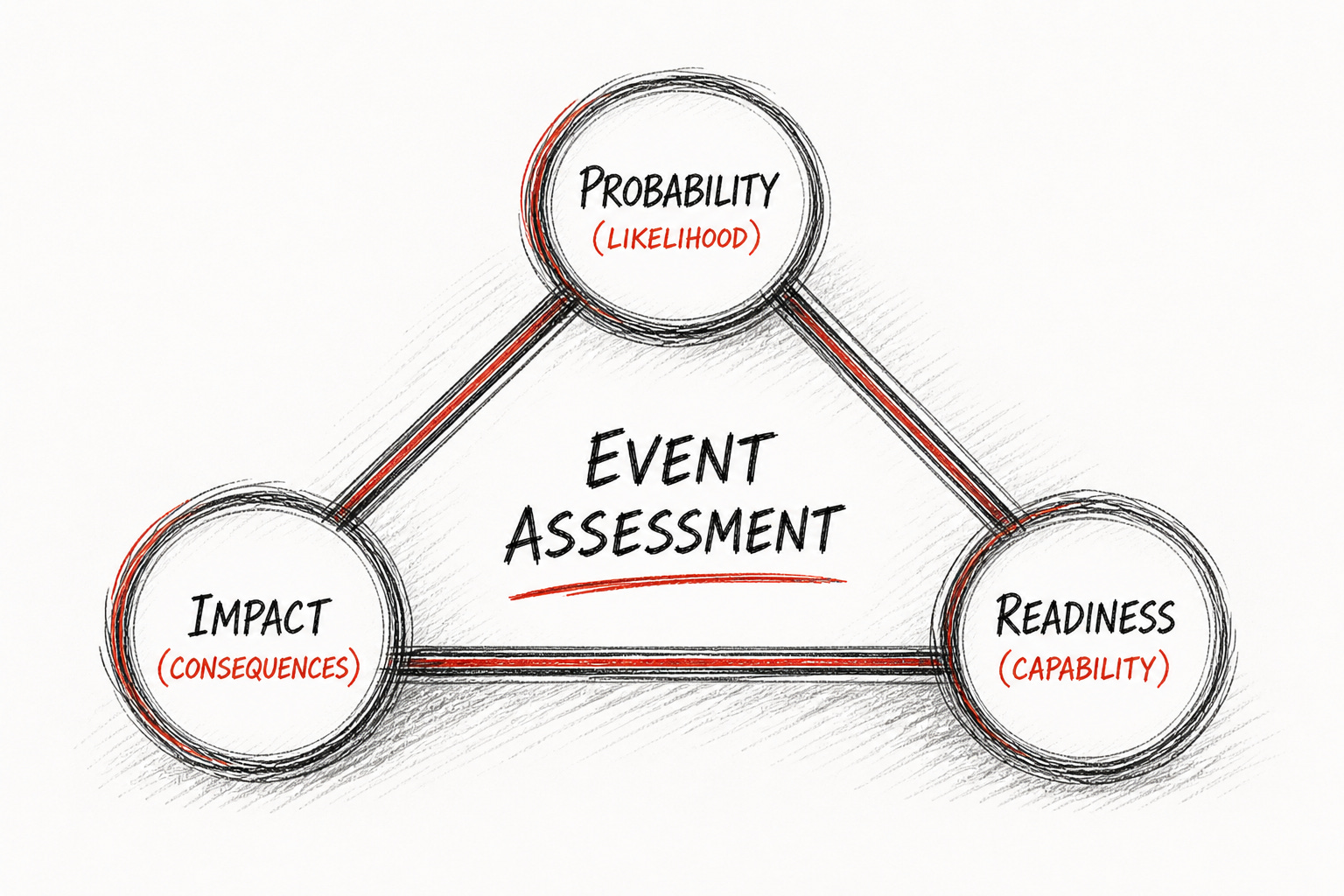
An event assessment is built on three elements:
The probability (or likelihood) of the event occurring
The consequences (or impact) if it does
The readiness of the organization to change the outcome
Most assessment processes focus on the first two. Looking at the likelihood and impact allows events to be categorized and compared—high probability and high impact, low probability and high impact, and so on. From there, organizations can determine the strategy that best fits each event—whether to reduce its likelihood, limit its impact, build the capability to perform through it, or a combination of those options—and then prioritize where to focus time, attention, and resources.
But many assessments stop here. They identify what could happen and how bad it would be, but not what the organization needs to be ready to perform when it does, and its current ability to perform at that level.
That gap is important for executives making budgeting and resource allocation decisions across the portfolio of risk they are responsible for.
Two events with the same likelihood and impact are not the same problem if the organization is well prepared for one but unprepared for the other. Without accounting for readiness, prioritization can be misleading—directing attention toward events that are already well-managed, while overlooking those where performance could break down.
That is why readiness is a critical second part of the assessment.
If a wildfire or flood is near the top of your list, the question becomes: are you ready to detect when they start? Are you prepared to issue alerts and warnings? Conduct evacuations? Surge mutual aid and partner resources to meet the demands of the incident?
If the loss of a key staff member or executive is on your list, readiness might mean your ability to launch a recruiting process, temporarily fill critical roles, maintain continuity in client delivery, and avoid single points of failure.
Those are capabilities—and as we discuss in our white paper on “Preparing the Organization You Will Need”—each with an expected level of performance.
I’ll just note that I didn’t always think about these elements this way. In the past, I treated likelihood and impact as the core of the assessment and considered readiness as something separate—first identifying the risks, then determining what to do about them at some later point.
But in practice, that separation between “what is happening outside the organization” and “what we are doing about it internally” is problematic. The decisions leaders make in relation to threats, hazards, and opportunities are often about what their organization will do to prepare for them. So when they aren’t connected in a single process, we create artificial barriers that limits an executive’s ability to choose the path forward.
However, when these decisions are made together, leaders are able to consider what could happen, what it would mean, and whether the organization is ready for it at the same time.
A Left of Bang Perspective
The way these three elements are applied matters just as much as the elements themselves. Conducting this assessment through a left of bang lens requires recognizing that the threats, hazards, and opportunities we are preparing for exist in the future, not the past.
In practice, the assessment process often relies on analyzing historical data—identifying rates of occurrence and the impacts of similar incidents. That is certainly a component of the process, but likelihood and impact are not static.
They change over time as the environment, the organization, and the broader context evolve. Historical data can inform that understanding, but it is not sufficient on its own.
Preparing for the future often requires making decisions about events that have not happened before, or have not happened recently enough to rely on data alone. In those cases, trends can provide direction—but they do not eliminate the need for judgment.
This is why getting left of bang is a function of leadership. Leaders still have to decide: even without a clear precedent, is this something we are going to prepare for?
As a result, a forward-looking assessment incorporates not only objective data, but also the subjective perception of the senior and elected leaders responsible and accountable for the organization’s performance when the event occurs.
Without that alignment, even well-supported risks can struggle to gain traction, while others receive attention based on how they are perceived.
In Closing
This process produces more than a list of threats, hazards, and opportunities. It creates the strategic clarity necessary for people across the organization to understand what matters, why it matters, and where time, attention, and resources should be focused.
That clarity is what enables action, and action is the reason we go through the process.
Once the events you care about are identified and assessed, the next step is to determine what needs to be done about them. In some cases, that means reducing the likelihood of the event. In others, it means limiting the impact. And in many, it means building the capability to perform effectively when the event occurs. These decisions translate into projects, which are the efforts to close gaps, improve performance, and align the organization with what it says is important.
But the goal of this process is not to produce a perfect list of events or perfectly precise data to describe them. It is possible to spend significant time and effort pursuing that level of certainty, but often at the expense of making actual progress. Analysis is necessary, but it is not the end state we are pursuing. The outcome we are seeking is direction for the organization’s preparations.
This is ultimately a leadership responsibility. Executives are accountable for both the risks an organization faces, and the opportunities it pursues, often within the constraint of limited resources and competing priorities. When likelihood, impact, and readiness are not clearly understood, those decisions are still being made—but without the context required for them to be made deliberately.
At its core, this process is about deciding what your organization is preparing for—and ensuring that decision is made clearly, and acted on.
Before You Go
Found this useful? Share it. If this sparked an idea, pass it along to someone responsible for getting left of bang. That’s how this work spreads.
If you want to go deeper, a paid subscription gives you access to advanced courses, playbooks, and exclusive leadership writing.
And if you’re asking the question many leaders eventually face—are we actually becoming more prepared, or just busier?—the first step is a Strategic Briefing, where we map how your organization is preparing today, identify where gaps exist, and what that means for your ability to perform when it matters.