

Welcome back to The CP Journal, where we break down what it takes to get left of bang.
Before we jump in, two quick announcements.
New Baselines & Anomalies Episode. This week, we published Episode #5 of Baselines & Anomalies, looking at the return of New World screwworm and a broader leadership challenge: what happens when risk changes faster than readiness can be rebuilt. Watch the episode for a practical example of applying the left of bang framework to a changing threat environment.
Ohio Police Officers: Earn CPT Credit. The Tactical Analysis Basic Course has been pre-approved by OPOTA for 8 hours of 2026 Continuing Professional Training credit. If you’re an Ohio peace officer—or responsible for training within an Ohio agency—visit the page for course and credit details.
The phrase “If You See Something, Say Something.” has been on repeat in my head this week.
I spoke with a client early in the week about why information does—and doesn’t—move through an organization when pre-event indicators are observed, and the phrase has been embedded in my brain like the hook to a catchy pop song ever since.
Before I explain why organizations and leaders should consider taking a step beyond this concept, I want to acknowledge the importance of the tagline itself.
Initially used by the New York City Metropolitan Transit Authority (MTA) in the months following 9/11, and later licensed by the U.S. Department of Homeland Security in 2010 to support a nationwide anti-terrorism campaign, “If You See Something, Say Something,” helped bring the idea that ordinary people have a role to play in preventing attacks into the mainstream.1
The importance of crossing that threshold can’t be overstated.
Getting people to realize that terrorism, crime, and violence prevention requires a whole-community approach—and that individual people have a role in that effort—was critical. Without that shift, any follow-on efforts to teach people how to recognize warning signs would have fallen on deaf ears. Prevention would have remained something people assumed belonged exclusively to public safety professionals and government agencies.
But inside an organization, letting people know they have a role to play in the organization’s ability to get ahead of emerging threats and opportunities is not enough. Messages like that do not, by themselves, solve the capability problem.
Recognizing a need to be aware of your surroundings and having a functioning program that consistently identifies meaningful pre-event indicators are two very different things. To operationalize the left of bang approach, leaders need to rethink what their organization’s equivalent of “See Something, Say Something” actually requires.
There are three things to consider.
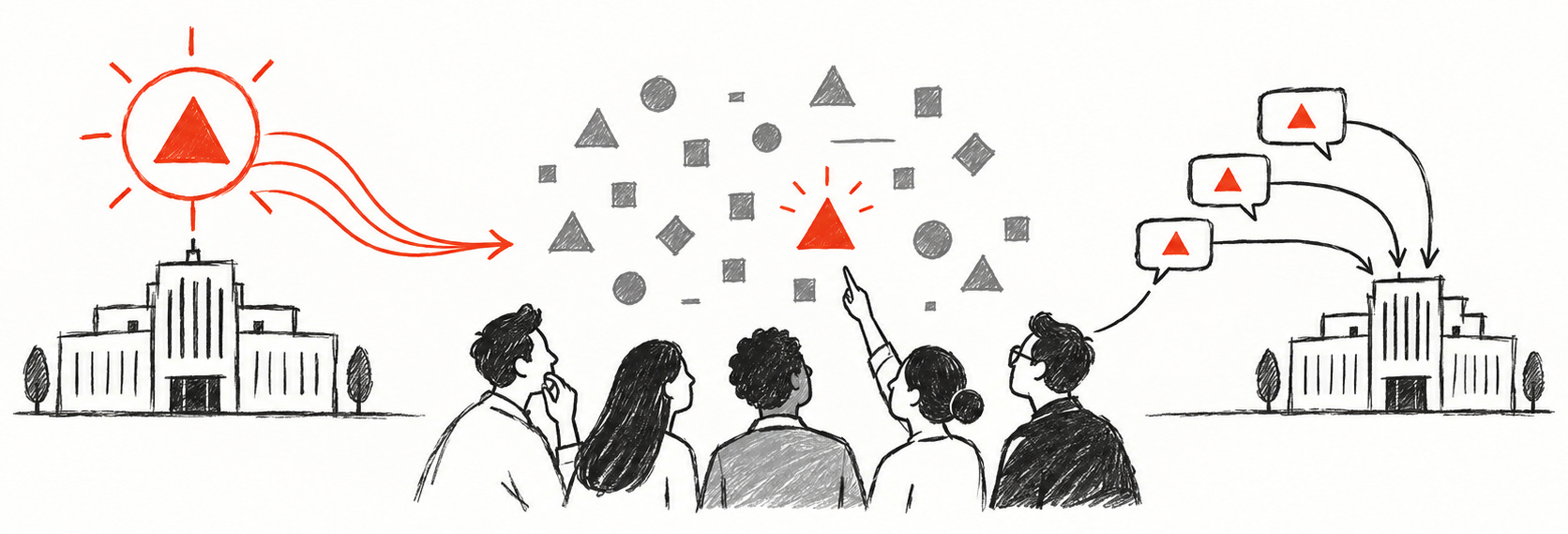
First, until the organization can “say” what it is looking for, its people will never be able to “see” it.
Take whatever threat or hazard is your organization’s equivalent to terrorism. If you tell people to be on the lookout for “suspicious people,” the reports you receive will inevitably reflect the personal experiences, assumptions, and biases of the people doing the observing. This is the result of unintentionally placing the burden of determining what is worth reporting on the individual.
But in an organization that is genuinely committed to getting left of bang, the responsibility starts at the organizational level.
Leaders have to define the pre-event indicators they want people looking for, and those definitions need to be specific. Until an organization develops a common language around what is important—and until that language creates a shared understanding of what is being observed—the chances of people consistently recognizing important indicators will remain limited.
Without that clarity, the organization is hoping people notice the right things. That is very different from intentionally building the capability to recognize them.
Second, until the organization demonstrates what it will do with the information, it reduces the chances that anyone will actually “say” anything.
People make a risk-and-reward calculation when deciding whether to share something they have observed, and trust plays a major role in that calculation. If someone doesn’t trust that the information will be assessed fairly, believes reporting it could create problems for them, or expects that nothing useful will happen as a result, the likelihood of them speaking up goes down.
The consequences don’t have to be severe either.
Sometimes the risk is simply developing a reputation as “Chicken Little” and becoming the person who is always sounding an alarm. They can become known as someone with poor judgment, and their credibility becomes discounted in other parts of their job.
That is especially problematic when the person being asked to recognize pre-event indicators doesn’t work in security, emergency management, public safety, or crisis response every day. We are asking people outside those fields to notice something unusual, raise their hand, and accept the possibility that they might be wrong.
If the organization punishes that behavior, either formally or informally, it should not be surprised when people stop doing it.
Leaders can reduce that risk by making the assessment process more structured and transparent. People should understand who receives the information, how it will be assessed, and what happens next. The more predictable and credible that process becomes, the easier it is for people to speak up when something does not look right.
Third, organizations have to be realistic about how much they expect people to notice.
People can only process so much information at any point in time.
As we get ready to start another NFL season—and as I get ready to win another fantasy football championship—think about a new quarterback entering the league.
An inexperienced quarterback can only make so many reads of a defense while also remembering the play, managing the pocket, watching the pass rush, and trying to move the ball down the field. Over time, experience allows that quarterback to process more information and recognize more subtle indicators, but early on, the coach has to be selective about what is and isn’t critical to notice.
The same principle applies to organizational awareness.
There is no shortage of information available. There are countless data points that could potentially provide an early warning of a meaningful shift in the environment, and observations could come from every part of the organization.
But since attention is finite, the goal cannot be to get everyone watching everything.
Leaders have to decide which observations are most valuable, which indicators deserve attention, and which changes should cause someone to look more closely or share what they are seeing. Choosing and prioritizing those high-value observations is an organizational responsibility.
Organizations that want to shift earlier on the timeline and get ahead of future events can build on the lessons of “See Something, Say Something” while making the concept more practical and operational.
We can’t forget that it’s not enough to simply tell people to pay attention.
Leaders have to define what is critical for the organization, teach people what to recognize, focus limited attention on the indicators that matter the most, and build a reporting process that people trust enough to use.
That is how awareness becomes an organizational capability.
This process of operationalizing the left of bang framework is the focus of our upcoming webinar. We will use wildfires—and specifically wind-driven fires—as the risk throughout the presentation, but the process is designed to be replicable across the threats and hazards your organization is preparing for.
We certainly hope to see you there.
Until next week, get left of bang, and stay there.
—Patrick
https://www.dhs.gov/see-something-say-something/about-campaign
.. a sticking point of mine for years.. you nailed it.