

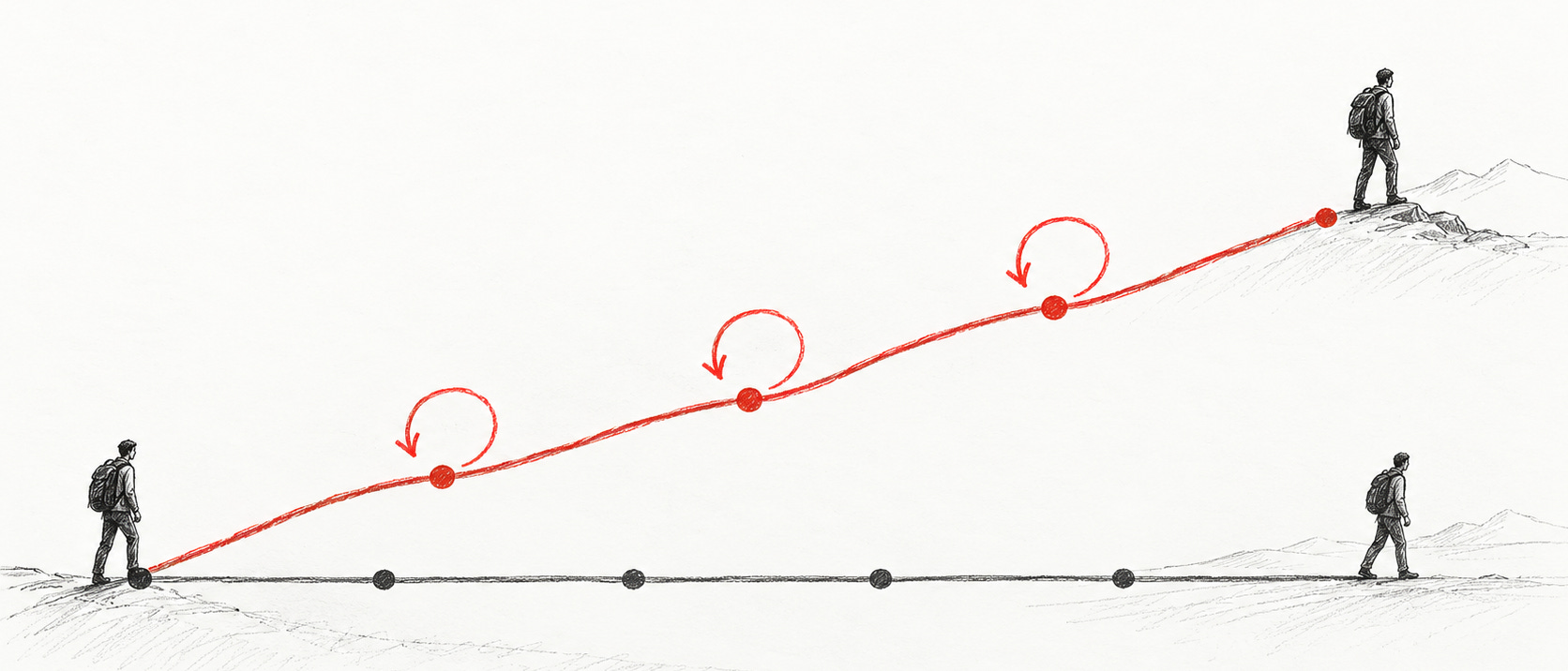
Welcome back to The CP Journal, where we break down what it takes to get left of bang.
For the last 15 years, one of the most common questions we’ve received has been some version of: How do we operationalize this military program inside our organization?
Our answer to that question has changed quite a bit over time.
In a recent webinar, we walked through how we teach the approach today. We used wildfire as the example, but the same steps can be applied to any threat, hazard, or opportunity you are trying to get ahead of.

Every once in a while, I run into a sentiment that really fires me up.
Sometimes, in public safety agencies, you come across a leader who tells new police officers, firefighters, and EMTs that the only way they will become truly competent and effective at their job is to simply spend more time on the job.
It is no different in the military. On my first deployment, I remember a member of the outgoing unit we were replacing telling me, “Once you do three or four deployments, you’ll become really good at spotting IEDs and finding insurgents.”
I hated it then, and I still hate hearing versions of it today.
And it’s not because I fully disagree with it either. New professionals need to gain experience as part of their apprenticeship. Doing the work is what allows people to learn what the job actually demands of them by making mistakes, learning to recognize patterns, and developing their judgment.
What gets under my skin is the idea that time itself is what provides the lesson. That if you just put in enough years, take enough calls, respond to enough incidents, or complete enough deployments, eventually you will have seen enough to know what you are doing.
And sure, sometimes that happens. But sometimes it doesn’t.
I’ve worked with people who had done their job for years but hadn’t done much with that time. They had accumulated plenty of experience, but they hadn’t really learned from it. They made the same mistakes, relied on the same assumptions, and approached problems the same way they had years earlier.
I’ve also worked with people who seemed to get better every year. They paid attention to what was happening around them. They asked questions, they thought about why something worked or why it didn’t, and they looked for patterns. Importantly, they carried lessons forward and tried to apply them the next time around.
Over time, that difference begins to add up in very noticeable ways. Even though both people may be gaining experience, only one of them is consistently turning that experience into an improved ability and something operationally useful.
This is something that has been a part of the left of bang framework and our work over the past 15 years.
How can we help people actually learn from what they experience?
How can we make each call, incident, operation, exercise, and deployment contribute to the development of a more capable professional?
How can we do the same thing at the organizational level, so that what happens today actually makes the organization better tomorrow?
Experience will always take time to accumulate—there isn’t really a shortcut around that—but we can become much more intentional and deliberate about what we do with that experience once we have it.
This is where frameworks become increasingly useful for both operators and leaders.
A Short Primer on Frameworks
Before we come back to how frameworks can help professionals learn from experience, it is worth taking a short detour to explain what I mean by a framework.
At its most basic level, a framework provides a supporting structure for thinking about or understanding something.
In the context of getting left of bang, we use frameworks to help people think and make decisions in uncertain environments because those environments tend to be messy. With incomplete information, changing conditions, limited time, and competing priorities, a framework gives people a way to bring some structure to that complexity. They can help a person determine what to pay attention to, what something they are seeing might mean, and what they may need to do as a result.
The specific frameworks we use depend on who we are working with and what they are trying to get ahead of.
At the tactical level, when we are teaching people how to recognize potential threats, we rely on the Four Pillars of Observable Behavior to help identify useful sources of information and the Baseline + Anomaly = Decision process to help make sense of what is being observed.
At the operational level, when we are helping people across an organization work together to get ahead of emerging events, we often rely on the Recognize → Assess → Decide → Act sequence.
At the executive level, when we are helping leaders think about organizational readiness, we use the Six Elements of the Operating Environment to make complexity more manageable and the Five Elements of a Capability to identify where improvement and investment may be needed.
Even though the chosen framework is selected based on the job a person has, none of them provides the answer to a problem. Their value is that they provide a structure for working toward one.
They help simplify something broad or complicated enough that a person can begin to work with it, without pretending that the environment itself has become simple. Once people have that structure, they can direct their attention more effectively and move more deliberately from information toward action.
When used well, frameworks offer several practical benefits.
Frameworks can reduce cognitive load. Instead of asking a question as broad as “What is happening here?” without any sort of guidance, a person can examine the environment through a set of pre-established lenses. The framework won’t make reality less complicated, but it can make that complexity more manageable. This becomes especially important when we remember that situational awareness is rarely the end goal. Understanding the situation is important because it supports whatever the person or organization is ultimately trying to accomplish.
Frameworks create consistency. Even though two people can look at the same situation and focus on completely different things, a shared framework gives them a common way to approach the problem. Asking someone to describe the baseline, explain the anomaly they observed, or walk through where an issue sits within Recognize → Assess → Decide → Act brings the conversation into a common structure. People may still disagree, but they now have a shared way to explain why.
Frameworks help move information toward action and expose what is missing. Most organizations today do not suffer from a lack of information. The harder problem is determining what to do with the information they have. Frameworks can help connect recognition to action while also making gaps more visible. If a person cannot complete part of the framework, that often reveals something they do not yet know, understand, or have the capability to do.
Those benefits alone make frameworks useful, but there is another advantage that matters even more for the issue we started with: learning from experience.
Once people share a framework and can use it to communicate what they saw, how they interpreted it, and why they acted the way they did, experience becomes something that can be examined much more deliberately. And that is where frameworks begin to change the learning curve.
Using Frameworks to Learn From Experience
One of the most important things a framework can do is give people a common way to talk about what happened. This becomes a massive advantage for organizations that use them because experience is often difficult to learn from when the lessons remain trapped in someone else’s head.
An experienced operator may know that something felt wrong, recognize that a situation was beginning to change, or understand why one course of action was better than another. But if they cannot explain what they saw, what mattered, and how they reached that conclusion, much of that experience remains difficult to transfer to someone else.
Frameworks can help make some of that thinking visible.
Once people share the same structure and terminology, they have a way to communicate what they were paying attention to and how they interpreted what they saw.
When someone says, “That was an anomaly,” another person who understands the approach already has some context for what they mean.
When someone says, “We hit a Watch Point, but we were still assessing and had not yet reached a decision,” the other person can understand where the situation was within the process and begin asking more useful questions about what happened next.
That shared language makes it possible to go back and examine that experience in a structured way. Instead of simply asking whether an operation went well or poorly, the framework provides something more specific to examine.
What did we recognize?
What did we miss?
How did we assess what was happening?
What assumptions were we making?
What information would have changed our understanding?
Where did we make a decision?
What happened once we acted?
Those questions allow us to break an experience apart and look more closely at how the outcome developed, which is where frameworks become especially valuable for professional development.
A person can go through an experience, examine it, identify a lesson, and then enter the next situation with a better idea of what to pay attention to. And because frameworks offer the opportunity to talk about a situation, they don’t have to go through this process on their own.
If an experienced professional can explain what they saw in the same situation and articulate why something mattered in a way that both of them understand, then the younger professional does not have to personally accumulate every lesson through trial and error.
In the spirit of John Boyd’s “Destruction and Creation,” we can take an event apart, examine it through a framework, and use each lesson to build a better understanding of how we should approach the next situation.
That is ultimately how experience becomes useful and begins to compound across a person’s career.
I’ll say again, we still have to do the work and accumulate those repetitions, but each repetition can become more valuable when we have a deliberate way to examine it, learn from it, and carry those lessons forward.
In Closing
Not every framework you use in your job has to perform the same function. In fact, they should help solve different cognitive problems you face. But as the observations and processes that support those frameworks become more practiced, they can build more confidence, improve how attention is directed, and simplify thinking without replacing it.
Time on the job, and the experiences accumulated along the way, do not automatically result in a better or more capable professional. We still have to learn from those experiences, and frameworks give us one way to do that more deliberately. They allow us to examine what happened, recognize the lessons, and carry them forward into whatever comes next.
Experience will always take time to accumulate, but if we can get better at learning from it, we can make each repetition more valuable and shorten the learning curve along the way.
Great article. I have worked with long time officers that seem to never progress. They stagnate. They are a one-year officer thirty times over. The key is experiential learning, which can come from the experiences themselves, or other sources such as training or self-study. It comes down to the mindset of the officer.