

Welcome back to The CP Journal, where we break down what it takes to get left of bang.
When organizations struggle during crises, the response itself is often blamed. Read most after-action reviews, and you’ll undoubtedly see familiar observations:
Communication failed
Coordination broke down
Resources weren’t where they were needed
Situational awareness was limited
Teams were overwhelmed
But what if the problems encountered during a response were not really response problems?
What if the “improvement areas” identified after incidents were actually unresolved organizational problems that only became visible during the incident?
During crises, the people carrying the burden of the response are often held accountable for conditions that were shaped long before the crisis began and far above them in the organization.
Seeing this pattern repeat itself across military operations, public safety incidents, and corporate security environments is what first pushed me to think about organizational readiness through the left of bang lens.
The operators closest to the problem were often the ones forced to navigate challenges they did not create:
Staffing decisions made months earlier
Training priorities shaped by limited time
Technology investments that failed under real conditions
Unclear coordination structures
Planning assumptions that did not survive contact with reality
Leadership priorities that were undefined or conflicted with each other
Resource tradeoffs to focus on immediate problems instead of the important ones
The more I work in and observe these environments, the more I realize that operational success is rarely just an operational issue. It was the product of decisions, priorities, and systems that extended across the organization and influenced the performance of the organization during a disruption or disaster.
The Fragmentation of Readiness
One of the problems—amongst many—that contributes to this dynamic is that preparedness is often treated as a shared responsibility touching nearly every department and team, without clearly defined roles for how decisions, priorities, and execution connect together across the whole organization.
Most organizational functions have relatively clear ownership for their day-to-day work responsibilities:
Finance owns finance
HR owns HR
Operations owns operations
IT owns IT
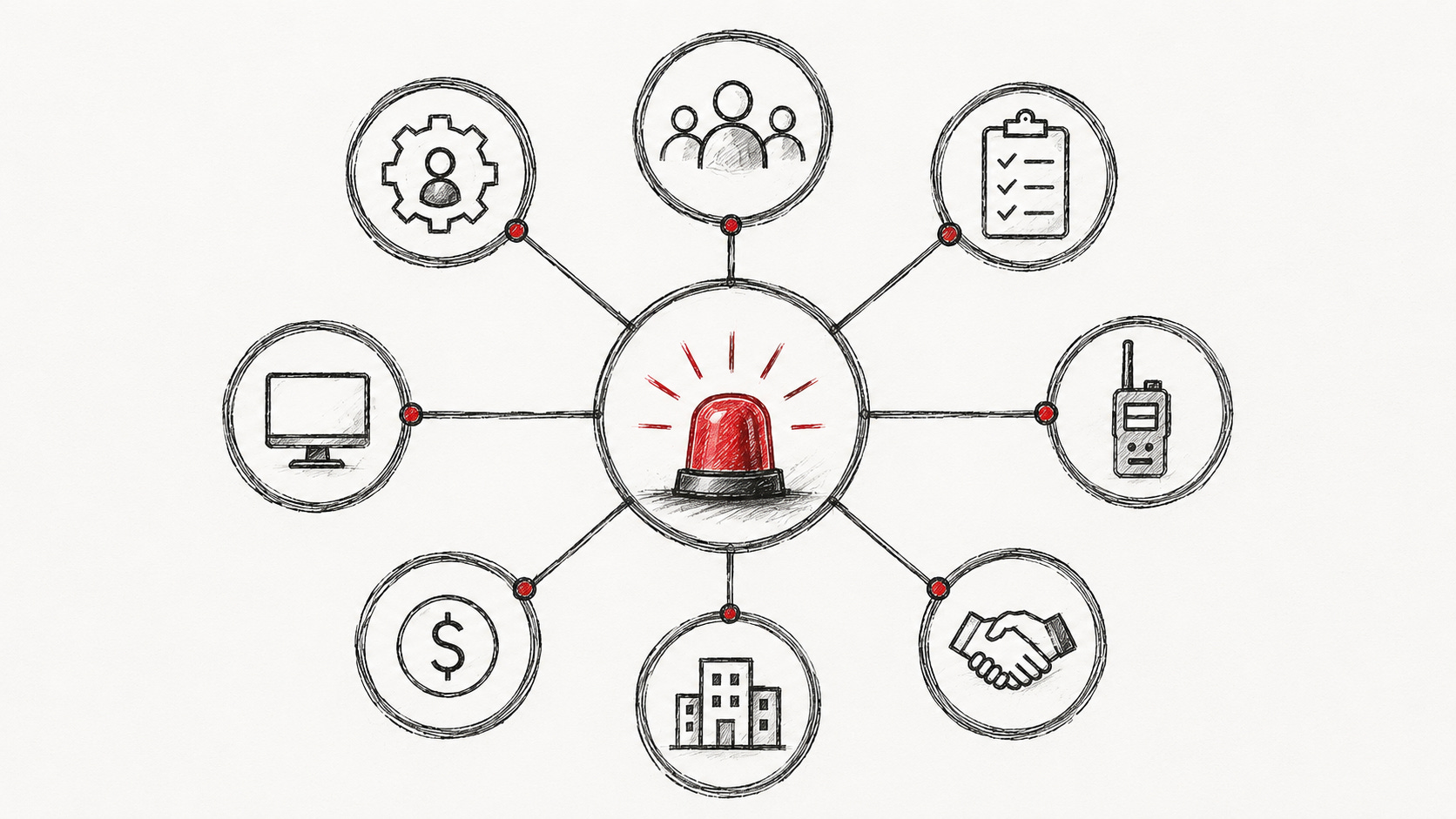
Preparedness rarely works that way. Instead, it touches leadership, operations, legal, communications, security, emergency management, facilities, technology, partnerships, logistics, and public affairs at different times and in different ways.
But when responsibility belongs to everyone, people naturally default toward the parts of preparedness they can directly control within their own vertical. People are cautious about stepping outside of their lane or stepping on someone else’s toes, often assuming that someone else is looking at the problem from a bigger-picture perspective.
I’m not being critical, I think that is an understandable human tendency. However, it does create very predictable seams between each of those naturally forming organizational silos.
Each department stays busy doing work they feel is important to them, but over time, the decisions about what to prioritize become fragmented and inconsistent across the organization as a whole. And when the decisions become disconnected from one another, organizations often end up with:
strategy without execution,
projects without direction,
and capability development without leadership intent.
The result is an organization where preparedness activities exist across the enterprise, but the burden of integrating those fragmented capabilities ultimately falls on operators and practitioners during the incident itself, under crisis conditions where time, uncertainty, and pressure make integration most difficult.
That is hardly a recipe for success: expecting operators to bring a patchwork of capabilities together in real time when those same problems could not be reconciled during steady-state operations.
Addressing that challenge requires more than participation and good intentions. It requires clearly defined responsibilities for the three critical roles that shape organizational readiness.
The Three Key Roles and Responsibilities
Organizations do not become ready by accident. Readiness develops through a system that connects strategic decisions, capability development, and execution over time.
This is part of the strategic layer of the left of bang operating model, where organizations identify, build, and manage the capabilities they will need before the next disruption arrives.
That requires more than awareness of the operating environment or an understanding of emerging threats, hazards, and opportunities. Organizations also need a management structure capable of translating those concerns into coordinated action across the enterprise.
Within that structure, there are three key roles.
First is the executive.
Every organization has someone who ultimately carries responsibility for how the organization performs during decisive moments. In terms of organizational readiness, the executive establishes direction.
Executives determine which threats, hazards, and opportunities deserve organizational attention and which ones will receive time, resources and sustained focus. Those decisions shape the organization’s portfolio of capabilities and establish the performance each capability must pursue.
This is fundamentally a portfolio management responsibility.
Executives decide where staff effort, funding, organizational attention, and political capital will be invested in preparation for future conditions. They make go/no-go decisions on initiatives, investments, and competing priorities because they are ultimately accountable for organizational performance.
Without clear executive direction, organizations tend to become reactive to the last incident or individual departments begin optimizing for their own local concerns instead of broader organizational priorities.
Second is the capability leader.
These are the mid-to-senior leaders responsible for managing a capability over time and translating strategic priorities into operational readiness.
If the executive is responsible for the portfolio, the capability leader is responsible for the program. Their role centers on assessing the organization’s ability to perform a critical function—the capability—to the standard established by leadership and overseeing the work required to improve performance over time.
This includes identifying weaknesses, prioritizing improvements, coordinating across departments, managing dependencies, assessing readiness, and ensuring that projects contribute toward a coherent operational outcome instead of becoming disconnected activities.
This “layer” of the model is important because organizations routinely mistake activity for progress when no one is explicitly responsible for the capability itself. Planning, training, and exercise projects might get completed, but they don’t guarantee that the organization is becoming more capable.
The capability leader is responsible for ensuring that those efforts collectively improve operational performance.
Third is the project leader.
These are the individuals responsible for executing the initiatives designed to improve readiness.
If the executive manages the portfolio and the capability leader manages the program, the project leader is responsible for implementation and delivery.
These are the people leading planning initiatives, training efforts, exercise programs, technology integration projects, infrastructure improvements, partnership initiatives, and other operational efforts intended to strengthen organizational readiness.
Readiness is ultimately built through execution. Strategic direction and capability management only create potential energy unless projects are successfully implemented across the enterprise.
The quality of project leadership directly shapes how effectively preparedness efforts become operational reality, especially in environments where time, resources, coordination, and organizational attention are limited.
How the Layers Work Together
We refer to this as an operating model because these three roles are not disconnected from one another. They function as part of a continuous management cycle where strategic direction, capability development, execution, feedback, and adaptation are constantly influencing each other.
A failure, gap, or disconnect in any one of three roles creates downstream problems for the others.
If an executive team decides cybersecurity is a strategic priority, but never clearly defines the operational capability the organization needs to develop, the capability leader is left trying to establish readiness standards, funding priorities, and organizational responsibilities without clear strategic direction.
The project leader then inherits that ambiguity. Technology gets purchased, training gets conducted, or policies get updated, but the projects often develop independently from one another because no one has translated the executive’s intent into capability targets.
At the capability layer, the same dynamic appears in a different form.
If a capability leader identifies important gaps but fails to convert those gaps into clear objectives, priorities, and measurable outcomes, project leaders may successfully complete initiatives without meaningfully improving the organization’s ability to perform.
The same relationship also works in reverse. Project leaders are often the people closest to implementation challenges and evolving conditions within the operating environment. They see the friction points and where practitioners continue struggling despite complete initiatives.
That feedback is critical. Without it, capability leaders and executives lose visibility into whether preparedness efforts are actually improving operational performance or simply generating more activity.
This is why organizational readiness cannot function as a one-time planning effort or a static preparedness program. It operates as a continuous management cycle where priorities shape capabilities, capabilities drive projects, projects generate feedback, and that feedback influences future strategic decisions.
In Closing
It doesn’t matter whether an organization is large or small, and this structure is not dependent on rank or title.
In a large organization, these responsibilities may be distributed across multiple people, departments, and teams. In a smaller organization, a single individual may perform all three roles. Executives may oversee critical capabilities directly, while capability leaders may also lead projects tied to their area of responsibility.
The structure still exists either way.
Someone must define priorities and determine which capabilities are critical.
Someone must assess readiness, identify gaps, and coordinate improvements across the organization.
Someone must execute the projects, initiatives, and operational changes required to improve performance over time.
When those responsibilities are clearly connected, preparedness stops functioning as a collection of disconnected activities spread across organizational silos. Instead, readiness becomes part of a continuous cycle.
That alignment is what allows organizations to move beyond simply hoping they are becoming more prepared. It creates a system capable of identifying gaps before crises expose them, improving performance before disruption occurs, and reducing the number of organizational problems operators are forced to solve under pressure during the incident itself.
That is the strategic layer of left of bang.
Before You Go
Found this useful? Share it. If this sparked an idea, pass it along to someone responsible for getting left of bang. That’s how this work spreads.
If you want to go deeper, a paid subscription gives you access to advanced courses, playbooks, and exclusive leadership writing.
And if you’re asking the question many leaders eventually face—are we actually becoming more prepared, or just busier?—the first step is a Strategic Briefing, where we map how your organization is preparing today, identify where gaps exist, and what that means for your ability to perform when it matters.