

Welcome back to The CP Journal, where we break down what it takes to get left of bang.
A military commander preparing for battle does more than develop plans for how their unit will fight. They also work to shape the conditions under which the fight will occur.
They clear fields of fire, harden positions, disperse supplies, and establish obstacles.
They remove anything and any condition that might give the enemy an advantage.
They reduce the number of things that could turn a small problem into a catastrophic setback.
Even though none of these actions guarantees victory, each one changes the terms of the future fight and increases the likelihood that their side will win.
Naturally, influencing the environment we operate in is not limited to military applications. Business, government, and organizational leaders do this as well. In the context of disasters, however, the work of shaping the environment before an incident occurs is referred to as mitigation.
And even though hazard mitigation planning is one of the most common preparedness activities conducted by local governments across the United States, I don’t think we’ve done ourselves any favors in the way we’ve come to think about mitigation itself.
Let me explain.
Mitigation Beyond Public Safety
While this article focuses primarily on public safety, mitigation is one of four strategic approaches organizations can use to reduce risk while left of bang.
Prevention. Prevent the event from occurring in the first place. The Marine Corps’ Combat Hunter Program, for example, focused on recognizing potential attackers early enough to stop an attack before it began.
Operational Readiness. Develop the capabilities and situational awareness needed to respond to and recover from an event effectively once it begins.
Mitigation. Shape the environment before an event occurs so that, if it does happen, its consequences are less severe.
Organizational Readiness. Build the people, processes, culture, and long-term focus that allow an organization to effectively invest in prevention, operational readiness, and mitigation.
The first three approaches influence risk in different ways. The fourth is what enables an organization to sustain all three over time.
A Short Primer on Hazard Mitigation Planning
For those unfamiliar with hazard mitigation planning, it is a recurring planning process that nearly every city, county, special district, tribal nation, and state undertakes every five years. Under federal law, jurisdictions must have a FEMA-approved hazard mitigation plan to remain eligible for many federal grant programs.
There is nothing inherently wrong with that arrangement. In fact, it has helped thousands of communities identify risks, prioritize mitigation projects, and secure funding for improvements that reduce future disaster impacts.
Over time, however, I believe an unintended consequence has emerged. Because FEMA approval is tied to the planning process, mitigation itself has gradually come to be associated with producing a FEMA-approved plan rather than with the broader strategic objective of shaping future operating conditions before disasters occur.
The incentives built into the process reinforce that perception. Since FEMA approval focuses on natural hazards, communities naturally devote most of their limited planning capacity to those risks. While jurisdictions can certainly consider other risks—such as crime, targeted violence, cyber attacks, or other human-caused threats—those topics play a much smaller role in the review and approval process. When time, funding, and staff capacity are limited, it is understandable that communities prioritize the work that leads directly to plan approval and grant eligibility.
The planning process itself also demands a significant investment in time and resources. I recently reviewed a hazard mitigation plan that exceeded 900 pages. While that document undoubtedly satisfied the planning requirements, very few people will ever read it from beginning to end after it is approved.
More importantly, the effort required to produce a document of that size often consumes much of an organization’s available planning capacity. By the time a jurisdiction completes the process, there is rarely much time, funding, or organizational energy left to step back and ask a broader question: How else can we shape our environment to reduce the impacts of future events?
So when I say we haven’t done ourselves any favors, this is what I mean. This isn’t about blaming FEMA or criticizing hazard mitigation planning, far from it. The process serves an important purpose and has delivered meaningful benefits to communities across the country.
Rather, I think we’ve unintentionally allowed one planning process to become synonymous with mitigation itself. Hazard mitigation planning is one application of mitigation, but it is not the complete definition of the strategy.
Where Mitigation Fits
Personally, I don’t believe compliance is the best way to think about mitigation. Mitigation is about intentionally shaping the environment before an event occurs so that, if it does happen, the event unfolds differently than it otherwise would have.
This is where mitigation complements the other left of bang strategies we discussed earlier.
Prevention focuses on reducing the probability of an event occurring in the first place. Mitigation assumes that some events cannot be prevented and instead works to reduce their consequences.
Operational Readiness develops the capabilities an organization will need once an incident begins. Mitigation, on the other hand, works to reduce the demands that will eventually be placed on those capabilities.
As a simple example, picture a culvert that allows a stream to pass underneath a road in your town. If the culvert is too small, it doesn’t take an especially large rainstorm for water to back up at the culver entrance, flood the roadway, and become an emergency that requires a response. But if the community replaces that culvert with one that can handle a greater volume of water, the same rainstorm may simply remain…rain.
The mitigation effort didn’t change the weather—it changed the environment.
Mitigation Beyond Public Safety
Think about waiting in line at a Disney park. For many rides, Disney has intentionally shaped the environment so that the queue winds through themed spaces, tells part of the story, provides things to look at, and keeps guests engaged.
The wait didn’t disappear, but Disney has made it feel shorter than it used to and reduced frustration for their guests. Mitigation doesn’t always eliminate a problem, sometimes it just changes the conditions surrounding the problem so its impacts are less severe.
Because the environment changed, the demands placed on responders changed as well. There was no flooded roadway, no stranded motorists, no road closure, and no emergency response required.
That is why mitigation is a left of bang strategy: it changes the relationship between supply and demand.
Most organizations think about preparedness with the goal of increasing supply. They hire more people, purchase more equipment, attend more training, and build additional capabilities so they can respond more effectively when something goes wrong. Those investments are important, but they are only one side of the equation.
Mitigation works from the opposite direction. Rather than increasing the supply of response capabilities, mitigation reduces the demands placed on them in the first place.
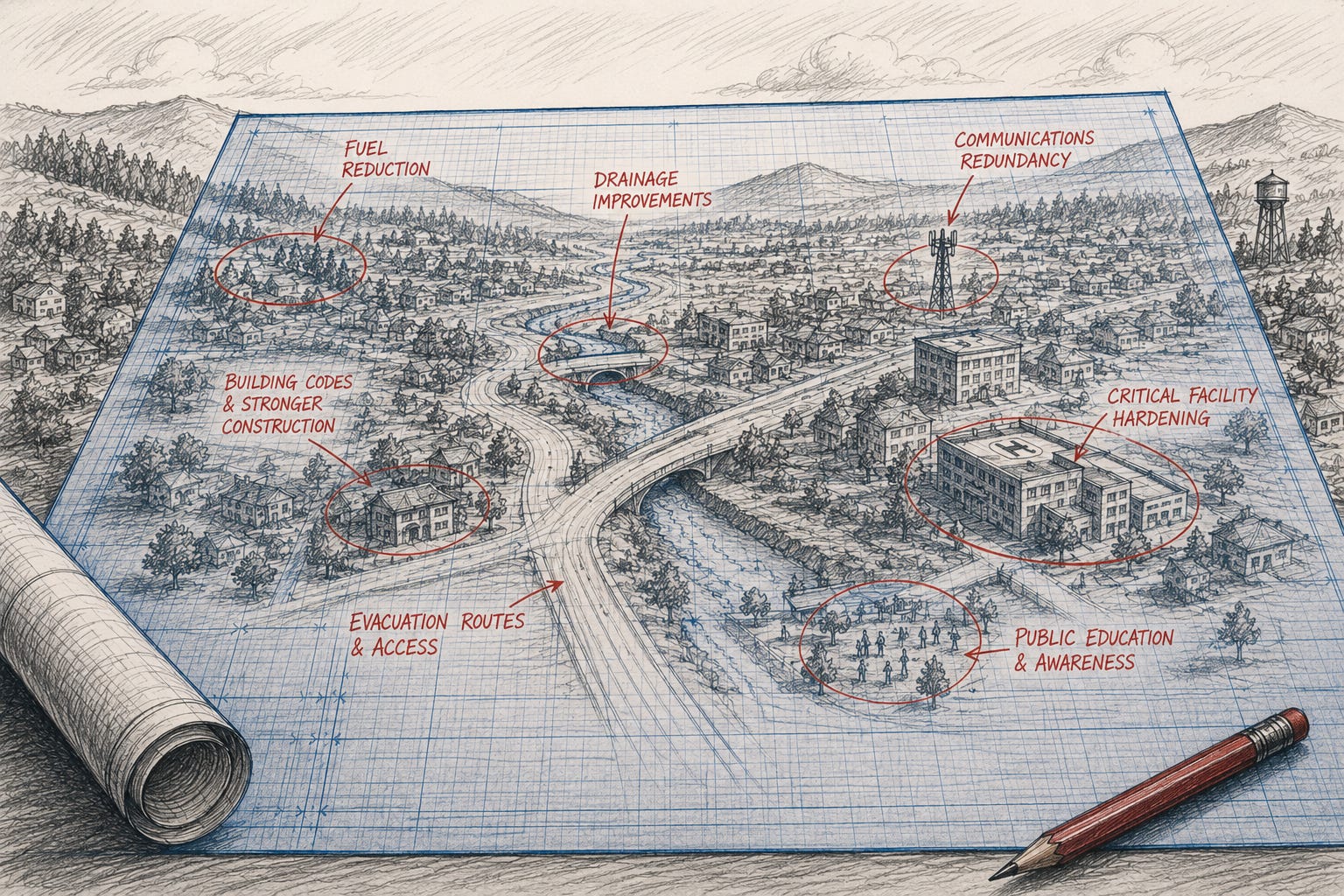
This is why mitigation extends beyond flood control projects and building codes. Communities can shape their future operating environment in countless ways: financial reserves that reduce the impacts of unexpected costs, redundant communications systems to reduce the impacts of equipment failure, and public education to reduce confusion during emergencies.
Even trust can be viewed through this lens.
Earlier this week, I wrote for paid subscribers about how public trust influences the effectiveness of response efforts during the current Ebola outbreak. At first glance, trust appears to be a response issue because it affects whether people cooperate with responders.
But trust is established long before a crisis begins. It shapes the environment responders will eventually operate in, reducing resistance and making response capabilities more effective when they are needed most.
Whether the issue is infrastructure, finances, technology, relationships, or public trust, the underlying question remains the same: how can you shape the environment today so that tomorrow’s event places fewer demands on your organizations and your community?
In Closing
When considering mitigation, I believe that we’ve unintentionally allowed one planning process to define an entire strategic approach. Hazard mitigation planning remains valuable and necessary, but mitigation itself is much broader.
Every leader has the opportunity to shape tomorrow’s operating environment before tomorrow arrives. That timeframe matters because you can’t surge mitigation. Trust, fuel reduction, building codes, drainage improvements, public education, and relationships all require years to become effective and meaningful.
The organizations that consistently get left of bang are not simply better at responding to difficult environments. They spend years shaping those environments before the crisis begins.
Before You Go
Organizations get left of bang when leaders begin asking different questions. Share this with someone responsible for preparing their organization for an uncertain future.
If you want to go deeper, a paid subscription gives you access to advanced courses, playbooks, and exclusive leadership writing.